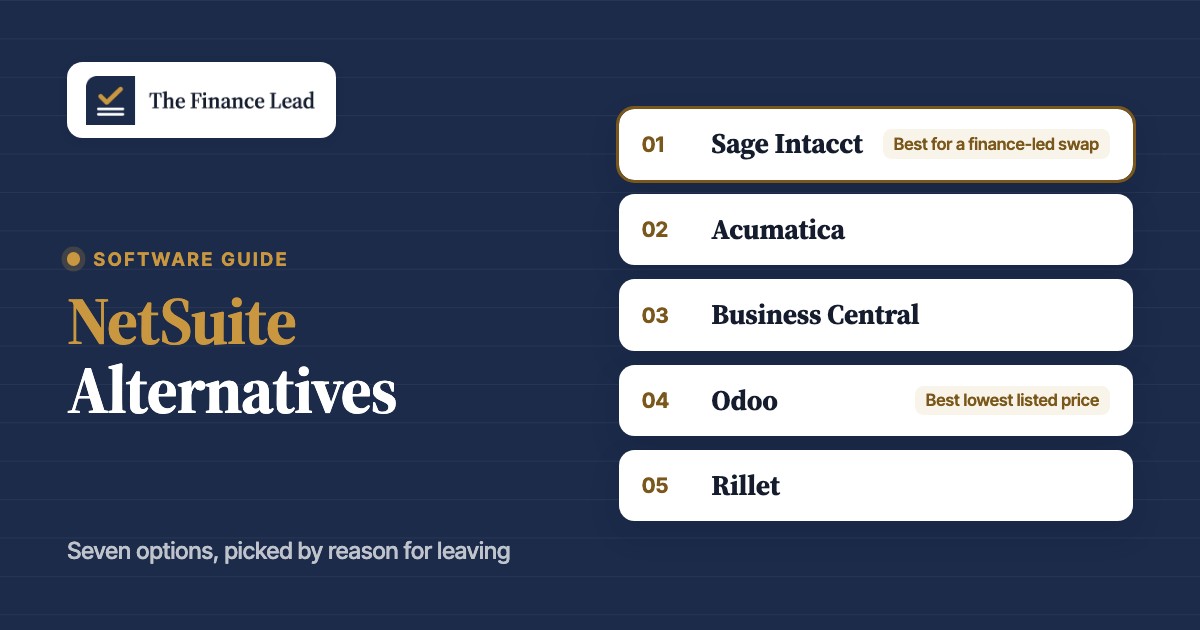
The best NetSuite alternative depends on what you're leaving. If you want a finance-first ledger with multi-entity accounting and dimensions, look at  Sage Intacct and
 Acumatica Cloud ERP. If your team already works in Microsoft 365 and wants a published price,
 Microsoft Dynamics 365 Business Central is the closest fit. If cost or a partner-led rollout is the issue,
 Odoo Accounting and
 SAP Business One are the cheaper or more local options, and if you're outgrowing NetSuite upward or want revenue recognition in a modern ledger,
 Microsoft Dynamics 365 Finance and
 Rillet are the ones to test.
This page compares seven NetSuite competitors for finance teams, with notes on what each one keeps from NetSuite and what you give up. We read vendor pricing, product and help pages and G2 data and didn't run these products. Where a vendor publishes no price, we say so instead of estimating. For a pairwise view, see our NetSuite vs Sage Intacct comparison and NetSuite vs QuickBooks comparison.
- NetSuite alternatives compared
- 7
- G2 reviews of NetSuite
- 5,270
- NetSuite G2 rating
- 4.1
- median NetSuite contract a year, Vendr
- $74,714
Our picks by reason for leaving
- Best for a finance-led swapSage IntacctDimensions, a shared multi-entity company and a locked-period close, with inventory and orders left to other tools.
- Best when per-user fees are the problemAcumatica Cloud ERPLicensing is based on the applications you implement and the compute you use, not on seats, with unlimited related companies in one environment.
- Best for Microsoft shops with a list priceMicrosoft Dynamics 365 Business CentralEssentials is $80 per user per month, paid yearly, and the ledger sits next to Excel, Outlook and Teams.
- Best lowest listed priceOdoo AccountingStandard is EUR 24.90 per user per month; multi-company needs the Custom plan at EUR 44.90.
- Best for inventory-heavy small teamsSAP Business OneA partner-sold ERP with posting-period locks and three bank reconciliation modes, for teams that run stock and sales next to the ledger.
- Best when you outgrow NetSuite upwardMicrosoft Dynamics 365 FinanceConsolidation with elimination rules, intercompany journals and a period close workspace, at $210 per user per month list.
- Best for SaaS teams that want revenue recognition in the ledgerRilletASC 606 schedules post to the same ledger that produces the statements, with a G2 average implementation of about 2 months.
 For the evidence gap, not the ledgerThe Finance LeadNot a NetSuite replacement. It tracks close tasks, evidence links and sign-off for teams of 2 to 8.
NetSuite and its alternatives compared
| Tool | What it is | What it owns | Starting price | G2 rating |
|---|---|---|---|---|
 Oracle NetSuite | Cloud ERP with financials | OneWorld ledger with subsidiary-level period locks and intercompany journals | Quote only; NetSuite publishes no list prices | 4.1 (5,270) |
| Sage Intacct | Mid-market cloud financials with multi-entity | Dimension-based GL with entity-level close and lock | Quote only; Sage publishes no plan names or prices | 4.3 (4,571) |
| Acumatica Cloud ERP | Mid-market cloud ERP with full financial management | Best fit when you have outgrown QuickBooks, need multi-entity books, and can fund a partner-led implementation. | Custom quote, resource-based licensing | 4.4 (2,056) |
| Microsoft Dynamics 365 Business Central | Cloud ERP for small and midsize businesses (finance, supply chain, sales, service) | G/L with 2 global and 8 shortcut dimensions, date-range posting control | Essentials $80, Premium $110, Team Members $8 per user per month, paid yearly (USD, informational; bought through Microsoft or a partner) | 4.0 (918) |
| Odoo Accounting | Modular ERP with an accounting app | Modular ERP ledger with analytic plans and an irreversible Hard Lock date | EUR 24.90 per user per month (Standard) and EUR 44.90 (Custom); One App Free EUR 0; multi-company needs Custom; Odoo lists euro prices only, so no USD price | 4.3 (78) |
| SAP Business One | Full ERP for small and midsize businesses | Partner-sold full ERP with real period locking and three bank reconciliation modes, but no public price and a roughly six-month average rollout. | Quote only through SAP partners; SAP publishes no price | 4.3 (542) |
| Microsoft Dynamics 365 Finance | Enterprise cloud ERP finance application | Multi-entity ledger with intercompany journals, elimination rules and a dedicated period close workspace | $210 per user per month for Finance and $300 for Finance Premium, paid yearly (Microsoft list price, informational) | No reviews yet |
| Rillet | AI-native ERP with built-in revenue recognition | Rillet hands the controller ASC 606 schedules and journal entries booked in the same general ledger that produces the financials, with no separate rev rec subledger to reconcile. | Quote only: no subscription price is published. The pricing page cites an implementation cost of $10K to $30K (one-time or recurring is not stated) | 5.0 (65) |
| The Finance Lead Our product | Month-end close checklists | Tracks close tasks, evidence and preparer/reviewer sign-off | Team $39/month (up to 8 team members), Plus $79/month (no member limit, read-only MCP server); card required at checkout | No reviews yet |
NetSuite first. Prices are as published on vendor pages between October 26 and November 14, 2026; quote only means no price is public. G2 ratings and counts as read on each tool's G2 page, with NetSuite read on November 19.
Why do people leave NetSuite?
People leave NetSuite over cost and quote opacity, an implementation that runs for months and a learning curve for teams that mainly need the ledger. On G2, NetSuite holds a 4.1 rating from 5,270 reviews, and reviewers praise reporting, navigation and customization while naming the learning curve and an outdated interface as the recurring complaints. Users report an average implementation time of 6 months and an average time to return on investment of 20 months, and an average discount of 25% off the quote.
Three concrete things sit behind those figures, and they're worth reading before you shortlist anything.
The bill is bigger than the subscription. NetSuite publishes no price list. Vendr's buyer data reports a median of $74,714 a year across 1,522 purchases, with a range of $7,160 to $299,115 and buyers saving 16% on average. For mid-market deployments, Vendr puts the total first-year cost including implementation at $150,000 to $500,000 in many cases. These are third-party figures, not Oracle rates. Our NetSuite pricing guide breaks down what a quote contains.
The rollout isn't quick. NetSuite's own article puts a simple single-entity project at 8 to 14 weeks and a midmarket one at 4 to 11 months, and G2 users report about 6 months on average. A finance team of a few people that needs a ledger and a close checklist carries the same project structure as a company with ten subsidiaries.
You may be paying for scope you don't use. NetSuite is a cloud ERP that covers financials, inventory, order management and multi-subsidiary accounting. A services firm or a software company that runs its operations elsewhere uses the general ledger and reporting, and pays for the platform around it.
What are people replacing NetSuite with?
Most teams that leave NetSuite move to Sage Intacct or Acumatica for a finance-led mid-market ledger, to Microsoft Dynamics 365 Business Central if they already work in Microsoft 365, or to Odoo or SAP Business One for a cheaper or partner-led ERP. Teams that need more scope move to Dynamics 365 Finance, and SaaS finance teams that want revenue recognition inside the ledger look at Rillet. Teams that are downsizing look at QuickBooks or Xero, which we cover in our QuickBooks alternatives guide, and at  Intuit Enterprise Suite, Intuit's multi-entity ERP for groups that have outgrown a single QuickBooks file.
The sections below follow that split: finance-led mid-market systems, modular and SAP options, then enterprise and SaaS-native options. If you want the wider category first, our ERP accounting software comparison, enterprise accounting software guide and multi-entity accounting software roundup cover more systems.
Finance-led mid-market systems
Sage Intacct, Acumatica and Business Central keep multi-entity accounting and reporting without NetSuite's operational scope. They differ mainly in how they charge and in how far they go on consolidation.
Sage Intacct
Sage Intacct
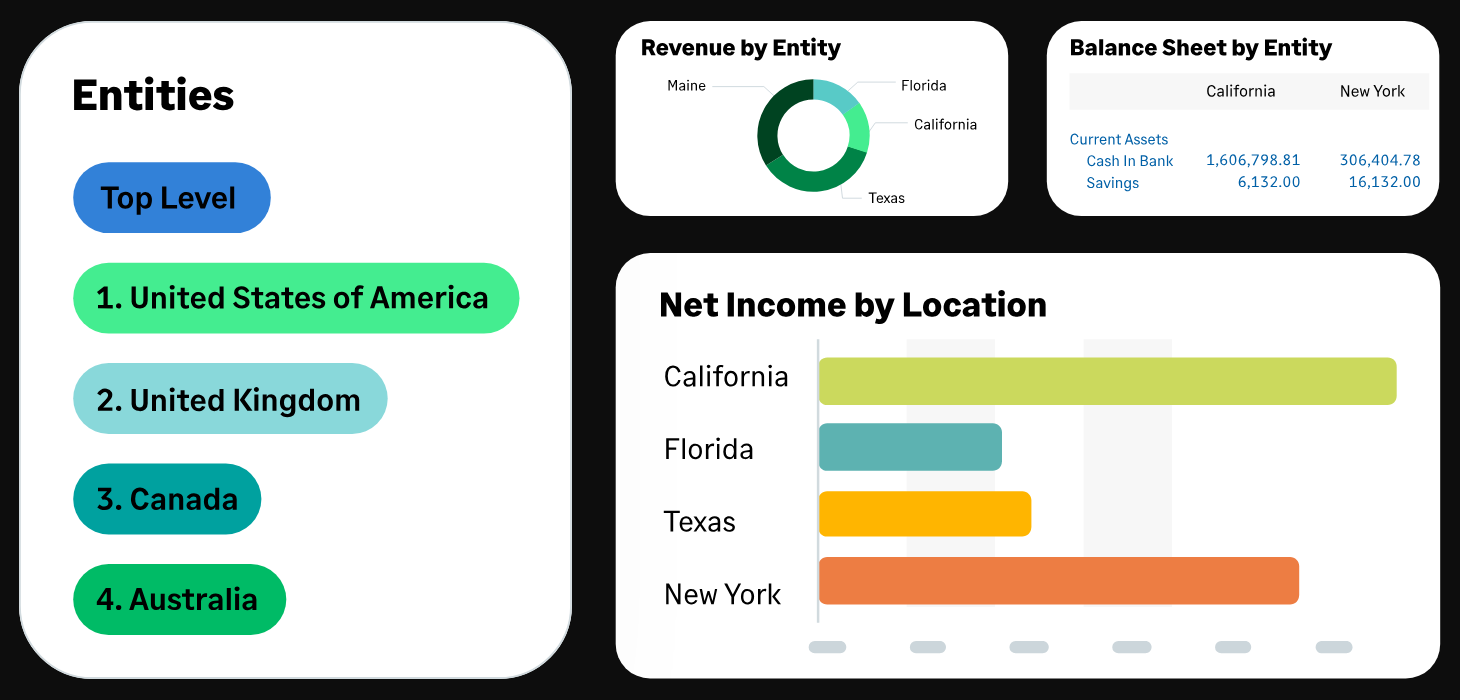
Sage Intacct is a cloud financial system for scaling and mid-sized companies. Entities share one login, reporting runs on dimensions such as location and department, and books close period by period so nothing can be posted into an older period.
Sage Intacct is the most direct finance-first replacement: a dimensional general ledger and a multi-entity structure, without NetSuite's order and inventory scope.
Intacct's ledger reports on dimensions: location, department, project, customer, vendor, employee and item, plus user-defined ones. Entities share one login and one chart of accounts in a shared multi-entity company, and one inter-entity journal entry adds the offsetting lines in each affected entity once an admin has mapped the inter-entity accounts. Journals can be drafted, submitted for approval, carry attachments and allocations, and reverse automatically. Books close by period with a separate Close books permission.
Sage says AP automation with AI bill capture, duplicate flagging and three-way matching has been generally available since May 2026, and the Marketplace lists 350+ integrations. Sage publishes no plan names or prices. Vendr's buyer data reports a median of $56,902 a year across 352 purchases, against $74,714 for NetSuite, but those deals don't share a scope. For plan and cost detail, see our Sage Intacct pricing guide.
- you run several entities or need reporting by department and location that QuickBooks classes cannot give you
- you want a controlled close with books that cannot be posted to once closed
- you are a small team on a small budget: pricing is quote-only and G2 users report about four months to implement
- you need consolidation on day one: consolidation is a separate paid capability
- Users like
- ease of use and reporting
- Users dislike
- steep learning curve, limited customization and missing features
- Source: G2, 4,571 reviews
What you give up compared with NetSuite
Intacct is a financial system, not an operational ERP, so inventory, order management and e-commerce come from other tools. Auto-elimination of inter-entity balances sits in the Consolidation module, which is subscribed separately. G2 reviewers cite a steep learning curve, limited customization and missing features. For a head-to-head, read our NetSuite vs Sage Intacct comparison.
- Starting price
- Quote only; Sage publishes no plan names or prices
- Implementation
- As few as 60 days per Sage; about 4 months average per G2 users
- Marketplace
- 350+ integrations per Sage
- Consolidation
- Separate extended capability
- AP automation
- AI bill capture, duplicate flagging, three-way matching generally available since May 2026
- Payments
- Check, ACH or virtual card
- 1099
- Tracked in Intacct; e-filing through a Marketplace partner
- Dimensions
- Location, department, project, customer, vendor, employee, item plus user-defined dimensions
- Journals
- Draft, submit for approval, attachments, allocations and automatic reversal
- Period control
- Close books by period with a Close books permission; closed statutory periods can be locked
- Entities
- Shared multi-entity company; inter-entity lines create balancing entries in both entities
- Audit trail
- Standard Audit Trail on records and transactions with an Audit History report
- Fixed assets: depreciation methods
- Straight-line, daily, 150% and 200% declining, custom declining balance with and without true-up; full-month, half-year and full-year conventions
- Fixed assets: workflow
- Assets are created manually or from AP bills and purchasing; gain or loss is calculated on disposal (Sale, Casualty loss, Theft, Other); bulk disposal through import
- Intercompany booking
- One inter-entity journal entry adds offsetting entries in each affected entity; admin maps inter-entity accounts once
- Intercompany mapping
- Basic plan: two accounts per entity. Advanced plan: separate accounts per entity pair
- Intercompany eliminations
- Auto-elimination of inter-entity receivable and payable in the Consolidation module, a separately subscribed capability
- Vendr median
- $56,902 a year across 352 purchases (range $9,359 to $188,338), read 2026-11-19
Acumatica
Acumatica Cloud ERP
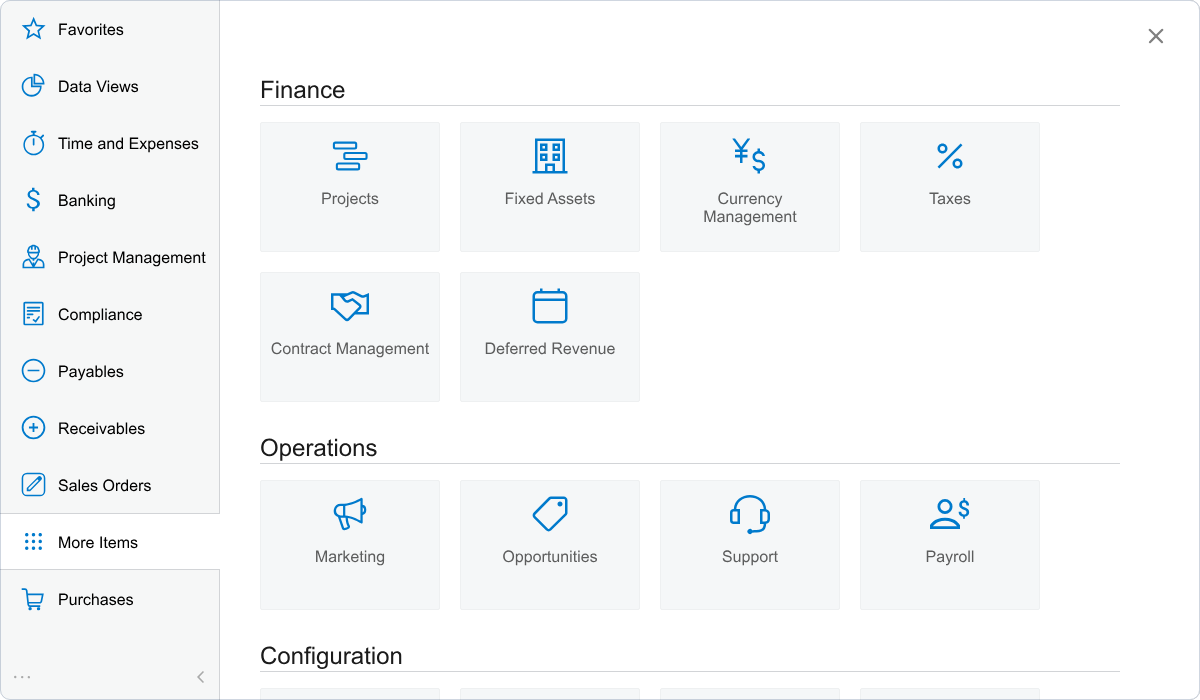
Acumatica is a cloud ERP whose general ledger, subledgers and multi-company accounting sit on one platform with open APIs. Licensing is based mainly on the applications you implement and the compute resources you use, not on user seats, and no dollar prices are published.
Acumatica replaces NetSuite when per-user pricing is the sticking point and you want unlimited related companies in one cloud ERP.
Acumatica's general ledger, subledgers and multi-company accounting sit on one platform with open APIs. Licensing is based mainly on the applications you implement and the compute resources you use, not on user seats, and no dollar prices are published. The vendor states an unlimited number of related companies in one environment, and says due-to and due-from entries are created automatically between related companies once an Inter-Branch feature, two accounts and mapping rules are set up. Accounting periods move through four statuses: Inactive, Open, Closed and Locked.
The same ledger can later take inventory, projects or distribution modules, which makes it the closest operational match to NetSuite on this list. G2 users report an average implementation time of 7 months and an average time to return on investment of 16 months.
- You run several related legal entities and want intercompany due-to/due-from entries and eliminated consolidated statements inside one system, and you have budget for a partner implementation.
- You want unlimited users without per-seat fees and expect to add inventory, projects or distribution modules to the same ledger later.
- You are a small team that needs a ledger live in days: Acumatica is quoted by the applications you implement, and G2 users report an average implementation time of 7 months.
- You want a self-service tool you can configure without a partner; G2 reviewers flag learning curve and difficult setup as recurring negatives.
- Users like
- Ease of use, customization, features (G2 top positive themes)
- Users dislike
- Missing features, learning curve, difficult or complex setup (G2 top negative themes)
- Source: G2, 2,056 reviews
What you give up compared with NetSuite
The quote-only model and a partner-led project point to a heavy rollout, and G2 reviewers flag missing features, a learning curve and difficult setup as recurring negatives. Acumatica doesn't publish prices, so you can't compare it with a list price before a sales call.
- Starting price
- Custom quote, resource-based licensing
- Pricing basis
- Applications implemented and compute resources, not seats; quote only
- G2 average implementation time
- 7 months (user-reported average)
- G2 average ROI time
- 16 months (user-reported average)
- Period statuses
- Inactive, Open, Closed, Locked
- Intercompany booking
- Vendor says due-to and due-from entries are created automatically between related companies; setup uses an Inter-Branch feature, two accounts and mapping rules
- Entities
- Vendor states an unlimited number of related companies in one environment
- G2 implementation time
- 7 months (user-reported average)
Microsoft Dynamics 365 Business Central
Microsoft Dynamics 365 Business Central
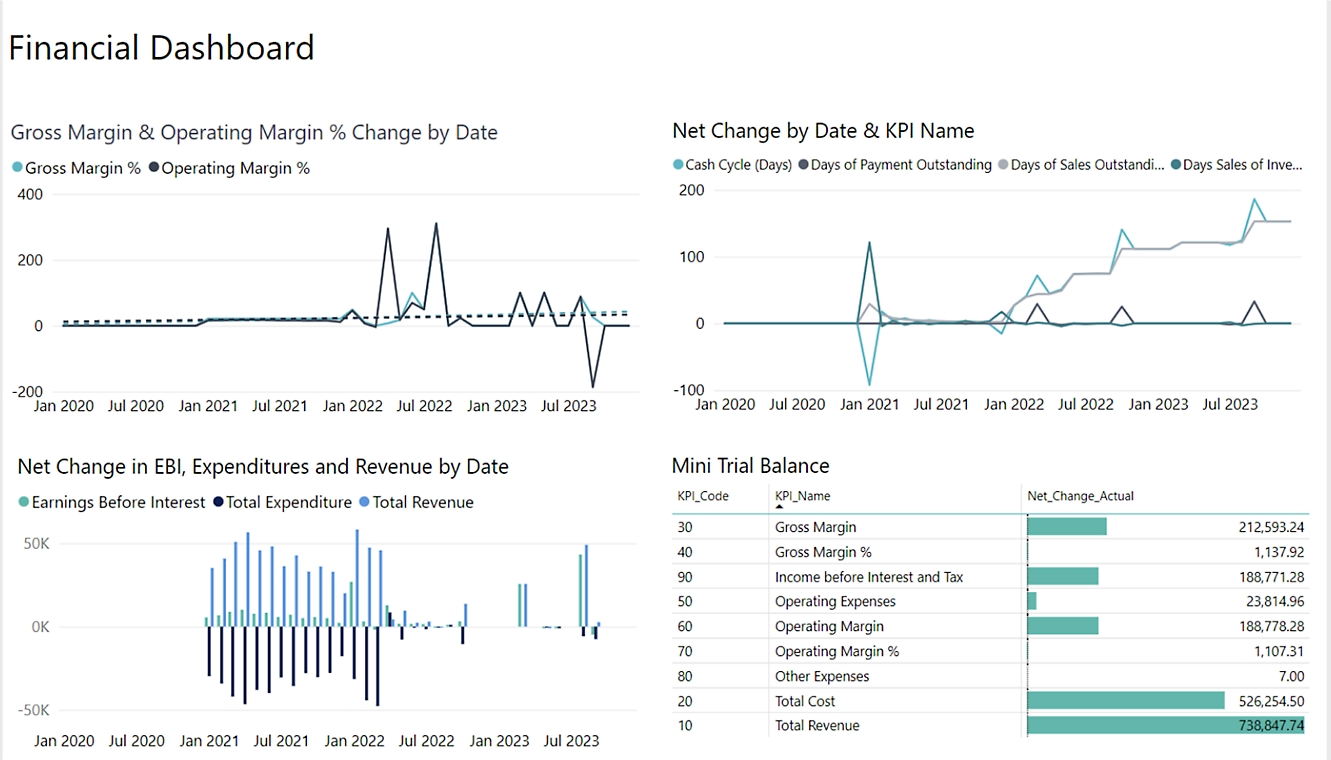
Business Central is Microsoft's cloud ERP with a general ledger, dimension-based analysis, bank reconciliation and multi-company consolidation, tied closely to Excel, Outlook, Teams and Power BI. It is sold and supported through Microsoft partners, so implementation is a project rather than a self-serve signup.
Business Central is the replacement for finance teams that live in Excel, Outlook and Teams and want a list price to start from.
Business Central's ledger carries two global and eight shortcut dimensions, with default dimensions per account and Code Mandatory rules that force a dimension on every line. Recurring journals come as fixed, variable and balance types, with allocations by percentage, and fixed assets support unlimited depreciation books per asset, for example one for tax and one for internal reporting. Posting control works through Allow Posting From and To dates per company and per user.
Microsoft lists Essentials at $80, Premium at $110 and Team Members at $8 per user per month, paid yearly. Team Members seats have limited access: they read data, approve workflows and update select information. Premium adds service management and manufacturing on top of Essentials, and Microsoft offers a 30-day trial. The product is sold and supported through Microsoft partners, so implementation is a project, not a self-serve signup.
- You report by department, project or entity and want dimensions on every journal and document line instead of a sprawling chart of accounts.
- Your team already lives in Excel, Outlook and Teams, and you have a partner budget for implementation and training.
- You need a self-serve tool live in days with no partner, or you only need bookkeeping and invoicing that QuickBooks already covers.
- You expect hard period close and fully automated consolidation eliminations out of the box (periods are controlled by posting-date ranges and eliminations are manual).
- Users like
- ease of use and customization, Microsoft integration and financial control
- Users dislike
- steep learning curve, missing features that need paid add-ons and license cost for smaller companies
- Source: G2, 918 reviews
What you give up compared with NetSuite
Consolidation runs through a container company, and Microsoft states that consolidation eliminations are a manual process. Closing a year doesn't stop posting into it. G2 reviewers cite a steep learning curve, features that need paid add-ons and license cost for smaller companies.
- Starting price
- Essentials $80, Premium $110, Team Members $8 per user per month, paid yearly (USD, informational; bought through Microsoft or a partner)
- Billing term
- Paid yearly, per user per month
- Cheapest seat
- Team Members at $8 per user per month with limited access (read data, approve workflows, update select information)
- Manufacturing and service
- Premium adds enhanced service management and manufacturing on top of Essentials
- Free trial
- 30 days
- Dimensions
- 2 global (filters) and 8 shortcut (journal and ledger fields); default dimensions per account and Code Mandatory rules
- Recurring journals
- Fixed, Variable, Balance, reversing variants and Balance by Dimension; allocations by percentage
- Period control
- Allow Posting From/To dates per company and per user; closing a year does not stop posting into it
- Consolidation
- Container company; eliminations are manual journal lines
- Audit
- Change Log for chosen tables; Microsoft advises against logging ledger entries
- Fixed assets: depreciation methods
- Straight-Line, DB1, DB2, DB1/SL, DB2/SL, Half-Year Convention, Manual and User-defined; no built-in MACRS
- Fixed assets: books
- Unlimited depreciation books per asset, for example one for tax and one for internal reporting
- Fixed assets: workflow
- Calculate Depreciation batch job fills the FA G/L journal and you post it; disposal posts through the FA G/L journal; maintenance and insurance tracking are native
- Intercompany booking
- IC partner codes create a matching document in the partner company, with an inbox and outbox to accept or reject
- Intercompany eliminations
- Microsoft states consolidation eliminations are a manual process; the Intercompany Transactions report supports reconciliation
- Price
- Essentials $80, Premium $110, Team Members $8 per user per month, paid yearly
Modular and SAP options
Odoo and SAP Business One suit teams that left NetSuite because of cost or because they want operations and the ledger in one system with a local partner. Neither is a finance-first ledger.
Odoo
Odoo Accounting
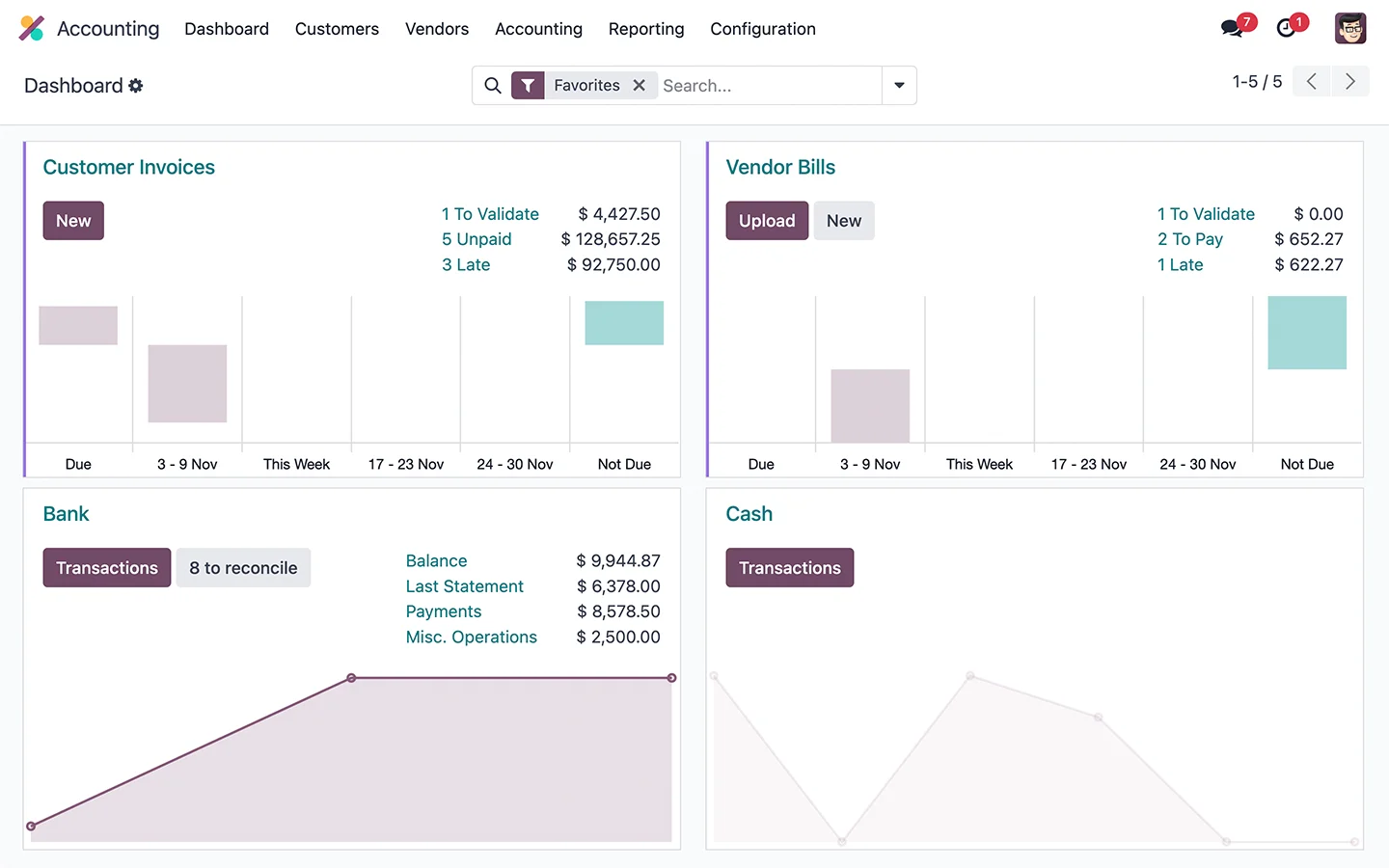
Odoo sells accounting as one app in a modular ERP, priced per user. Its documentation covers bank reconciliation with auto-matching and lock dates, including a Hard Lock date that cannot be reversed.
Odoo replaces NetSuite when the goal is a low per-user price and a modular ERP that someone on your team can configure.
Odoo sells accounting as one app in a modular ERP, priced per user. Standard is EUR 24.90 per user per month and Custom is EUR 44.90, and a One App Free plan costs EUR 0. Multi-company needs the Custom plan, where inter-company transactions can create the counterpart vendor bill, sales order or purchase order in the other company. Analytic plans group analytic accounts such as project or department, and a plan can be set to Optional, Mandatory or Unavailable per document type.
For period control, Odoo has a Lock Everything date plus an irreversible Hard Lock date, and only Accounting administrators can create exceptions. Depreciation supports straight line, declining, and declining then straight line, with entries created in draft and posted automatically. Odoo lists euro prices only, so there's no published USD price.
- you want accounting, inventory and other business apps in one system and have someone to configure it
- you want the option to self-host or to customize the system
- you want a ready-made US accounting setup with a one-click QuickBooks import: no official QuickBooks import is documented, only a paid third-party app
- you want a published USD price: Odoo lists euro prices only
- Users like
- not available (aggregate summary figure only)
- Users dislike
- not listed
- Source: G2, 78 reviews
What you give up compared with NetSuite
Odoo's documentation describes no automatic elimination of intercompany balances. US bank feeds run through Plaid and need an Enterprise subscription, there's no official QuickBooks import (a paid third-party importer exists), and MACRS isn't native. Custom reports need developer mode. G2 shows 78 reviews for Odoo Accounting.
- Starting price
- EUR 24.90 per user per month (Standard) and EUR 44.90 (Custom); One App Free EUR 0; multi-company needs Custom; Odoo lists euro prices only, so no USD price
- Lock dates
- Lock date plus an irreversible Hard Lock date
- Bank feeds
- Plaid in the US and Canada
- QuickBooks import
- Third-party paid importer (EUR 95.70), no official tool documented
- Analytic plans
- Plans group analytic accounts such as project or department; applicability Optional, Mandatory or Unavailable per document type; distribution models split automatically
- Period control
- Lock date plus irreversible Hard Lock date
- Multi-company
- Custom plan; inter-company transactions can auto-create bills and orders
- Reports
- Custom reports through the report editor, which needs developer mode
- Bank sync
- Third-party providers (Plaid for US and Canada); needs an Enterprise subscription
- Fixed assets: depreciation methods
- Straight Line, Declining, and Declining then Straight Line; one depreciation board per asset
- Fixed assets: workflow
- Assets come from vendor bills or asset models; depreciation entries are created in draft and posted automatically, checked once a day; Sell or Dispose generates the gain or loss entries
- Fixed assets: MACRS
- Not native; a third-party US tax-books module lists MACRS at EUR 119.85
- Intercompany booking
- Per-company switches create the counterpart vendor bill, sales order, purchase order or stock move in the other company
- Intercompany eliminations
- Docs describe no automatic elimination of intercompany balances
- Price
- EUR 24.90 per user per month (Standard), EUR 44.90 (Custom)
SAP Business One
SAP Business One
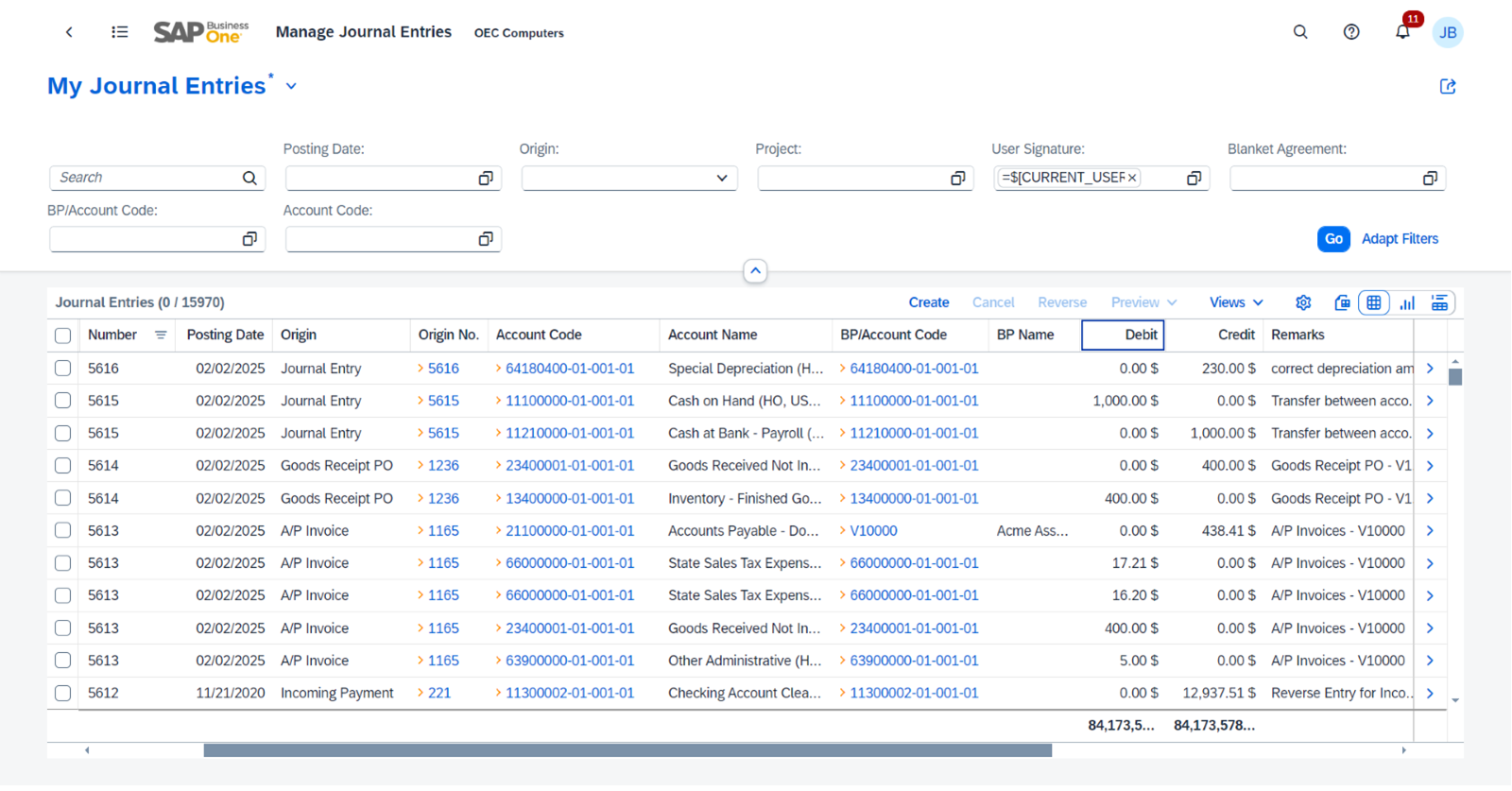
SAP Business One is SAP's all-in-one ERP for small and midsize companies, covering accounting, purchasing, inventory, sales and reporting in one system sold and implemented through partners. For finance teams it offers posting periods with status locks, three external bank reconciliation options and parallel local and system currencies, at the cost of partner-led setup, a quote-based price and a steeper learning curve for non-accountants.
SAP Business One replaces NetSuite for small and midsize teams that run inventory, purchasing and sales next to the ledger and want a partner to set it up.
Business One covers accounting, purchasing, inventory, sales and reporting in one system sold and implemented through partners. For finance teams it offers posting periods with status locks, three external bank reconciliation options and parallel local and system currencies. SAP shows a quote request only, with no published price, and the product runs in the cloud or on premise. SAP says it has over 85,000 customers worldwide, which is a vendor claim.
G2 users report an average implementation of 6 months and an average time to return on investment of 28 months. Reviewers credit quick navigation and flexibility for specific workflows.
- You run inventory, purchasing and sales alongside the ledger (distribution, light manufacturing, retail) and want the general ledger inside the same system, with a partner to configure and support it.
- You need controlled period locking by month or quarter and a choice of bank reconciliation methods, and can budget for a multi-month, partner-led implementation.
- You want published, self-serve pricing and a go-live in days; pricing is quote-based and G2 users report an average implementation of about six months.
- Your finance team is a few accountants who only need a ledger, AP/AR and close tasks; reviewers cite complexity for non-accountants, so a lighter accounting-first tool fits better.
- Users like
- Ease of use and quick navigation that shortens training (8 and 5 mentions), flexibility to fit specific workflows (4 mentions), good customer service (3 mentions).
- Users dislike
- Complexity and a difficult interface for non-accountants (5 mentions), hard upgrades and customization (3), steep learning curve for people new to accounting software (3), weak intercompany data handling (2), integration problems (2).
- Source: G2, 542 reviews
What you give up compared with NetSuite
G2 reviewers cite complexity and a difficult interface for non-accountants, hard upgrades and customization, a steep learning curve for people new to accounting software, weak intercompany data handling and integration problems. A team of accountants that only needs a ledger, AP and AR and close tasks fits a lighter tool better.
- Starting price
- Quote only through SAP partners; SAP publishes no price
- Pricing model
- Quote through SAP partners; no published price
- Deployment
- Cloud or on-premise (SAP product page)
- Average implementation (G2)
- 6 months; average ROI 28 months
- Customers (SAP claim)
- Over 85,000 worldwide
- G2 implementation time
- 6 months average; 28 months to ROI
How does SAP Business One compare with NetSuite?
SAP Business One is the better fit when inventory, purchasing and sales run beside the ledger and a partner will configure it, and NetSuite is the broader choice when you need subsidiaries, many currencies and one cloud suite. The G2 averages are close: about 6 months to implement for both, and 28 months to return on investment for Business One against 20 for NetSuite. Business One is sold only through partners and shows no price. NetSuite also shows no price, so the quote and the implementation scope are what you compare.
Enterprise and SaaS-native options
Two systems sit at the edges of this list. Dynamics 365 Finance is for teams that have outgrown NetSuite on entities and consolidation, and Rillet is a newer ledger for SaaS finance teams. Our enterprise accounting software guide and revenue recognition software roundup cover the wider categories.
Microsoft Dynamics 365 Finance
Microsoft Dynamics 365 Finance
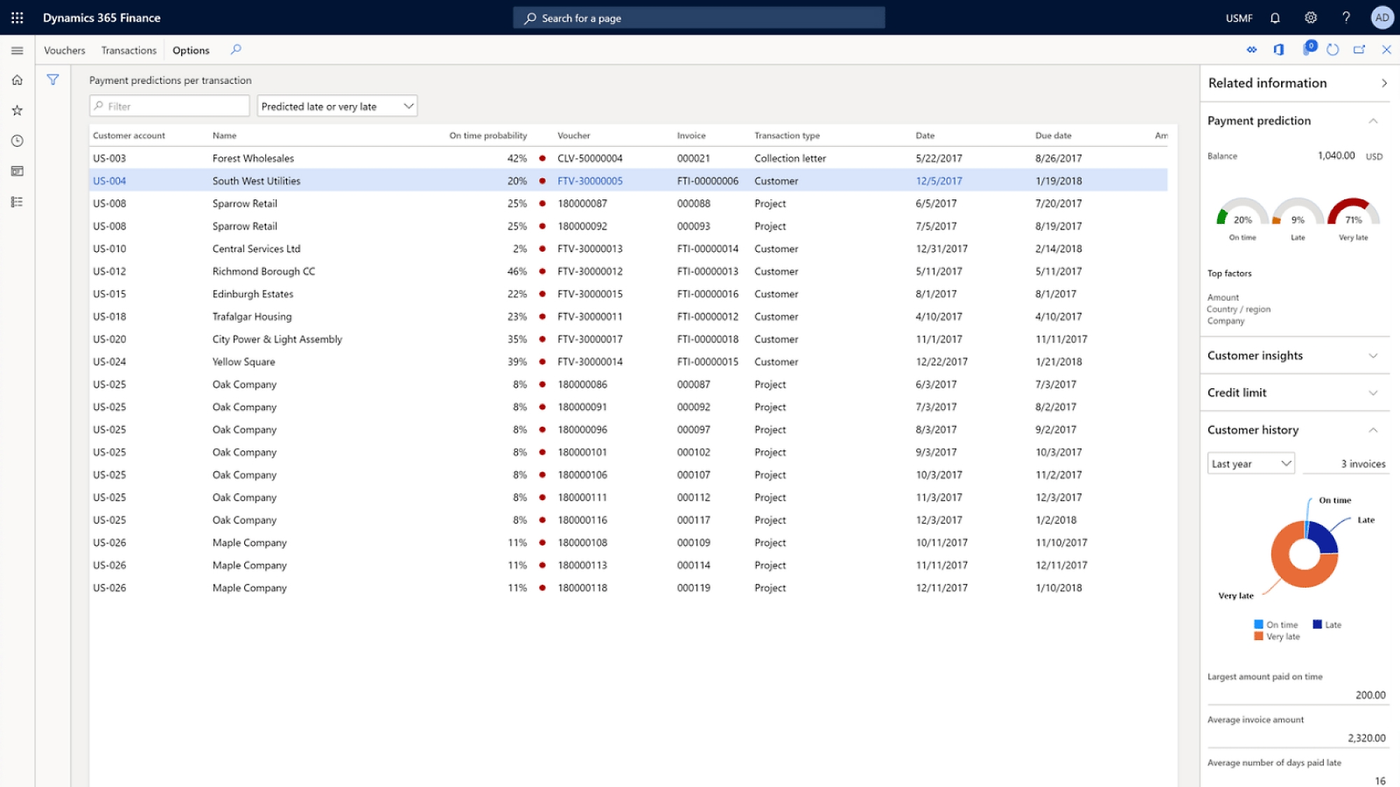
Dynamics 365 Finance is Microsoft's enterprise finance application for multi-entity accounting, with intercompany accounting, consolidation with elimination rules, and a period close workspace with task dependencies. Segregation of duties rules are enforced when security roles are created and assigned.
Dynamics 365 Finance replaces NetSuite for groups with many legal entities, different currencies or fiscal calendars that need consolidation and eliminations in the ledger.
Intercompany accounting is set up as pairs of legal entities with due-to and due-from accounts, and one posting creates vouchers in both companies. Consolidation can run online or through financial reporting, and supports multiple charts of accounts, different fiscal calendars and multiple reporting currencies. Elimination rules, by net change or fixed amount, post to an elimination legal entity during consolidation, and currency translation moves each source company's balances into the consolidation currency.
The period close workspace has its own calendars, templates, closing roles, task dependencies and attachments, and the schedule can be locked when the close is complete. Completed tasks record the time and the user. Segregation of duties rules are enforced automatically when security roles are created or assigned. Microsoft lists $210 per user per month for Finance and $300 for Finance Premium, paid yearly, and says the actual price is shown at checkout.
- you run many legal entities with different currencies, charts of accounts or fiscal calendars and need consolidation and eliminations in the ledger
- your auditors expect enforced segregation of duties and a tracked, task-based close
- you want a quick, light setup: the setup involves many moving parts, such as intercompany entity pairs, elimination rules, consolidation companies and closing templates
- you need a fully self-serve price: Microsoft states the actual price is shown at checkout and purchase requires contacting Microsoft
What you give up compared with NetSuite
The setup has many moving parts: intercompany entity pairs, elimination rules, consolidation companies and closing templates. Microsoft advises against the Permanently closed period status because it can't be reopened, and currency revaluation still has to be run when rates change. There's no G2 rating to compare it with.
- Starting price
- $210 per user per month for Finance and $300 for Finance Premium, paid yearly (Microsoft list price, informational)
- List price
- $210 per user per month (Finance), $300 (Finance Premium), paid yearly
- Intercompany
- Intercompany journals for daily, vendor invoice and payment journals and ledger allocations, set up as pairs of legal entities with Due to and Due from accounts
- Consolidation
- Consolidate online, Financial reporting, or both; supports multiple charts of accounts, different fiscal calendars and multiple reporting currencies
- Eliminations
- Elimination rules (net change or fixed amount) processed during consolidation or via an elimination proposal into an elimination company
- Currency translation
- Translates from each source company's accounting currency to the consolidation company's currency; currency revaluation still has to be run when rates change
- Period close
- Financial period close workspace with its own calendars, templates, closing roles, task dependencies and attachments; the schedule can be locked when the close is complete
- Period control
- On hold, restricted to a user group, or Permanently closed
- Segregation of duties
- Rules are enforced automatically when roles are created or assigned; conflicts are logged and overrides require a reason
- Audit
- Completed close tasks record time and user identifier; consolidation keeps dimensions and accounts for audit; Microsoft markets built-in audit trails and documentation
- Intercompany booking
- Legal-entity pairs with due-from and due-to accounts; one posting creates vouchers in both companies
- Intercompany eliminations
- Elimination rules in the Consolidations module post to an elimination legal entity; intercompany setup alone does not eliminate
Rillet
Rillet
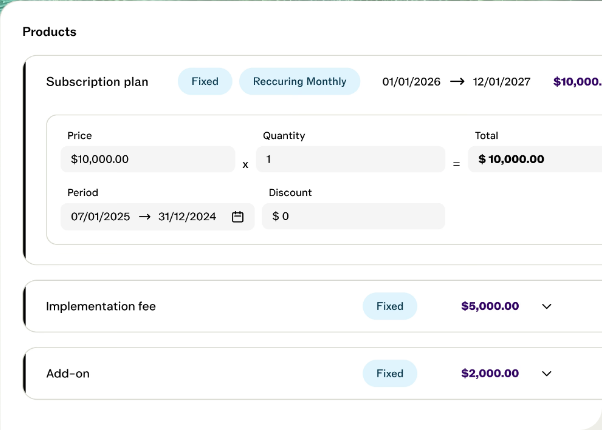
Rillet is a cloud ERP and general ledger for SaaS finance teams that includes ASC 606 and IFRS 15 revenue recognition natively. It syncs closed-won contracts from the CRM, generates recognition patterns, and posts the entries directly to the ledger.
Rillet replaces NetSuite for SaaS finance teams that want ASC 606 revenue recognition to post into the same ledger that produces the financial statements.
Rillet is a cloud ERP and general ledger with ASC 606 and IFRS 15 revenue recognition built in. You connect the CRM, Rillet syncs closed-won contracts from Salesforce or HubSpot and generates a recognition pattern from product and service periods, and you review and approve the contract details before they post. In-flight contracts can be amended in Rillet and the changes flow into the ledger. Billing platforms such as Stripe, Chargebee and Maxio feed usage and invoices.
The revenue waterfall, deferred revenue, prepaid and fixed asset schedules are part of the ledger, and Rillet says it keeps lineage from the source record to the revenue schedule, the journal entry and the general ledger. No subscription price is published; the pricing page cites an implementation cost of $10K to $30K. Vendr's median is $28,500 a year, with a range of $20,100 to $46,742. G2 users report an average implementation of 2 months.
- you are replacing a legacy or entry-level ERP and want rev rec inside the ledger instead of a separate subledger
- you sync deals from Salesforce or HubSpot and bill through Stripe, Chargebee or a similar billing tool
- you want a CPA-led implementation measured in weeks rather than a months-long ERP project
- you want to keep your current ERP and add only a rev rec module, because Rillet's rev rec is built into its own ledger
- you need the subscription cost to shortlist, because Rillet's pricing page shows only a $10K to $30K implementation cost
- Users like
- Reviewers highlight strong customer support, ease of use and automation efficiency, with one reporting Salesforce integration and order processing working within the first week.
- Users dislike
- Some users note a learning curve and want more granular user permissions; missing features and integration issues are the top con tags.
- Source: G2, 65 reviews
What you give up compared with NetSuite
Rillet is built for SaaS companies, so inventory-heavy operations don't fit it. Revenue recognition isn't sold as a module for another ERP. G2 reviewers want more granular user permissions and note a learning curve, and the 65 reviews are a much smaller base than NetSuite's 5,270.
- Starting price
- Quote only: no subscription price is published. The pricing page cites an implementation cost of $10K to $30K (one-time or recurring is not stated)
- ASC 606 / IFRS 15 coverage
- The vendor states "Rillet handles ASC 606 and IFRS 15 out of the box" and posts ASC 606 allocations based on your revenue policy.
- Rules and schedules
- Connect your CRM to sync closed-won contracts and Rillet generates a revenue recognition pattern from product and service periods; you review and approve contract details before they post to the ledger.
- Contract modifications
- In-flight contracts can be amended directly in Rillet and changes flow into the general ledger; the vendor's blog says the system recalculates prospectively or cumulatively per ASC 606 modification guidance.
- Usage and variable consideration
- The product page says Rillet supports digital products, services or usage-based transactions, and Rillet's blog says usage data flows in from billing systems with variable consideration adjusting accordingly (generic description).
- Multi-element and SSP allocation
- Rillet's docs describe an AI Contract Analysis with identification of obligations and allocation of the transaction price across them; the SSP method is not detailed on the pages read.
- Journal entries and sync
- Rillet books journal entries in the same ledger that produces the financial statements, syncs closed-won deals from Salesforce or HubSpot, and integrates with billing platforms including Stripe, Chargebee, Maxio, Tabs, Sequence, Measure, HubiFi and Upflow.
- Reporting
- The revenue waterfall, deferred revenue, prepaid and fixed asset schedules are built into the ledger, and the deferred revenue roll-forward is described as a ledger artifact, not an export.
- Audit trail and controls
- The vendor says Rillet preserves lineage from source record to revenue schedule to journal entry to the general ledger, and the 606 analysis can be downloaded for audit support.
- Deployment and pricing basis
- Rillet is a full cloud ERP, so rev rec is part of the platform, and no subscription pricing is published beyond an implementation cost range of $10K-$30K.
- Implementation time
- The vendor blog cites CPA-led implementation in 4-8 weeks with accounting support after go-live, and G2 lists an average time to implement of 2 months.
- AI role
- Aura AI reads contracts, identifies performance obligations and applies the ASC 606 framework to produce an analysis for review, and the vendor says the agent proposes while you approve.
- What it does not do
- Rev rec is not sold as a standalone module for another ERP on the pages read, and the docs page read does not describe SSP or modification handling in the AI analysis.
- Vendr median
- $28,500 a year (range $20,100 to $46,742), read 2026-11-19
- Price
- Quote only; implementation cost $10K to $30K cited
- G2 implementation time
- 2 months (user-reported average)
How do the alternatives handle period close and intercompany?
No alternative matches NetSuite's OneWorld on every control, so match each system to the control your auditors test. The table shows what each vendor's own documentation says about period locks, intercompany booking, eliminations and audit trail, which is the fairest basis for comparison.
| System | Period control | Intercompany | Eliminations | Audit trail |
|---|---|---|---|---|
| NetSuite | Locks AP, AR and GL postings per period, per subsidiary in OneWorld; an override permission exists | OneWorld subsidiaries with intercompany and advanced intercompany journals | An elimination run in the period close checklist creates elimination journals | System Notes record period lock changes |
| Sage Intacct | Close books by period with a Close books permission; closed statutory periods can be locked | One inter-entity journal books both sides in a shared multi-entity company | Auto-elimination in the Consolidation module, subscribed separately | Standard Audit Trail with an Audit History report |
| Acumatica | Period statuses Inactive, Open, Closed and Locked | Due-to and due-from entries between related companies, set up through Inter-Branch | Eliminated consolidated statements, per the vendor | Not published |
| Business Central | Allow Posting From and To dates per company and per user; closing a year doesn't stop posting | IC partner codes create a matching document in the partner company | Manual, per Microsoft | Change Log for chosen tables; Microsoft advises against logging ledger entries |
| Odoo | Lock Everything date plus an irreversible Hard Lock date | Per-company switches create the counterpart document; Custom plan | No automatic elimination described | Not published |
| SAP Business One | Posting periods with status locks | G2 reviewers flag weak intercompany data handling | Not published | Not published |
| Dynamics 365 Finance | Ledger periods On hold, restricted to a user group or Permanently closed; close workspace | Legal-entity pairs; one posting creates vouchers in both companies | Elimination rules post to an elimination legal entity | Close tasks record time and user; segregation of duties rules enforced |
| Rillet | Not published | Not published | Not published | Lineage from source record to schedule to journal entry, per the vendor |
Auditor access matters as much as the controls. Ask every vendor to show a closed period, a locked subsidiary and an intercompany elimination on your own data, and to show what a user with period-override rights can change. Our month-end close checklist lists the evidence an auditor asks for, and our intercompany accounting software guide goes deeper on eliminations.
How much do the alternatives cost?
NetSuite costs a median of $74,714 a year in Vendr's buyer data, and of the seven alternatives only Business Central, Dynamics 365 Finance and Odoo publish a list price, so most of this comparison comes down to what you can learn before a sales call. Treat every figure below as an input to a quote request, not a budget, because scope sets the price.
| System | What's public | What drives the quote |
|---|---|---|
| NetSuite | No price. Vendr median $74,714 a year (1,522 purchases, $7,160 to $299,115) | Edition, modules, named users, subsidiaries and implementation services |
| Sage Intacct | No price. Vendr median $56,902 a year (352 purchases, $9,359 to $188,338) | Entities, modules such as consolidation, and users |
| Acumatica | No price; licensing by applications and compute, not seats | Applications implemented and resource use, plus partner services |
| Business Central | Essentials $80, Premium $110, Team Members $8 per user per month, paid yearly | Users, add-ons and partner implementation |
| Odoo | EUR 24.90 (Standard) and EUR 44.90 (Custom) per user per month; One App Free EUR 0 | Apps, multi-company (Custom plan), Enterprise for bank sync |
| SAP Business One | No price; quote through SAP partners | Licenses and partner services |
| Dynamics 365 Finance | $210 (Finance) and $300 (Finance Premium) per user per month, paid yearly | User count, tier and partner services |
| Rillet | No subscription price; implementation cost $10K to $30K cited; Vendr median $28,500 a year | Entities, contract volume and integrations |
Vendr's figures come from deals it saw and don't share a scope, so a lower median doesn't mean a lower bill for your company. Compare quotes on three-year cost with services included, and ask each vendor what the renewal increase is and how long the notice period runs. NetSuite's G2 users report an average discount of 25%, so the first quote isn't the price. Our NetSuite pricing guide lists the components of a NetSuite quote.
How do you move off NetSuite?
To move off NetSuite, cut over at a period boundary, export your history and saved searches first, rebuild the chart of accounts and dimensions in the new system, run both for one close, and check the contract end date before you commit. Keep the closed-period evidence, because that's what an auditor will ask for: the periods you already closed stay in NetSuite, so decide what you need before access ends.
List what you use
Export the list of active subsidiaries, currencies, saved searches, SuiteApps, custom segments and approval workflows. Mark each as keep, replace or drop. Anything that's custom costs time in the new system.
Map the structure
NetSuite's departments, classes and locations plus custom segments have to become the new system's dimensions, analytic plans or entities. Map the chart of accounts once, in a spreadsheet the auditors can read.
Pick a period boundary
Cut over at a month-end or a quarter-end, after the old period is locked. Lock each subsidiary's last period in NetSuite and keep a record of who held override rights.
Export history and evidence
Export trial balances, open items, fixed asset registers and the audit records you'll need for closed periods, including period lock changes. Store them where the auditors can reach them.
Run both for one close
Close one month in both systems, and compare the trial balances account by account before you switch off the old one. Track the close tasks and the evidence for the parallel run in one list.
How do you choose a NetSuite alternative?
The best way to choose a NetSuite alternative is to start from the reason you're leaving, then test each system on your own close. These five checks narrow the list quickly.
- Scope: do you need inventory and order management in the same system, or only the ledger? Finance-first systems such as Sage Intacct drop the operations scope, and ERPs such as Acumatica, Odoo and SAP Business One keep it.
- Entities: how many legal entities and currencies do you run, and does the system eliminate intercompany balances automatically or through a manual journal?
- Price model: per user, per application, or quote only? Ask for three-year cost with services and renewal terms.
- Rollout: ask for a reference customer of about your size, and compare the vendor's timeline with the G2 averages above.
- Close and audit: ask to see a locked period, an override and the audit trail on your own data.
What do you still need after you switch?
After you switch from NetSuite you still need a close routine, because moving the ledger doesn't move it. A new system gives you period locks and journals, but the checklist, the evidence per task and the preparer and reviewer sign-off still live wherever your team keeps them today. If that's a spreadsheet and a chase for missing support every month, a lightweight close tracker fills the gap without touching the ledger.
What is the best NetSuite alternative?
The best NetSuite alternative depends on what you're leaving. Sage Intacct and Acumatica fit a finance-led mid-market team, Business Central fits a Microsoft 365 shop, Odoo and SAP Business One suit a cheaper or partner-led ERP, and Dynamics 365 Finance suits groups with many entities.
Is NetSuite like Salesforce?
No. NetSuite is a cloud ERP whose core is financials, with inventory, order management and CRM as modules. Salesforce is a CRM platform. Teams sometimes compare them because both sell cloud software to growing companies.
Is NetSuite better than QuickBooks?
Neither is better in general. NetSuite fits companies with several entities, currencies or inventory, and QuickBooks fits smaller single-entity teams at a much lower cost. Our NetSuite vs QuickBooks comparison goes through the differences.
Which NetSuite alternatives publish a price?
Of the seven compared here, Business Central ($80 per user per month for Essentials), Dynamics 365 Finance ($210 per user per month) and Odoo (EUR 24.90 per user per month) publish list prices. Sage Intacct, Acumatica, SAP Business One and Rillet are quote only.
How long does it take to move off NetSuite?
Moving off NetSuite takes months, not weeks. G2 users report an average implementation time of 4 months for Sage Intacct, 6 for SAP Business One and 7 for Acumatica, and Rillet reports about 2 months. Run the old and new systems for one close before you switch.
Does The Finance Lead replace NetSuite?
No. The Finance Lead tracks month-end close tasks, evidence links and preparer and reviewer sign-off. It doesn't touch ledgers or bank data, so it complements an ERP and doesn't replace one.