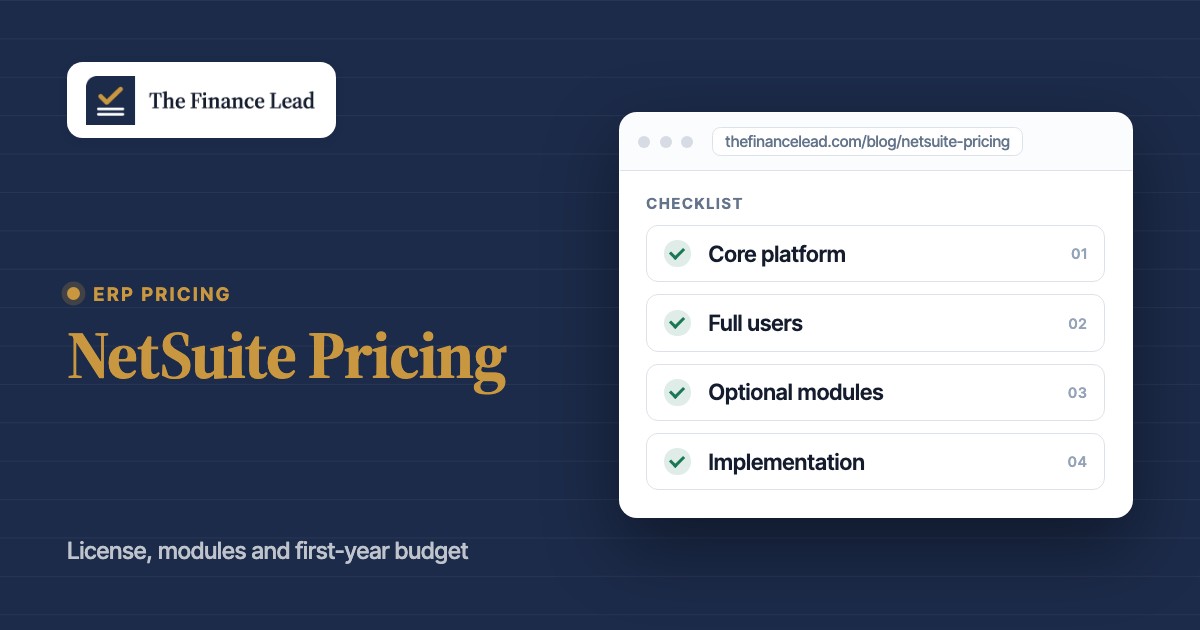
NetSuite pricing is quote-based, not a fixed public price list. For a starting budget, NetSuite consultancy Broken Rubik reports a base platform around $999 per month and $129 to $199 per full user per month. Those figures are market-reported estimates, not rates guaranteed by Oracle. Optional modules, capacity requirements and a separately scoped implementation can materially change the total.
NetSuite's own pricing explanation is more useful than an unsupported flat fee: an annual subscription combines the core platform, optional modules and users, while implementation is a separate one-time charge. Before comparing NetSuite with its current accounting stack, a finance team should request an itemized quote and a matching implementation statement of work. To see how NetSuite's period locks and implementation time compare with five other systems, read our guide to ERP accounting software.
NetSuite pricing at a glance
NetSuite pricing doesn't have a public, universal USD rate card. The reported entry point is useful for a first-pass budget, but you'll need separate figures for the platform, named users, modules, implementation and ongoing support. Treat every number below as an estimate until Oracle supplies a written proposal; they're only planning inputs.
- Oracle describes an annual license made up of platform, optional modules and users, plus a separate implementation fee.
- Broken Rubik reports a $999 monthly platform starting point and $129 to $199 per full user monthly; Oracle does not guarantee those figures.
- General ledger and financial reporting are listed as platform-included capabilities; revenue management and planning are described as add-ons.
- A controller should compare a three-year subscription and services budget, not just the initial monthly license figure.
The following planning ranges come from an October 2026 review of publicly accessible consultant and research pages. They are not official NetSuite list prices and shouldn't be presented as a negotiated offer.
| NetSuite cost component | Market-reported reference (USD) | What to confirm in a quote |
|---|---|---|
| NetSuite base platform | Around $999 per month at the reported entry point | Edition, included functionality and service tier |
| NetSuite full user | About $129 to $199 per user per month | Role permissions, seat quantity and price lock |
| NetSuite Employee Center | About $15 to $25 per user per month, as reported by one consultancy | Exact permitted tasks and whether the license type fits |
| NetSuite implementation | Separate, one-time services project | Migration, integrations, training and acceptance criteria |
| NetSuite optional modules | Individually quoted | Modules, environments, subsidiaries and start dates |
- Core platformAbout $999 per month, consultant-reportedNegotiated
- One of three license components Oracle names
- General ledger, reporting and close management are platform-included
- Edition and service tier set the final price
- Full users$129 to $199 per user per month, consultant-reportedQuoted by Oracle
- The second license component
- Role permissions and seat count drive the total
- Employee self-service seats are priced separately
- Modules and servicesQuoted no public rateScoped per project
- Revenue management and planning are add-ons
- Consolidation comes through OneWorld or Multi-Book
- Implementation is a separate one-time fee
Oracle publishes no list prices for these components. The dollar figures are Broken Rubik's reported estimates, checked October 25, 2026, and are not an Oracle offer.
Pricing evidence matters. Broken Rubik's consultant-reported figures differ from other published ranges: ERPResearch lists $99 to $199 per user per month, while ISV Co-Sell's benchmark puts typical pricing at $99 to $149 before negotiation. That spread is a reason to avoid a false precision claim, and it isn't a reason to average the numbers into a supposed Oracle rate. Request the current Oracle quote for your exact configuration.
How does NetSuite calculate its subscription price?
NetSuite calculates the subscription around three inputs that Oracle identifies explicitly: the core platform, optional modules and the number of users. Implementation sits outside that annual license, so it's quoted separately. For controllers, the practical job is to turn those categories into auditable quote lines and identify which costs recur.
Define the core financial scope
List legal entities, currencies, ledgers, bank accounts and reporting requirements. Separate must-have close processes from a later expansion.
Count users by actual work
Name the people who post transactions, approve expenses, review financial statements or administer the system. Ask Oracle to map each workflow to the lowest permitted license type.
Confirm module entitlements
Mark each requirement as included, optional or still unconfirmed. Request the SKU and start date for every add-on, especially consolidation and planning.
Scope implementation independently
Ask for a services statement of work covering data conversion, integrations, testing, training and the first production close.
Model renewals and change orders
Put renewal caps, added users, future entities, support and optional services in the multiyear forecast rather than hiding them in a contingency cell.
Core platform and edition
NetSuite's core platform is the starting subscription component. Oracle's general ledger page states that general ledger capabilities are included with the platform license, while its financial reporting page says financial reporting is included as well. An entry-level finance deployment shouldn't assume that every adjacent finance feature is bundled.
A quote may use an edition or industry-specific SuiteSuccess package name. NetSuite describes SuiteSuccess as editions with preconfigured industry solutions, best practices and role-based dashboards, not as a public three-tier subscription menu with guaranteed sticker prices. Ask for the actual included modules and service capacity, and don't infer them from a package label.
User licenses and roles
NetSuite user licensing needs a workflow-based inventory, not an employee headcount. Broken Rubik distinguishes full users from cheaper employee self-service access, but Oracle must confirm which permissions and user types apply to your contract. A controller who can approve a journal entry might require a different entitlement from an employee who only submits an expense report.
Create a licensing matrix before the sales call; it's the fastest way to keep the quote honest. The matrix below is a proposed requirements worksheet; it isn't an Oracle license classification.
| NetSuite access need | Example user | Buyer verification |
|---|---|---|
| Post and adjust general ledger entries | Staff accountant | Full transactional permissions and segregation of duties |
| Approve material journals and review close | Controller | Approval role, reporting and edit restrictions |
| Submit expenses or time | Employee | Employee Center scope and actual quote |
| View consolidated reports | CFO or finance leader | Report access, subsidiaries and required license |
| Manage integrations and roles | ERP administrator | Administrator rights, integration users and security |
Don't downgrade a user on price alone, because that's a control risk. Ask the vendor to demonstrate that the proposed role can complete its required tasks and can't complete tasks that violate the company's approval policy. The access review should be documented alongside the license quote so a later implementation change doesn't silently expand the seat count.
Optional modules and subsidiary complexity
Optional modules are the part of NetSuite pricing that's most likely to disappear inside a broad product demo. Oracle describes Revenue Management as an add-on, and it says the same of Planning and Budgeting. It says financial consolidation capabilities are available through OneWorld and Multi-Book modules, so the buyer should verify exactly which of those modules are on the proposal.
A company with a single ledger and routine month-end close has a different buying problem from a group that needs intercompany eliminations and reporting under multiple accounting standards. For the second company, the controller should map the legal entity hierarchy, required currencies, consolidation steps and reporting books before signing a module order.
| NetSuite finance capability | Oracle's published packaging description | Finance decision |
|---|---|---|
| NetSuite general ledger | Included with platform | Verify accounts, segments and close roles |
| NetSuite financial reporting | Included with platform | Verify reporting permissions and templates |
| NetSuite financial close management | Described as platform-included capabilities | Demonstrate reconciliation and period-close workflow |
| NetSuite Revenue Management | Add-on module | Require a revenue recognition use case |
| NetSuite Planning and Budgeting | Add-on module | Separate budgeting from basic reporting |
| NetSuite OneWorld and Multi-Book | Modules associated with consolidation | Scope entities, eliminations and accounting books |
A module's existence doesn't prove the quoted edition contains it. Ask Oracle to mark each capability as included or excluded on the order form, then confirm the same scope in the implementation agreement.
How much does NetSuite cost for a small finance team?
A small NetSuite finance team can use a transparent arithmetic model before receiving a quote. Using Broken Rubik's reported entry-level platform and full-user floor, 10 full users produce an illustrative recurring subtotal of $2,289 per month or $27,468 per year before optional modules, taxes, support and implementation. This is an assumption-driven model, not an observed customer invoice.
The calculation's simple: $999 for the monthly platform plus 10 times $129 for full-user licenses. A controller can replace each assumption with a written quote line without rebuilding the spreadsheet.
For a simple illustrative first-year budget, assume an additional $30,000 for implementation. The result is $57,468 in year one before unquoted modules, integration subscriptions, taxes and ongoing services. The $30,000 figure is a modeling assumption; it isn't an Oracle fee or an implementation benchmark.
Third-party estimates from Broken Rubik, checked October 25, 2026. Excludes optional modules, support, taxes and implementation. Oracle's written quote controls the actual price.
The small-team model is especially sensitive to the license mix. If only a few employees post transactions while the rest submit time or expenses, the controller should request a role-by-role quote. Don't assume every staff member needs full access, and don't assume Employee Center supports a workflow without a vendor demonstration.
What does a midmarket NetSuite deployment cost?
A midmarket NetSuite deployment gets more expensive when more users need transactional access and the implementation must handle multiple systems or entities. A second illustrative model uses 25 full users at the upper end of the same consultancy's reported user range, with the same entry-point platform assumption. It produces $5,974 per month or $71,688 per year before modules and services.
The arithmetic is $999 plus 25 times $199. Add a hypothetical $75,000 implementation allowance and the modeled first-year subtotal becomes $146,688. These inputs deliberately exclude optional modules because Oracle's actual module quote isn't available. They shouldn't be used to imply that a 25-user multi-entity project can be purchased at the entry platform tier.
The two examples show the mechanics, not a market distribution. They don't prove what a typical NetSuite customer pays.
| NetSuite illustrative scenario | Full users | Recurring annual subtotal (USD) | Assumed implementation (USD) | Modeled first year (USD) |
|---|---|---|---|---|
| NetSuite small-team model | 10 | $27,468 | $30,000 | $57,468 |
| NetSuite midmarket model | 25 | $71,688 | $75,000 | $146,688 |
A realistic midmarket request for proposal should ask whether OneWorld, Multi-Book, additional environments, specialized users, transaction capacity or third-party integrations change those subtotals. The finance lead should also request a quote for the next expected business configuration, not only the current org chart.
What is included in NetSuite implementation pricing?
NetSuite implementation pricing covers a separate project whose scope varies with configuration, migration, integrations, testing and training. Oracle's implementation guidance emphasizes subsidiary count, transaction history and customization as major drivers. The buyer needs a services budget with deliverables and acceptance tests, not a single unexplained implementation fee.
Discovery and financial design
Discovery should define the chart of accounts, fiscal calendar, tax setup, legal entities, reporting segments and approval rules. Finance should approve a future-state close map before consultants configure transactions. Otherwise the project can automate a process the controller hasn't agreed to own.
Require a written decision log for every proposed deviation from the standard workflow. A design workshop isn't an acceptance criterion; a signed chart-of-accounts mapping and an agreed close checklist are.
Data migration and integrations
Data migration needs a specific cutoff and reconciliation method. Decide whether the project imports opening balances only, detailed historical transactions or several years of source data. Oracle identifies historical data scope as a significant cost variable, so an open-ended migration promise is a budget risk.
Ask for an inventory of source systems, transformation owners, rejected-record handling and the evidence required to approve the opening trial balance. If an integration posts journals or invoices, specify who owns error queues and who reconciles source-to-ledger totals.
Testing, training and the first close
The first clean month-end close is a stronger acceptance milestone than a technically successful login, and it's one the SOW should name. Oracle's implementation guidance explicitly treats the first clean month-end close as a practical finish line. The controller should test recurring entries, bank reconciliation, period locks, accruals, reporting and reviewer sign-off with real scenarios before production release.
- Signed chart-of-accounts and entity mapping
- Agreed list of modules and integration endpoints
- Opening balances reconciled to approved source records
- Documented journal preparer and approver permissions
- UAT evidence for AP, AR, bank and close workflows
- Named owners for failed imports and integration retries
- Training completion and administrator handover
- First month-end close completed with reviewer sign-off
Oracle's implementation article describes simple single-entity timelines of 8 to 14 weeks, while moderately complex midmarket projects can take 4 to 11 months. Those are vendor-published planning ranges, not delivery commitments, and they're no substitute for a scoped plan. You'll want to ask the implementation partner for milestones tied to your actual data and approval dependencies.
Which NetSuite costs can appear after the initial quote?
NetSuite's subscription quote may not describe every service and operating expense that finance will incur. You'll want to budget separately for integration maintenance, custom scripts, internal project time, support arrangements, additional modules and renewal changes. Some of these costs are contract-dependent, so they belong in a quote checklist rather than a universal percentage uplift.
Oracle's implementation guidance says support and managed-support arrangements can be charged relative to annual license fees, and custom scripts need maintenance. That doesn't establish an automatic support surcharge for every account. Require the seller to specify what support is included, what is optional and whether a partner retainer duplicates Oracle services.
A useful cost-control practice is to split the budget into three columns: contracted recurring charges, one-time contracted services and internal or contingent costs. Finance can then approve the first two from signed documents, and it'll flag the third for sensitivity testing.
Service tiers and usage capacity
NetSuite service tiers and capacity should be checked against actual workloads, not inferred from a user-count headline. Ask for the purchased tier, transaction volume assumptions, storage, integration concurrency and the conditions for a paid upgrade. The exact entitlements and any overage rules can't come from a headline; they must come from your order form or Oracle's account-specific documentation.
Renewals, extra seats and expansion
NetSuite renewal planning shouldn't wait until the first contract is signed. Request written terms for annual uplift, renewal notice, added seats, removed seats, module changes, price protection and future subsidiaries. A discount without a renewal clause doesn't tell you what the next term costs.
Keep a change-control record that separates requested features from approved paid scope. When the ERP administrator asks for a new module, the controller should see the recurring fee, implementation effort and effect on the close before approving the change.
How should finance compare NetSuite's three-year cost?
A three-year NetSuite cost comparison should combine recurring license charges, implementation and any signed additional services for each year. With no renewal increases or additional modules assumed, the illustrative small-team model totals $112,404 over three years and the midmarket model totals $290,064. These are arithmetic examples, not contract forecasts, so don't read them as quotes.
For the small model, the calculation is $27,468 times three plus $30,000 once. For the midmarket model, it's $71,688 times three plus $75,000 once. Both assume a constant seat count and unchanged prices, which is a simplifying assumption, not a prediction, and it's unlikely to hold.
| NetSuite modeled budget | Year 1 (USD) | Year 2 (USD) | Year 3 (USD) | Three-year total (USD) |
|---|---|---|---|---|
| NetSuite small-team model | $57,468 | $27,468 | $27,468 | $112,404 |
| NetSuite midmarket model | $146,688 | $71,688 | $71,688 | $290,064 |
Before signing, build a sensitivity table with the vendor's actual renewal formula and a realistic expansion case. A controller should also include the cost of parallel systems during migration and the internal time spent validating transactions. An ERP project can look affordable on license price while it's still disruptive during the first close.
What should a controller request before signing NetSuite?
A controller should request a line-item subscription quote, a matching services scope and contract language covering changes and renewals. The objective isn't to secure the lowest headline rate; it's to make the cost and accountability of each finance workflow clear enough to approve and audit.
- One entity, core ledger and reportingRequest a platform-only quote with the smallest defensible user mix and a scoped first close.
- Multiple entities or accounting booksAsk Oracle to identify OneWorld, Multi-Book and consolidation entitlements in writing.
- Recurring revenue recognitionRequest the Revenue Management module SKU and a tested recognition scenario.
- Formal budgeting and forecastingPrice Planning and Budgeting separately from the core ledger.
- Complex migration or integrationsGet a separate SOW with acceptance tests, error ownership and change-order rates.
- Renewal cost predictabilityRequest a written price-increase cap and clear terms for seat and module changes.
Send the same requirements worksheet to the NetSuite sales team and the implementation partner, since they're quoting different halves of the project. Reconcile differences before signature, because nobody else will: a subscription quote that includes a module the partner hasn't scoped can still leave a costly gap in delivery. Conversely, a partner might estimate a workflow that the license doesn't permit.
For a smaller business that only needs basic bookkeeping, compare the ERP proposal with the current accounting system's actual limitations. NetSuite becomes easier to justify when the cost of manual entity consolidation, inventory handoffs or disconnected reporting is documented, not when the finance team merely wants a newer interface.
How should NetSuite fit into the month-end close?
NetSuite can serve as the accounting system of record, while the controller remains responsible for evidence, review and sign-off. Oracle describes general ledger, reporting and financial close capabilities, but buying ERP software doesn't by itself define who approves a reconciliation or when a close is complete.
Use a simple responsibility map: the preparer completes the accounting task, the reviewer checks evidence and the controller releases the close only after exceptions are resolved. If your team needs a separate recurring checklist with proof attachments and preparer and reviewer sign-off, that's a workflow question distinct from the ERP subscription. The handoff should reference the approved journal or reconciliation record rather than duplicate it.
The operating pattern is described in our month-end close process guide. Teams building their control inventory can also use the month-end close checklist to identify tasks, owners and evidence before an ERP migration.
NetSuite pricing FAQ
NetSuite pricing is best understood as a negotiated subscription plus a separately scoped implementation. These answers address the purchasing questions that most often create mismatched budgets.
Does NetSuite publish a fixed price list?
NetSuite does not show a universal public USD rate card on the official pricing pages reviewed. Oracle describes an annual subscription made up of platform, users and optional modules, plus a one-time implementation fee.
How much is NetSuite per user per month?
NetSuite full-user pricing is negotiated. Broken Rubik reports roughly $129 to $199 per full user per month, but that is a consultant's market estimate rather than an Oracle offer.
Is NetSuite implementation included in the subscription?
NetSuite implementation is a separate one-time fee according to Oracle's published pricing explanation. Ask for a statement of work that includes migration, integrations, testing and training.
Does NetSuite charge extra for consolidation?
NetSuite says financial consolidation capabilities are available through OneWorld and Multi-Book modules. Confirm the modules and subsidiaries included in your written quote.
Can NetSuite handle a month-end close?
NetSuite provides financial close management capabilities and a period close checklist. The finance team still needs documented preparer and reviewer responsibilities, exception handling and approval evidence.
Is NetSuite worth it for a small business?
NetSuite can be appropriate when a small business needs integrated ERP workflows that simpler accounting tools cannot support. Compare the full implementation and recurring budget against the cost of the specific process gaps you need to remove.