Sage Intacct pricing in the United States is quote-based. Sage's US product page asks buyers to request pricing instead of publishing a standard USD rate card. A Sage implementation partner, Cargas, currently reports a starting annual subscription of $10,920 for one Business User and Core Financial Management. That's a partner's entry configuration, not a universal Sage list price. The same partner reports average customer subscriptions of $20,000 to $35,000 per year, before implementation and optional services.
If you're budgeting a purchase, don't multiply an internet per-seat estimate by your headcount and call it the total. The quote depends on who needs to post to the general ledger, which applications you subscribe to, your legal entities and currencies, and how much migration and integration work your team needs. Here's how this guide works: it separates sourced market observations from illustrative math, then shows how a controller can compare competing proposals.
- US pricing: customized quote; no public USD plan ladder verified.
- Partner starting point: $10,920 per year for Core Financial Management and one Business User.
- Cargas reports $20,000 to $35,000 as the average annual subscription for its customers.
- Optional modules, additional entities, user types and implementation change the total.
- Request an itemized, multi-year proposal and an explicit close-workflow demonstration.
How much does Sage Intacct cost in 2026?
Sage Intacct doesn't display a public US monthly subscription checkout price on the US product page as of November 1, 2026. It directs buyers to request a tailored quote. That makes a published third-party estimate useful for planning, yet insufficient for purchase approval.
| Cost component | What the available evidence says | What to request in your quote |
|---|---|---|
| Core financial management | Cargas reports an entry configuration starting at $10,920 annually, including one Business User. | Exact included applications, initial entities, user rights and subscription start date. |
| Typical subscription | Cargas reports $20,000 to $35,000 per year for its own average customer. | Your annual recurring subtotal, with each line identified. |
| Additional modules | Cargas says optional modules can add $3,000 to $10,000 or more per module per year. | Separate prices for each required module and its dependencies. |
| Additional users | Sage says user types have different fees; its public help doesn't list US rates. | Business User versus Employee User quantities and prices. |
| Additional entities and currencies | Cargas says extra legal entities cost more; Sage says multiple base currencies can trigger a consolidation fee. | Entity and consolidation pricing for today's and forecast structure. |
| Implementation | Cargas estimates its implementation at 1.0 to 1.5 times the annual subscription. | Fixed-fee or capped services statement of work, acceptance criteria and change-order rates. |
| Ongoing integrations and services | Pricing depends on which partner products and integrations you choose. | Connector licenses, maintenance, sandbox, training and support, separately stated. |
Important: The dollar figures above are published by Cargas, not by Sage as a US price list. They reflect that partner's experience and may not match another reseller, contract or deployment. A partner's average is no guarantee, so don't treat it as an outright minimum or maximum.
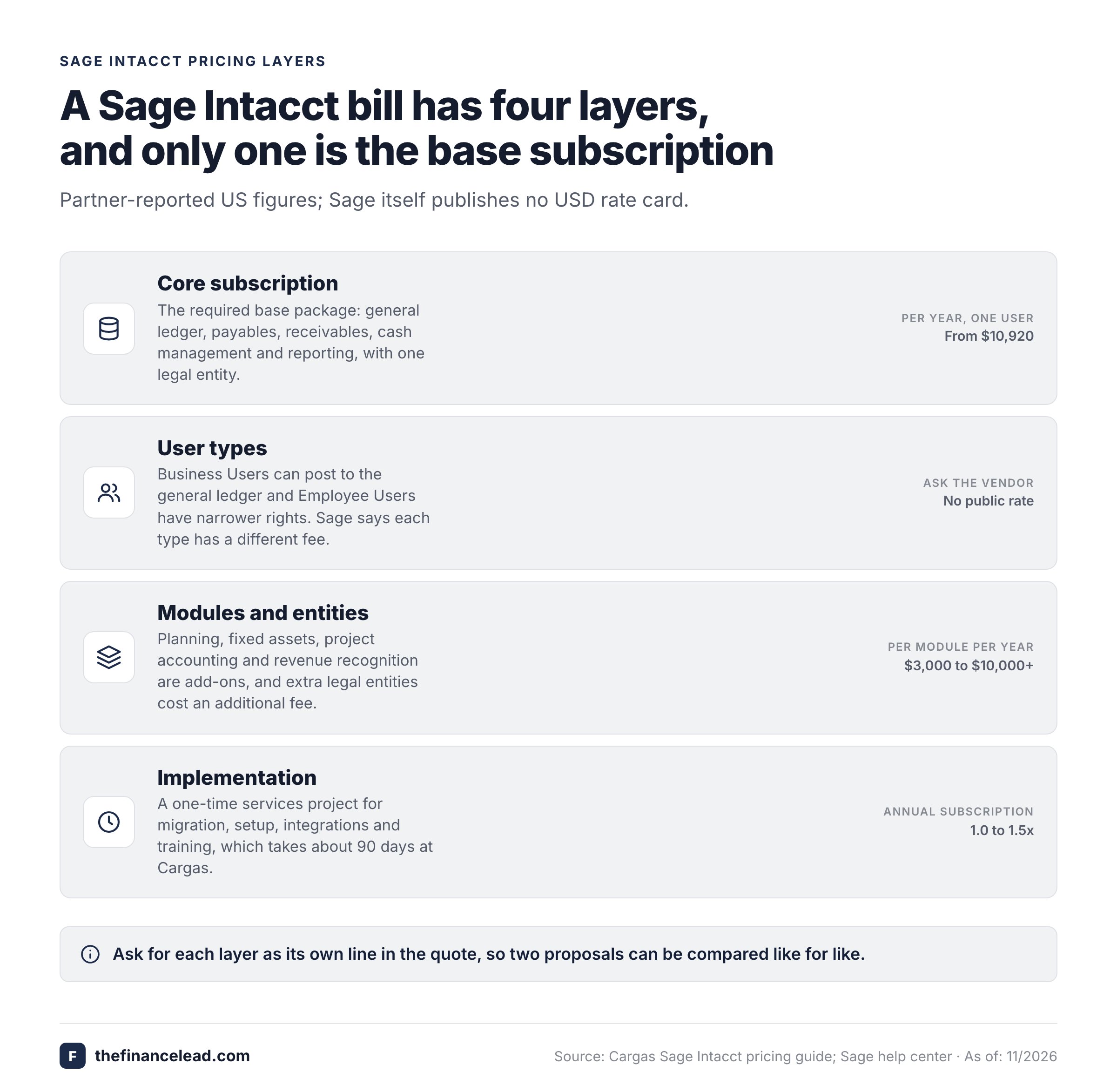
- Core Financial ManagementFrom $10,920 per year, Cargas-reported, one Business UserPartner-reported
- Required base package: general ledger, payables, receivables, cash management, order management, purchasing, invoicing, dimensions, dashboards and reporting
- First legal entity is included
- Sage itself publishes no US rate
- Add-on modules$3,000 to $10,000+ per module per year, Cargas-reportedVaries by scope
- Planning, fixed assets, project accounting, revenue recognition and others
- Extra legal entities carry a separate fee
- Close Automation is a separate Sage subscription
- Implementation1.0 to 1.5 times the annual subscription, one time, Cargas-reportedSeparate services
- About 90 days on average at Cargas
- Migration, integrations and training depend on the statement of work
- Not a Sage guarantee
Sage asks US buyers to request pricing and shows no USD rate card. These figures come from the Cargas guide dated October 28, 2026, as read on November 1, 2026. Treat them as one partner's observations, not a Sage offer.
Is there a monthly Sage Intacct price?
A monthly equivalent is useful for budgeting, but it isn't evidence of a month-to-month contract. Dividing Cargas's $10,920 annual starting point by twelve produces $910 per month equivalent. Dividing its reported $20,000 to $35,000 annual average produces roughly $1,667 to $2,917 per month equivalent. These are arithmetic conversions of partner figures, not monthly Sage plans or payment terms.
Ask whether your contract bills annually in advance, annually in installments or on another schedule. Also ask what happens to unused licenses when staff change roles. A cash-flow forecast needs actual payment dates, not just an annualized headline.
Why do websites report different per-user prices?
Different websites combine unlike components, so the totals aren't comparable. One may divide a whole subscription by the number of finance users. Another may quote an incremental user license without the core subscription. Others mix employee access, full posting rights, negotiated discounts and implementation into a single number.
Sage's help center confirms the underlying distinction: Business Users can directly affect the general ledger, while Employee Users can perform narrower activities such as entering expenses or timesheets. Sage also says that different fees apply to user types and directs customers to their account manager for details. A rate labeled simply “per user” is therefore plainly incomplete unless it names the role, included modules and base fee.
What is included in the core Sage Intacct subscription?
Cargas describes the required base package as Core Financial Management. Its listed components include general ledger, accounts payable, accounts receivable, cash management, order management, purchasing, invoicing and billing, dimensions, dashboards and reporting. Confirm the exact scope in your signed schedule, while remembering that labels on marketing pages don't replace contractual entitlements.
For a controller, the more useful question isn't whether a feature appears somewhere in the product catalog. It's whether the proposed configuration supports the close without another license, custom build or manual export.
| Controller requirement | Core versus extra scope to clarify | Acceptance test for the demo |
|---|---|---|
| General ledger and AP/AR | Included in Cargas's Core Financial Management description. | Trace an AP posting through the ledger and month-end reporting. |
| Dimensions and reporting | Core dimensions and dashboards are listed; some dimensions have subscription dependencies. | Run a department and entity view with the fields you will actually use. |
| Fixed assets | Cargas lists Fixed Assets among optional modules. | Show depreciation, additions and the reconciliation support. |
| Contract revenue | Sage's help documents a Contracts subscription and Revenue Management configuration. | Trace a contract amendment to its revenue schedule and posting. |
| Multi-entity consolidation | Extra entities and consolidation options require scope review. | Demonstrate elimination, currency translation and reviewer sign-off. |
| Close coordination | Sage documents a Close Automation subscription. | Show checklist owners, blocked tasks, evidence and approval history. |
| Integrations | External systems may require separate applications or services. | Demonstrate the exact data handoff and error recovery. |
Are revenue recognition and contract billing included?
Revenue recognition and contract billing aren't automatically part of the base subscription. Sage's Contracts documentation identifies Contracts as a subscription and explains its connection to Revenue Management. It also describes Standard and Advanced Revenue Recognition options. If you have recurring contracts, specify the required revenue schedules, modifications, multiple-element arrangements and audit evidence before you request a final price.
A sales demonstration that shows revenue recognition in a fully licensed demo tenant isn't proof that your proposed subscription includes it. Have the seller mark each demonstrated application as included, separately priced or excluded. Absolutely require the same treatment for the data migration and setup effort needed to make the workflow usable.
Does multi-entity accounting increase the cost?
Yes, multi-entity accounting can raise the bill. Cargas states that the first legal entity is included in the core bundle and additional entities have fees. Sage's consolidation documentation distinguishes Domestic, Global and Advanced Ownership Consolidation. It also states that enabling multiple base currencies adds a fee for a qualifying consolidation subscription.
For a company with a US parent and a foreign subsidiary, the important scope questions are entity count, base currencies, intercompany transactions, partial ownership and reporting currency. Ask for a demo that uses your own entity structure, not a generic consolidated dashboard. The cheapest quote for a single-entity company isn't comparable with a quote that includes multi-base-currency consolidation.
Are custom dimensions free?
Custom dimensions aren't necessarily free. Sage's Dimensions documentation says additional fees can apply to user-defined dimensions. It also notes that some standard dimensions depend on subscriptions such as Contracts, Fixed Assets or Projects. Before you sign, list every dimension that appears in your management reports and verify which subscriptions unlock it.
A dimensional reporting requirement can quietly become an implementation project when the chart of accounts, project codes and reporting hierarchy aren't designed in advance. Put dimension design, migration mapping and report acceptance in the implementation scope, since they're easy to forget.
What does Sage Intacct implementation cost?
Implementation is a separate buying decision from the software subscription. Cargas says its implementation typically costs $1.00 to $1.50 for each $1.00 of annual subscription. It also says its average implementation takes about 90 days. These are partner observations, not Sage guarantees, and a complex deployment may still differ substantially.
An implementation statement of work should identify who owns the chart of accounts mapping, opening balances, historical transactions, entity setup, permissions, integrations, test scripts, report validation, training and cutover. If the quote says only “implementation services,” the controller can't determine what is actually delivered.
Example of a change-order trap: The project scope includes importing trial balances but excludes historical AP detail. The finance team discovers the omission during user acceptance testing. A later request to migrate vendor history is then a new paid project. The fix? Define the migration objects and sample records in the original statement of work.
Freeze the target configuration
List entities, currencies, posting users, employee users, applications and close requirements before requesting pricing.
Request itemized proposals
Ask each seller for annual software recurring charges and one-time implementation services as distinct totals, with all optional modules named.
Test your accounting scenarios
Demonstrate a real reconciliation, a revenue adjustment, intercompany elimination and final reviewer approval using sample data.
Calculate the multi-year commitment
Model software, implementation, integrations, support, renewal changes and planned new entities in the same worksheet.
Negotiate acceptance and renewal terms
Document milestone deliverables, change-order rates, cancellation notice, renewal caps and data-export assistance.
How can you estimate first-year and three-year cost?
Use a worksheet with recurring subscription, one-time implementation, third-party integrations and internal project work as separate rows. Don't hide setup fees inside a per-user monthly equivalent. The examples below show the calculation, and they aren't vendor quotes.
Scenario A: Entry configuration with two optional modules
Start with the Cargas-reported $10,920 annual entry configuration. For an illustration, add two optional modules using the partner's reported $3,000 to $10,000 annual range for each. That gives a $16,920 to $30,920 annual subscription before any other charges. Applying Cargas's 1.0 to 1.5 times implementation ratio produces a $33,840 to $77,300 first-year subtotal for subscription plus implementation.
This scenario leaves out additional user licenses, extra entities, integration subscriptions, taxes and internal staff time. It's a range built from a single partner's published inputs, not a prediction of what Sage will quote you. It's useful for showing which assumptions you'll replace with actual line items.
Scenario B: A typical partner customer, before extras
Use Cargas's reported average subscription band of $20,000 to $35,000 per year. At that partner's implementation ratio, the first-year software plus implementation subtotal is $40,000 to $87,500. That isn't a market-wide average total cost of ownership. It combines two Cargas observations and leaves out ongoing third-party costs and future changes.
You'll do better with your own itemized quote than with either scenario. A proposal with more included applications may be cheaper over time than a lower starting subscription that doesn't include critical close and consolidation workflows.
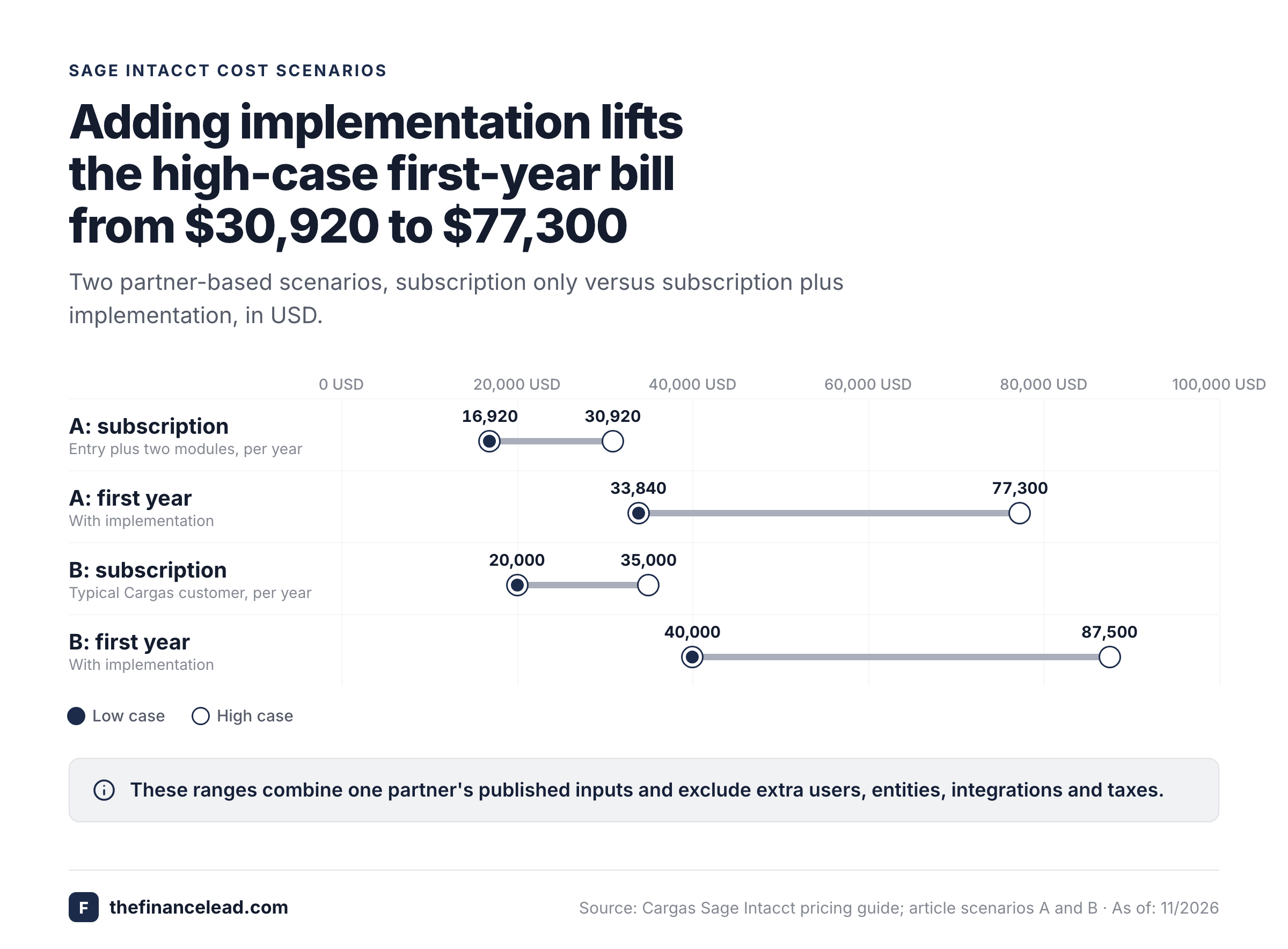
Built from the Cargas guide as of November 1, 2026. One Business User, one legal entity. Excludes extra users, extra entities, integrations, taxes and internal staff time. Your written quote controls the actual price.
A quote-normalization worksheet
| Line item | Proposal A | Proposal B | Controller check |
|---|---|---|---|
| Annual core subscription | Enter quoted USD | Enter quoted USD | Same modules and base entities? |
| Business User licenses | Enter count and total | Enter count and total | Same posting rights? |
| Employee access | Enter count and total | Enter count and total | Same access limits? |
| Extra modules | Itemize each | Itemize each | Same feature entitlements? |
| Extra entities/currencies | Itemize each | Itemize each | Same corporate structure? |
| Implementation, one time | Enter fee | Enter fee | Same migration and test scope? |
| Integrations and support | Enter annual cost | Enter annual cost | Same connectors and service level? |
| Renewal adjustments | Enter contractual formula | Enter contractual formula | Same cap and renewal notice? |
| Three-year modeled total | Calculate | Calculate | Include growth assumptions? |
For a simple static model, calculate three-year cost = 3 × annual recurring fees + one-time implementation + other one-time fees. Replace that formula with a year-by-year schedule if user counts, entities, support or renewal pricing won't stay flat. The formula is a budgeting framework, not a claim about Sage's renewal policy.
Illustrative math only: Suppose a hypothetical proposal has $24,000 in annual recurring charges, $30,000 in implementation and $6,000 in additional one-time work. Its first-year subtotal is $60,000 and its unchanged three-year subtotal is $108,000. Those inputs are invented to show the formula, and they're not Sage or partner price observations.
Which Sage Intacct costs are easiest to miss?
Budgets go wrong when teams compare software subscriptions while treating all implementation and add-on assumptions as equal. The risk is highest when a demo shows functionality that the initial quote doesn't cover.
User roles. Separate people who post to the general ledger from those who only submit expenses, timesheets or requests. Sage documents distinct user types with different fees. Confirm whether temporary implementers, auditors and integrations count as billable access.
Modules and dependencies. Cargas lists fixed assets, planning, project accounting, revenue recognition and global consolidations among optional applications. Sage's Contracts help describes subscription dependencies. Ask for a configuration map that includes prerequisites, not just the final feature names.
Entities and currencies. A subsidiary acquisition or new operating currency may change the required consolidation subscription. Price the planned organization, not only today's entity list. Request a written rule for adding and removing entities during the contract.
Data migration and report rebuilding. Historical detail, custom dimensions and management reporting can consume more services effort than importing opening balances. Define a reconciliation standard for migrated data and who signs off on it.
Integrations. Ask whether the quote includes the connectors and recurring subscriptions for payroll, expense management, banking, CRM or billing systems. An integration that appears in a product catalog may still require an outside vendor or custom work.
Close workflow. Sage's help center identifies Sage Intacct Close Automation as a subscription and provides setup steps for Close Assistant and Close Workspace. Don't assume a core financials license includes every close coordination feature demonstrated by the sales team. Ask for the entitlement and price in writing.
Renewal and exit. Record the initial term, auto-renewal notice, permitted increases, data export format and assistance fees. These are negotiation questions, not claims that Sage applies a particular default increase or cancellation window.
Is Sage Intacct worth the cost for a finance team?
Sage Intacct can be a credible candidate when your finance operation needs more than basic bookkeeping, especially complex dimensional reporting, multi-entity consolidation, contract revenue workflows and a structured audit trail. Sage's US product documentation describes these capabilities, but whether they're included depends on the purchased configuration.
It's a less straightforward purchase when your immediate pain is only tracking close tasks, evidence and reviewer sign-off. In that case, compare the cost of improving the close process with the cost of replacing or expanding the accounting system. Don't buy an ERP-scale implementation to solve a checklist problem unless the ledger itself also needs change.
The Finance Lead is a separate close coordination tool for small accounting teams. It tracks recurring tasks, evidence links and preparer/reviewer approval; it doesn't post journal entries, reconcile accounts or connect directly to an ERP. That makes it a different category of purchase, not a substitute for Sage Intacct's general ledger. That's the distinction that matters for your budget.
Here's a practical decision rule: write down the failure you need to fix. If your current ledger can't handle entity consolidation or contract accounting, evaluate the accounting platform. If your ledger is adequate but close work is late because owners, evidence and approvals are scattered, evaluate the close operating process first. Some teams will need both, with clear boundaries between them.
Which Sage Intacct scope fits which need?
Use this as a starting point for the quote request. Each row names the item to price separately.
- Single entity with core ledger and reportingRequest a core-only quote with the exact Business User and Employee User counts.
- Revenue recognition or contract billingPrice Contracts and its Revenue Management dependency, then watch the demo with your own contracts.
- Several entities or currenciesAsk for entity fees and the consolidation subscription in writing, for today and the planned structure.
- Fixed assets, planning or project accountingGet each module as its own line with prerequisites, not a bundled total.
- A tracked close with owners and approvalsConfirm whether Close Automation is in the quote and shown in the demo.
- Predictable renewalsRequire the renewal term, notice period and any increase cap in the order form.
What should you ask before signing a Sage Intacct contract?
Send the same written questions to each shortlisted reseller or implementation partner. Get the answers in the proposal, because verbal assurances from a demo won't hold up later.
- What is included in Core Financial Management? List every application, dimension, entity and report entitlement.
- How are users licensed? Distinguish Business Users, Employee Users and any other proposed access categories.
- Which close capabilities are included? Price Close Automation and show the workflow for task ownership, reviewer approval and exceptions.
- Which revenue modules are required? Name Contracts, revenue management options and their prerequisites.
- What does multi-entity cost today and after expansion? Model planned subsidiaries and currencies.
- Which integrations are included? Name connector providers, data directions, monitoring and recurring fees.
- What exactly is migrated? Specify opening balances, transaction history, master data, attachments and validation criteria.
- Who owns implementation risks? Identify the partner, deliverables, change-order process and acceptance milestones.
- What is the payment and renewal schedule? Record billing dates, term, notice, price adjustments and exit assistance.
- Can we test a realistic month-end close? Require an end-to-end example with preparer, reviewer, evidence and a corrected exception.
The strongest proposal isn't automatically the lowest price, but it's the one whose scope can be reconciled to the accounting requirements, tested in a demo and verified against the signed order form.
Frequently asked questions
Does Sage Intacct publish US pricing?
Sage's US product page requests a custom quote rather than displaying a standard public USD rate card. Ask for an itemized proposal.
What is the starting Sage Intacct cost?
Cargas, a Sage Intacct implementation partner, reports an entry annual subscription starting at $10,920 for one Business User and Core Financial Management. It's a partner figure, not an official universal US list price.
Does Sage Intacct charge per user?
User type is one cost factor. Sage documents different fees for Business Users and Employee Users, and subscriptions also depend on modules and entities.
Is implementation included in Sage Intacct pricing?
No, don't assume implementation is included. Request a separate services statement of work. Cargas estimates its implementation at one to one and a half times the annual subscription.
Is Sage Intacct Close Automation included?
Sage documents Close Automation as a separate subscription. Ask the seller to confirm whether your specific quote includes Close Assistant and Close Workspace.
Can I compare Sage Intacct with QuickBooks or NetSuite by monthly price?
Only after normalizing functionality, users, entities, implementation, integrations and the contract term. A simple monthly figure conceals important scope differences.