NetSuite vs Sage Intacct comes down to where your business complexity lives. Choose NetSuite, Oracle's cloud ERP, when inventory, orders and finance need one operational record. Choose Sage Intacct, Sage's cloud financial management platform, when dimensional reporting, multi-entity accounting and a finance-led system matter more than replacing your operating stack.
Don't buy either one as a small-business bookkeeping upgrade from a feature checklist alone. Both require a scoped quote, implementation planning and a controlled close migration. Base your decision on the same legal entities, users, transaction flows and reporting requirements, not on a generic price range.
 Choose NetSuite when operations drive accounting
- Inventory, order management and finance belong in one ERP
- OneWorld supports multi-subsidiary consolidation
- The period-close checklist can include inventory-specific dependencies
 Choose Sage Intacct when reporting drives accounting
- Dimensions keep management reporting flexible
- Multi-entity consolidation and intercompany accounting are central workflows
- A finance-first deployment can retain your existing operational tools
NetSuite vs Sage Intacct: what are the main differences?
NetSuite vs Sage Intacct is primarily a choice between a broad ERP and a finance-first platform. Both handle core accounting, consolidations and reporting, but their operational scope and the way finance teams organize analysis differ. Here's the practical test: the ledger either owns orders and stock itself, or it interprets data coming from other systems.
| Tool | Core scope | Consolidation | Reporting model | Operations scope | Close controls | US list price |
|---|---|---|---|---|---|---|
| Oracle NetSuite | Finance plus operational ERP | OneWorld and relevant accounting modules | Financial reports, dashboards and custom segments | Broad native order and inventory workflows | Period close checklist and subsidiary period locks | No universal public quote for your configuration |
| Sage Intacct | Finance-first, with optional extensions | Multi-entity and global consolidation capabilities | Transaction dimensions and configurable reports | Order management and operations extensions; scope must be quoted | Continuous GL, consolidation and Close agent | Customized quote from Sage |
A controller comparing NetSuite with Sage Intacct should separate transaction ownership from reporting ownership. If your sales order creates inventory movements, fulfillment, invoices and GL entries in the same system, NetSuite's broader scope has a tangible purpose. If you keep an established CRM and operational stack, Sage Intacct's dimensional ledger can make the finance layer more adaptable without forcing every team into a new suite.
Which is better for month-end close and audit evidence?
NetSuite and Sage Intacct can both support a disciplined month-end close, but the failure modes differ: in NetSuite the risk is trusting a completed checklist, in Sage Intacct it's assuming every demo feature is licensed. NetSuite's accounting-period workflow is tightly linked to the ERP ledger and subsidiary permissions. Sage Intacct emphasizes a configurable GL, multi-entity consolidation and close monitoring. Neither purchase removes the need for a preparer, a reviewer and evidence that the underlying work was done.
NetSuite: period-close dependencies and permissions
NetSuite's financial close management pairs its Intelligent Close Manager task plan with account reconciliation, consolidation and exception spotting. Oracle's help documentation describes a period close checklist and subsidiary-level locks in OneWorld, with access determined by role. That's valuable when the parent controller needs a consistent cutoff while local teams finish their books.
The checklist isn't just a decorative task list. Oracle documents dependencies between period-close tasks such as locking transactions, reviewing inventory, calculating consolidated exchange rates and eliminating intercompany balances. If you're inventory-heavy, test these dependencies with your actual warehouse cutoffs, not just a clean demo company.
Here's one subtle risk that deserves a live test: Oracle says Quick Close marks tasks complete without running them. A controller shouldn't treat a completed icon as proof that reconciliations or eliminations were performed. You'll still need a bank tie-out, open-item review, journal support and an explanation of late postings in your sign-off package.
Sage Intacct: dimensional GL and consolidation reviews
Sage Intacct's general ledger lets teams define workflows, use dimensions and consolidate entities while retaining drill-down visibility. Sage also describes its Close agent as tracking close tasks and flagging issues. Verify the specific agent entitlement, approval behavior and evidence export in the proposed package, and don't assume every demo feature is licensed.
For a service group, the question isn't merely whether consolidated financials appear. The reviewer needs to inspect an entity-level trial balance, an intercompany elimination, the resulting consolidated statement and the source transaction. Sage's multi-entity and dimension features make that a natural acceptance test, but it won't work unless the team configures the entity hierarchy and mappings correctly.
Finance sign-off rule: a closed accounting period and an approved close checklist aren't the same record. Define who owns each, how exceptions reopen work and what the CFO receives. Our month-end close process explains the dependency chain, while the month-end close template gives you a starting task structure.
How do NetSuite and Sage Intacct handle multi-entity consolidation?
NetSuite and Sage Intacct both support multi-entity consolidation, intercompany work and multiple currencies. NetSuite's OneWorld is designed to manage subsidiaries inside a wider ERP. Sage Intacct focuses on a multi-entity accounting structure and financial reporting. Don't let either one win just because a sales slide says real-time consolidation.
NetSuite's official financial consolidation page identifies OneWorld and Multi-Book as the relevant capabilities. Its OneWorld documentation also covers subsidiary-level period locks, which matters when the holding company and operating entities close at different speeds. Before signing, check the entities, books and countries in the quote against your actual ownership chart.
Sage's global capabilities page describes inter-entity transactions, eliminations and multi-currency consolidation. Its general ledger page also describes entity hierarchies and continuous consolidation. For a controller, what you'll want to test is how easily each system produces a board view and then drills back into a legal entity and transaction.
Use one controlled consolidation case in both demonstrations: a US parent, a foreign subsidiary, an intercompany charge, a currency translation adjustment and a post-close correction. Don't accept screenshots of a finished report. Ask the implementer to show the underlying journal, reviewer approval and the steps needed to rerun the group statement after an adjustment.
| NetSuite vs Sage Intacct test | What the controller should request | Pass condition |
|---|---|---|
| Subsidiary close | Separate entity cutoff and parent review | Permissions and reopen history are visible |
| Intercompany | Reciprocal balances and elimination entry | Exceptions reconcile to the same source |
| Currency translation | Local books and group currency report | Rate selection and adjustments are traceable |
| Consolidated report | Group total with entity drill-down | Reviewer can reproduce the balance |
| Late adjustment | Reopened period and refreshed reports | Downstream sign-offs are reconsidered |
Which has better financial reporting and dimensions?
Sage Intacct has a particularly explicit dimensional accounting model, while NetSuite provides financial reporting, dashboards and configurable analysis within its broader ERP. The better reporting system is the one that answers your management questions without rebuilding the chart of accounts or maintaining a shadow spreadsheet.
Sage's Dimensions feature lets teams tag transactions with values and then filter or group reports by those dimensions. Sage identifies location, department, project, customer, vendor, employee, item and class as examples. For a nonprofit or professional-services controller, that can reduce the pressure to encode every reporting slice into account numbers.
NetSuite's financial reporting documentation describes configurable reports, dashboards, custom fields and multidimensional analysis. The distinction isn't that NetSuite lacks dimensions. It's that the reporting design, license scope and configuration burden may differ. Have each vendor build the same project profitability report and reconcile its totals to the GL.
A good proof of concept uses three views of the same month: legal-entity P&L, department P&L and project margin. Change a department assignment on a test transaction, then check whether the three views remain consistent. If the report needs a manual export and reclassification each month, the reporting design isn't ready.
How much do NetSuite and Sage Intacct cost?
NetSuite and Sage Intacct don't publish a universal US price for a comparable mid-market configuration. NetSuite describes an annual license composed of a core platform, optional modules and user count, plus a one-time implementation fee. Sage says Intacct pricing is customized to the organization's needs and offers an annual subscription. Don't trust third-party dollar estimates until the vendor quotes your exact scope.
A useful comparison is a three-year total cost of ownership, not a single license line. Request the same functional baseline, number of full users, entities, currencies, integrations, environments, support levels and data-migration tasks from both vendors. The lowest license price isn't always the better deal if the close still needs custom exports or a second application.
- Annual core license and exact user roles
- Entity, subsidiary and consolidation entitlements
- Financial reporting, revenue recognition and multi-book modules
- Order, inventory and operational modules where required
- API access, integration middleware and sandbox access
- Implementation scope, data migration and test cycles
- Training, support, renewals and price increase terms
- Export rights, transition assistance and exit costs
A transparent three-year cost model
A three-year cost model should include subscription fees, implementation and ongoing integration support. Because neither vendor supplies a public quote for this exact scope, the example below uses illustrative procurement inputs, not vendor prices. Examples A and B are two hypothetical quote scenarios, not tied to either vendor. Replace every amount with a signed proposal before using the result in a decision memo.
| NetSuite vs Sage Intacct cost input (USD) | Example A (USD) | Example B (USD) |
|---|---|---|
| Annual subscription, illustrative | $42,000 | $34,000 |
| One-time implementation, illustrative | $65,000 | $48,000 |
| Annual integration and support, illustrative | $9,000 | $16,000 |
| Three-year modeled total, derived | $218,000 | $198,000 |
The arithmetic is three times the annual subscription, plus implementation, plus three times annual integration and support. Example A is $126,000 + $65,000 + $27,000 = $218,000. Example B is $102,000 + $48,000 + $48,000 = $198,000. These aren't quotes, benchmarks or a prediction that one platform is cheaper.
What integrations and implementation work matter most?
NetSuite and Sage Intacct both support integration, but their architecture creates different ownership decisions. NetSuite's SuiteTalk REST services can expose records and queries, while Sage Intacct has a REST API and integrations for finance-adjacent systems. The controller needs to budget for exception handling, reconciliation and support, not just the first successful data transfer.
Oracle's REST documentation covers SuiteQL queries through REST web services. Its SOAP roadmap also says that SOAP web services are scheduled to be unavailable with the 2028.2 release. If your existing ERP connectors use SOAP, make migration planning part of the implementation scope rather than accepting a vague integration checkbox.
Sage's developer portal says access to the Intacct REST API requires a web services developer license. Sage also documents Salesforce integration and order-management connections. A controller should ask which connector is vendor-supported, which is partner-built and which needs a separate subscription or support contract.
The most useful integration test is a failure: post a credit memo after the billing cutoff, replay an integration message and confirm the GL doesn't duplicate it. Then verify that the exception lands with a named owner and that the reviewer can identify what changed. A successful sync isn't the same as a controlled close.
Sage's US site says Intacct implementation typically takes 3 to 6 months, depending on scope and planning. That vendor statement isn't a guarantee for your company. Get NetSuite's timeline quoted against the same migration and process boundaries, and don't infer it from a generic implementation blog.
Which platform should different finance teams choose?
NetSuite is the stronger shortlist candidate when finance must share transactional ownership with inventory and fulfillment. Sage Intacct is the stronger shortlist candidate when a finance-led organization values dimensional analysis, consolidations and integration with existing operational systems. The final choice should follow the workflows you can reproduce, not a blanket winner label.
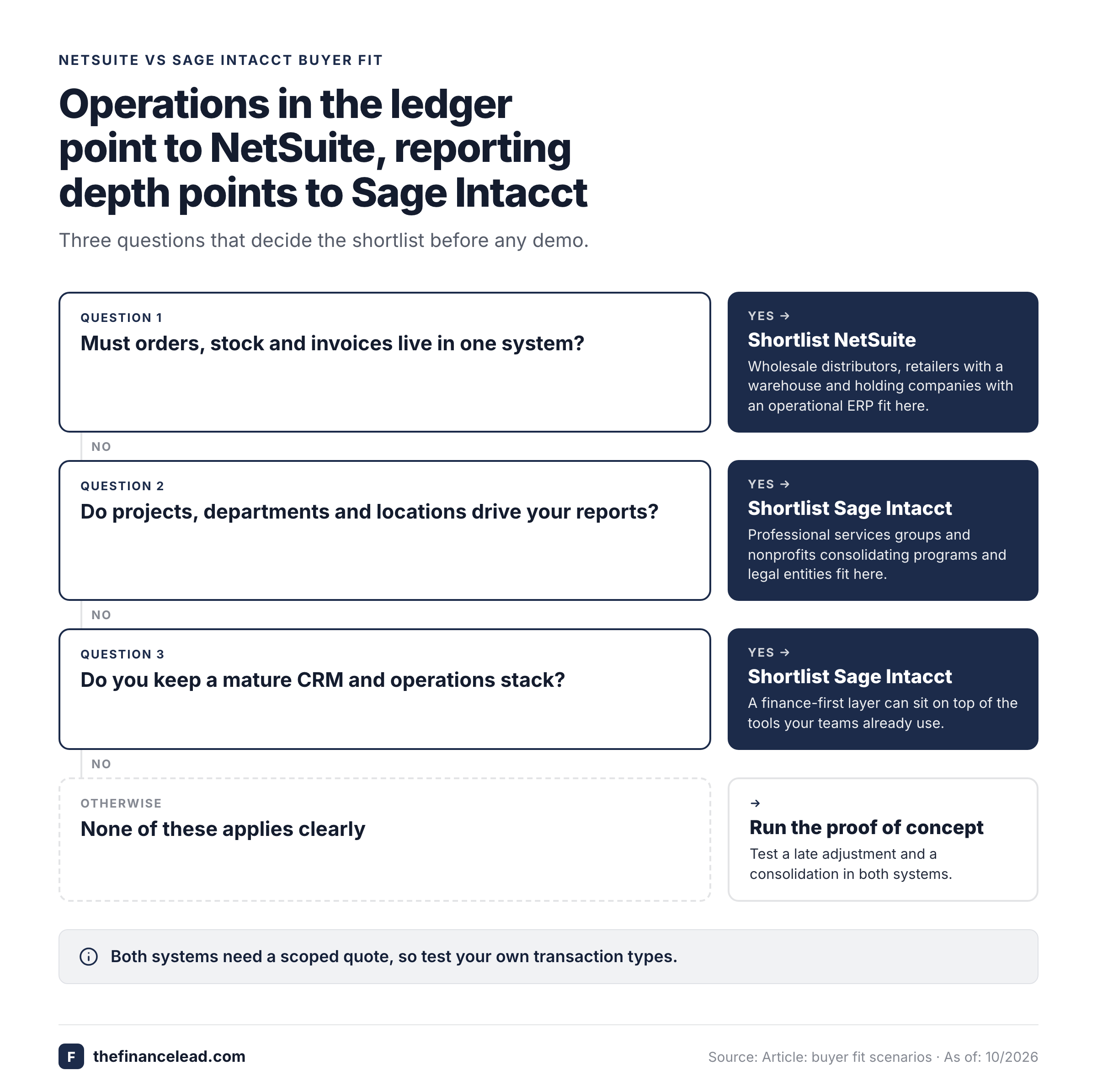
- Wholesale distributor needing sales orders, stock and GL in one systemOracle NetSuite
- Multi-entity professional services group prioritizing project and department reportingSage Intacct
- Retail business with warehouse and ecommerce process redesignOracle NetSuite
- Nonprofit consolidating programs, locations and legal entitiesSage Intacct
- Holding company with complex subsidiary close and operational ERP needsOracle NetSuite
- Finance team retaining a mature CRM and specialized operations stackSage Intacct
NetSuite: a practical buyer fit
NetSuite is an ERP platform for businesses that need finance and operational transactions to stay connected. Its native financial management connects to order management, inventory and CRM, while OneWorld handles multiple subsidiaries. That's a meaningful fit when sales orders, physical stock and invoicing must reconcile without several independent data models.
A distributor might start with a purchase order, receive inventory, fulfill a customer order and post the invoice. The controller can then inspect the transaction path through the books. The buying advantage isn't a prettier dashboard. It's the potential to keep fulfillment and finance aligned without maintaining a separate inventory ledger.
The trade-off is scope discipline. NetSuite has optional modules and implementation costs, so a buyer can easily price capabilities the accounting team won't use. Ask the seller to identify which workflows are in the core platform, which depend on OneWorld and which require additional modules. A standard demo shouldn't substitute for a configured pilot using your transaction types.
NetSuite's period-close checklist also deserves scrutiny. Your controller should test task dependencies, period locks and approvals with a late adjustment. Skip a broad ERP migration if your only problem is collecting close evidence and reviewing journal support.
Sage Intacct: a practical buyer fit
Sage Intacct is a financial management platform for organizations whose reporting needs are more complex than their physical operations. Its dimensional general ledger lets finance tag and report on projects, locations and departments without hard-coding every combination into account numbers. Multi-entity accounting and consolidations are central parts of its value.
A professional-services controller could track revenue by customer, costs by project and results by legal entity. If those reports tie back to the same transactions, the team can prepare board reporting without maintaining a parallel workbook. It's easier to assess that value through a live reporting exercise than through a checklist of generic ERP features.
Sage Intacct isn't limited to a bare ledger. Sage advertises order management, inventory control and newer operations extensions. Still, buyers should insist on a module-by-module demonstration, because an add-on shown in a marketing tour isn't automatically included in the core subscription. The vendor quotes pricing rather than publishing one universal US amount.
Sage's developer portal adds a less obvious consideration: the REST API requires a web services developer license. If your close depends on billing, payroll or CRM feeds, put that entitlement and the integration owner in the proposal. Skip a finance-first design if replacing the operating stack is your primary goal and integration maintenance would recreate the fragmentation you're trying to eliminate.
How should a controller run the final selection?
A controller should select NetSuite or Sage Intacct only after both vendors complete the same close-and-reporting proof of concept. The pilot should include a late adjustment, a consolidation, an approval and a reproducible management report. Use a written scoring sheet and call out what isn't supported before negotiations.
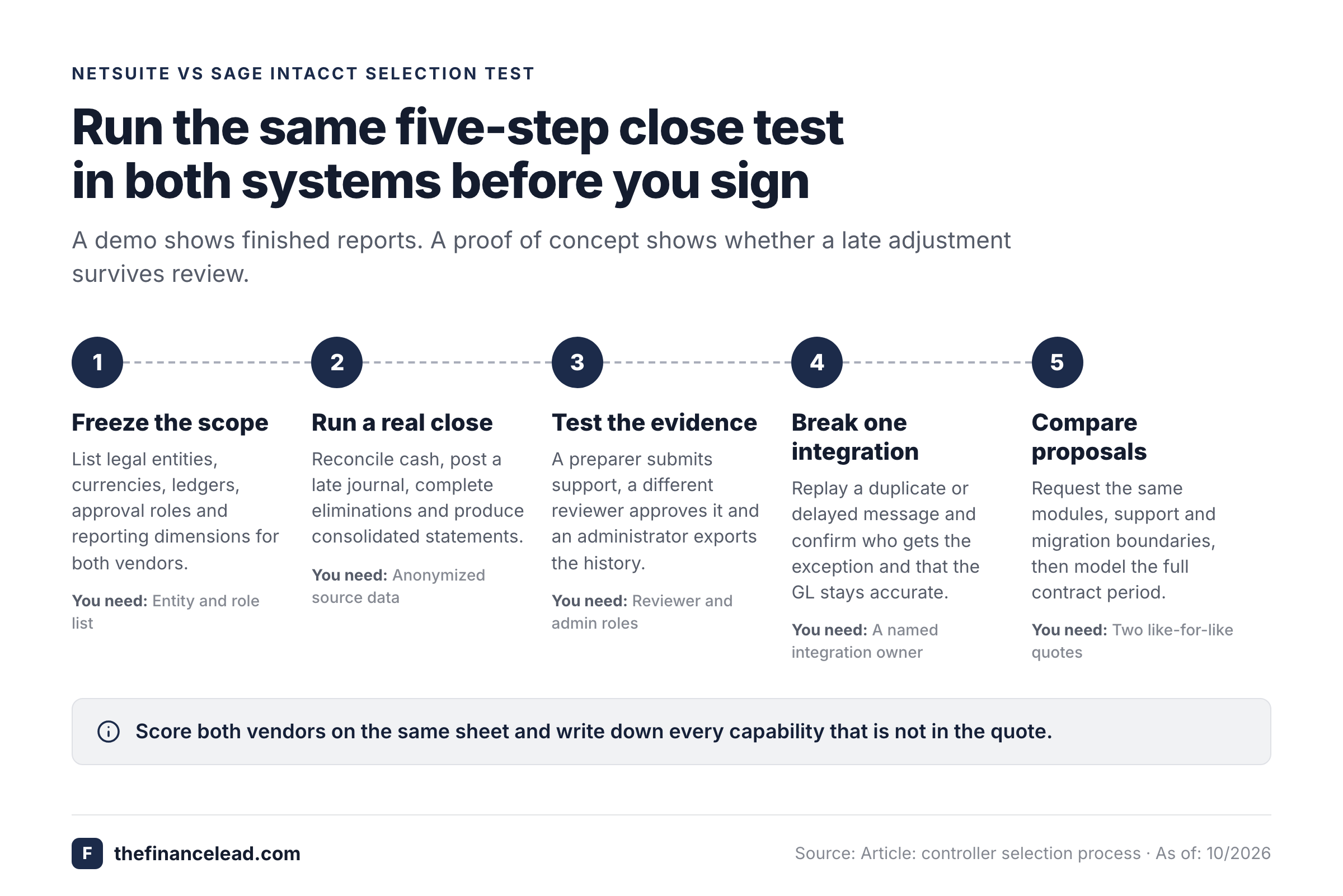
Freeze the accounting scope
List legal entities, currencies, ledgers, approval roles, reporting dimensions and transaction sources. Separate mandatory workflows from nice-to-have modules.
Run one real close scenario
Use anonymized source data to reconcile cash, process a late journal, complete intercompany eliminations and produce consolidated statements.
Test evidence and segregation
Have a preparer submit support, a different reviewer approve it and an administrator export the history. Confirm reopened items invalidate the relevant sign-off.
Exercise one failed integration
Replay a duplicate or delayed message. Confirm who receives the exception, what's logged and whether the GL remains accurate.
Compare complete proposals
Request the same modules, support, integrations and migration boundaries, then model the full contract period and renewal exposure.
For teams that don't need another ERP, our own product, The Finance Lead, is a separate close coordination tool for recurring checklists, evidence links and preparer/reviewer sign-off. It doesn't post journals, reconcile accounts or connect to a general ledger. That narrower workflow may be enough when your accounting platform is sound but the review trail is scattered.
What should finance leaders remember before signing?
NetSuite vs Sage Intacct should be decided on the system boundary, not a universal winner. NetSuite makes more sense when the ERP owns both operations and finance. Sage Intacct makes more sense when finance needs flexible dimensions and consolidation while operational systems stay in place. Both still need a close-control design, a priced implementation scope and a tested exit path.
Is NetSuite better than Sage Intacct for inventory businesses?
NetSuite is often a better fit for inventory-heavy businesses because its ERP connects finance with order and inventory workflows. Sage also offers operations extensions, so test your required warehouse processes before deciding.
Does Sage Intacct support multi-entity consolidation?
Sage Intacct supports multi-entity and multi-currency consolidation with intercompany capabilities. Ask the seller to demonstrate your entity hierarchy and confirm the required modules in the quote.
Is Sage Intacct cheaper than NetSuite?
Sage Intacct isn't automatically cheaper than NetSuite. Both require scoped quotes, and the right comparison includes subscriptions, implementation, integrations and renewals.
Can NetSuite close accounting periods by subsidiary?
NetSuite OneWorld supports subsidiary-level period locks subject to role permissions. A controller should test reopen behavior and verify that completed checklist tasks have actual evidence.
How long does Sage Intacct take to implement?
Sage's US site says Sage Intacct implementation typically takes 3 to 6 months, depending on scope and planning. Your contract should specify the data migration, integrations and acceptance tests.
Do either NetSuite or Sage Intacct replace a close sign-off tracker?
NetSuite and Sage Intacct both provide close-related workflows, but your team still needs evidence and approval rules. A separate close tracker can coordinate reviewers when the ERP isn't the source of task ownership.