FloQast vs BlackLine comes down to what you're trying to fix. FloQast is a close management platform built around the checklist, reconciliation sign-off and review work your accounting team already does, with AI matching and a controls layer added in separate packages. BlackLine is a broader record-to-report suite sold module by module, with its deepest strength in high-volume reconciliation, transaction matching, journal entries and consolidation. Neither publishes a price list. Both are rated 4.5 or higher on G2. The better fit depends on where your close actually breaks.
If the problem is coordination (nobody sees who owns which task, sign-offs live in email, evidence is scattered), start with FloQast. If the problem is volume and complexity (thousands of reconciliations, bank and payment files that need rule-based matching, consolidation across many entities), BlackLine belongs in the first demo. We read vendor material and G2 data for this comparison and did not run either product.
 Shortlist FloQast when coordination is the pain
- The close checklist, reconciliations and review notes need one shared view
- No per-user fees, so a growing close team doesn't raise the bill by headcount
- Lower reported median spend in buyer data ($24,663 a year versus $40,125)
 Shortlist BlackLine when volume and scope are the pain
- High-volume transaction matching feeds reconciliations and adjusting journals
- Consolidation, journal entry and risk analysis sit on the same platform
- Built for large account populations, with a steeper setup to match
- FloQast G2 rating, 1,424 reviews
- 4.6
- BlackLine G2 rating, 1,073 reviews
- 4.5
- FloQast median a year, Vendr
- $24,663
- BlackLine median a year, Vendr
- $40,125
What are the main differences between FloQast and BlackLine?
The main difference is scope and starting point. FloQast starts from the close itself: the checklist, the reconciliation review and the sign-off trail, with AI agents and a risk and controls package available on top. BlackLine starts from the accounting data: it ingests ledger, bank, payroll and subledger data, matches it by rule, reconciles it and pushes adjusting entries back to the ERP, then adds task management, consolidation and compliance around that core.
| Tool | Core idea | Reconciliations | Transaction matching | Consolidation | Controls | Pricing model |
|---|---|---|---|---|---|---|
| FloQast | Close management: checklist, reconciliations, projects | Preparer and reviewer sign-off, tie-out to support, tracked reconciling items | AI Matching in the Close AI package | No separate module listed on its close pages | Risk & Compliance package | Quote only, no per-user fees |
| BlackLine | Financial close and consolidation suite with separate modules | Auto-reconciliation rules, templates, Verity Prepare for preparation | Rule-based matching module for bank, ERP, payroll and revenue data | Dedicated module with intercompany eliminations and top-side adjustments | Compliance module for control testing and issue tracking | Quote only, module based |
Read that table as a starting hypothesis, not a verdict, and don't treat a missing mention as a missing feature. Vendor pages describe what a product is designed to do. They don't prove how it'll behave on your data, and neither vendor lists every capability on its marketing pages. A feature that's missing from a landing page can still exist in a module you haven't been shown, which is why the demo script later in this guide matters more than the table.
Here's the split in one sentence for a controller: FloQast organizes the people doing the close, and BlackLine automates the data work underneath it. Many teams need that first layer long before they'd need the second.
How does FloQast approach the month-end close?
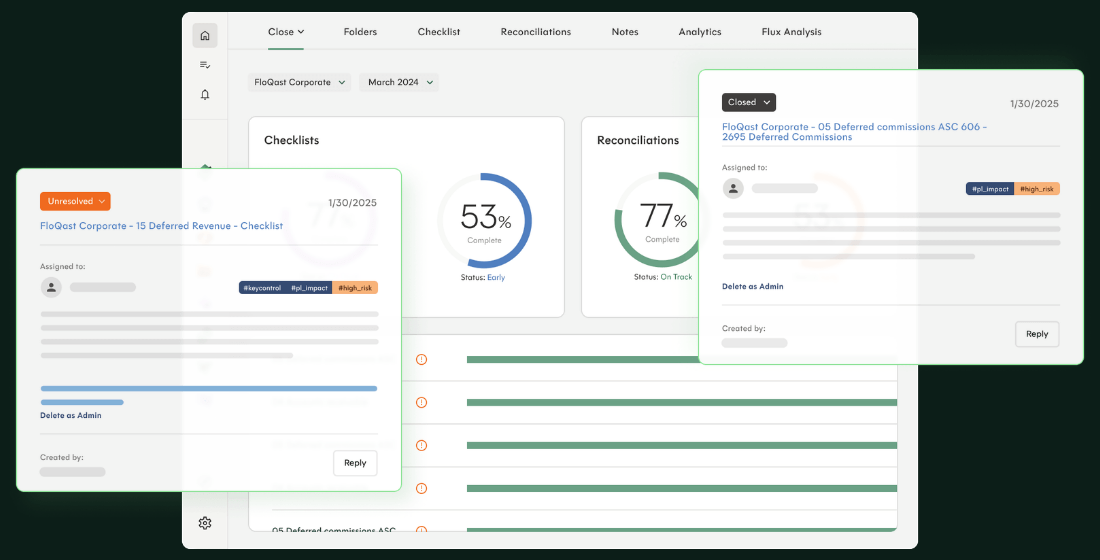
FloQast's Close Management package is built around the checklist, and the company says more than 3,500 companies use it. Its product page describes tasks tracked by owner, entity, duration, dependencies and due date, dashboards that flag at-risk tasks, and checklists that roll forward automatically each period. Reconciliations sit in the same workspace, tied to supporting documents, with review and sign-off enforcement and a completeness check before the books close.
Two other parts of the package matter for a comparison. Accounting Operations extends the same checklist logic to work outside the close, such as accounts payable, compliance, FP&A and reporting, with dashboards for each. Projects tracks one-off initiatives like system implementations, audits and acquisitions. FloQast also lists an AI Assistant that answers questions from your close records and follows existing permissions.
FloQast's product page cites one finance team that cut its month-end close from 14 days to 4. That's a single vendor-selected example, not a benchmark. FloQast's own material describes its reconciliation approach as working with the Excel workbooks accounting teams already use, tying them to the general ledger rather than replacing them. That's attractive if your team reconciles in spreadsheets today and doesn't want to rebuild every schedule just to get a controlled sign-off layer. It also means the depth of automation depends on which package you buy, so it isn't one product.
Close AI: where FloQast adds automation
Close AI is a separate package, but it includes everything in Close Management. FloQast lists seven named capabilities. They are AI Matching for three-way and high-volume transaction matching, automated reconciliations for amortization, depreciation and subledgers, journal entry management that prepares, approves and posts entries, AI-drafted variance explanations, anomaly detection across the general ledger and COSO-aligned AI governance.
The page says the governance wrapper means AI use "will pass audit." Treat that as a vendor assertion, not an audit opinion, and ask your auditors what evidence they'd expect for an AI-prepared reconciliation before you rely on it.
How does BlackLine approach financial close and consolidation?
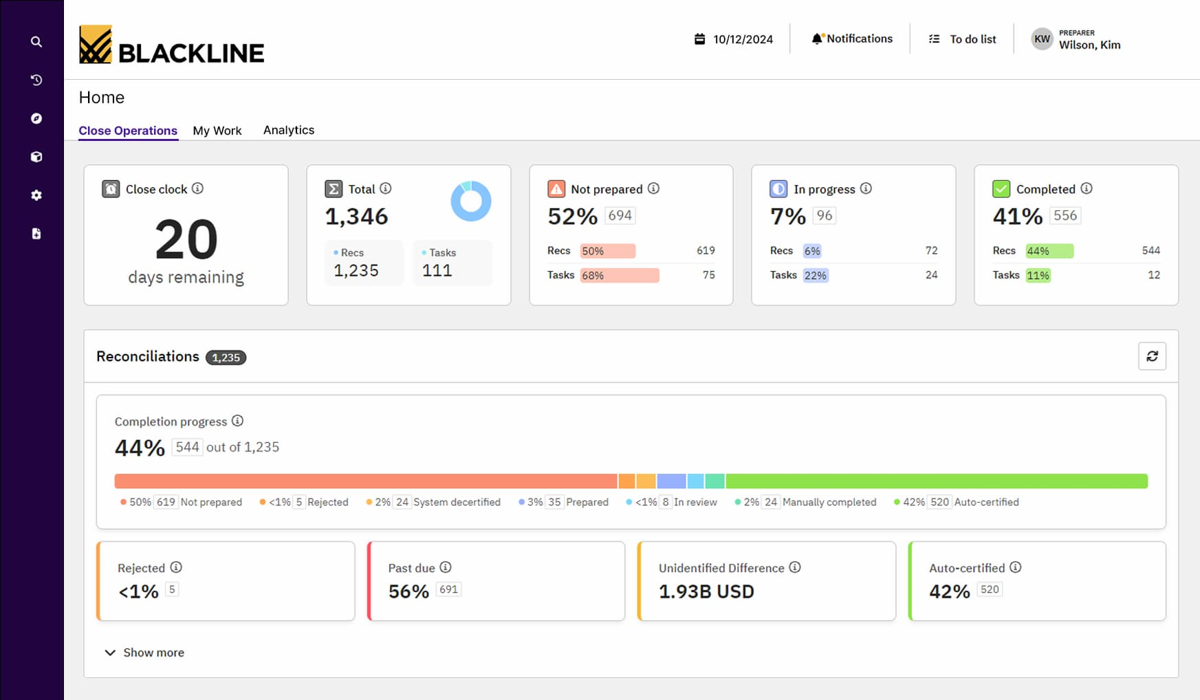
BlackLine describes an end-to-end financial close and consolidation solution whose product page lists eleven named sections, from Account Reconciliations to Compliance. Account Reconciliations covers loading supporting items, auto-reconciliation rules, standardized templates and real-time status dashboards. Transaction Matching ingests high volumes of data from ERPs, banks, payroll providers, revenue systems, lease accounting and procurement, applies rule-based matching, sends reconciling items to reconciliations and can create adjusting journal entries from the results.
Around that core sit Journal Entry (create and post journals to the ERP with threshold-based approvals), a Journals Risk Analyser for anomaly detection across ERPs, Verity Accruals, Account Analysis, Reporting and Analysis, Consolidation, Task Management and Compliance. The Consolidation module covers balance aggregation, ownership interest calculations and intercompany eliminations. Task Management is described as a command center for thousands of tasks, and Vendr's data shows BlackLine implementation fees that can equal or exceed the first-year subscription. For SAP shops, Smart Close for SAP runs the close directly inside SAP.
BlackLine's Verity AI layer adds agents on top. Verity Prepare handles reconciliation preparation so reviewers spend time reviewing, and Verity Flux supports variance analysis. As with FloQast's AI, the useful question isn't whether the feature exists. It's how much review work it leaves behind on your own accounts.
Which is better for account reconciliations?
BlackLine has the deeper reconciliation engine on paper, with 4.5 out of 5 on G2 from 1,073 reviews, and FloQast has the simpler review workflow, with 4.6 from 1,424. However, if you reconcile a few hundred accounts and your main need is clean preparer and reviewer sign-off with evidence attached, both can do the job, and FloQast's narrower scope may be enough. If you reconcile thousands of accounts across entities and want low-risk accounts certified automatically by rule, BlackLine's reconciliation rules and templates are aimed squarely at that.
Don't test with one clean account. Test with three types. Use a straightforward balance sheet account, an account with a rollforward and an account with a long list of unmatched items. For each, ask the vendor to show the data load, preparation, reviewer assignment, sign-off, a late adjustment after sign-off and the evidence trail an auditor would pull. Our guide to account reconciliation software covers the wider category, and the bank reconciliation software roundup helps if bank data is your main volume driver.
Which handles transaction matching and journal entries better?
BlackLine is the clearer choice for rule-based transaction matching at volume, because Transaction Matching is a named, standalone module with data ingestion, match rules and automatic journal creation. FloQast offers AI Matching inside Close AI, which is part of the AI package rather than the base one. If you match bank, card, payment processor or intercompany files with many lines per period, put both in a proof of concept and compare the exception queue, not the match rate.
Instead of asking for a match rate, ask each vendor what happens when identifiers are inconsistent, when a source file arrives late and when a correction requires a rerun. Don't accept a slide as the answer. A headline automation percentage tells you little. The work left for staff after matching tells you most.
Journal entries follow the same pattern. BlackLine describes journals generated from reconciliation items, from matching results, as consolidation top-side entries or from raw data feeds, posted directly to the ERP with approvals. FloQast's Close AI lists journal entry management that prepares, approves and auto-posts entries. Insist on a demonstration of your own approval matrix and segregation-of-duties rules in either product, not a generic approval flow.
What about consolidation, intercompany and SOX controls?
BlackLine documents consolidation as its own module and FloQast's close pages list none, so a multi-entity group that needs consolidation automation should start with BlackLine unless FloQast's sales team can show an equivalent on your entity structure. For a deeper look at the category, see our roundup of financial consolidation software.
Controls, however, are a closer call, and you shouldn't settle it from a feature list. FloQast's Risk & Compliance package covers financial controls for SOX scoping and testing, audit readiness with evidence collection and issue remediation, enterprise risk management and operational audits. It can be bought alone or with any Close package. BlackLine's Compliance module centralizes risk and compliance tasks, control testing and reporting with role-based permissions and segregation of duties. FloQast's Risk & Compliance package lists four areas (financial controls, audit readiness, enterprise risk and operational audits). If SOX is on your plate, compare both against the dedicated tools in our SOX compliance software list before assuming a close vendor is the right home for controls.
Which integrates better with your ERP?
FloQast names six ERP families as supported: NetSuite, SAP, Workday, Microsoft, Sage Intacct and Xero. BlackLine's close pages name SAP prominently, including Smart Close for SAP, and describe ingestion from ERPs, banks, payroll, revenue, lease accounting and procurement systems. Still, neither page replaces a technical check, and you'll need one against your exact ERP edition.
That check should be specific: establish whether each connection is a scheduled file exchange, an API, a managed connector or a custom build, who owns the fix when a load fails and how duplicates are prevented after a rerun. Post a corrected balance after the initial import and see how each platform treats it. A connector name alone doesn't establish implementation readiness. Smaller teams on Xero or QuickBooks shouldn't assume support, so confirm whether the platform they're considering works with their ledger at all: FloQast lists Xero, while BlackLine's pages name no QuickBooks or Xero connector.
How much do FloQast and BlackLine cost?
FloQast and BlackLine publish no prices. FloQast's pricing page lists three packages, Close Management, Close AI and Risk & Compliance, each ending in a Contact Sales button, and states "No Per-User Fees." BlackLine sells by module on quote. Our FloQast pricing guide covers the packages and what drives a quote in detail.
The best public benchmark is Vendr's buyer data, and it's imperfect. As of its February 2026 updates, Vendr reports a FloQast median of $24,663 a year with a range of $10,199 to $68,404 across 316 purchases, and a BlackLine median of $40,125 a year with a range of $13,154 to $101,000 based on 74 BlackLine purchases. Those are third-party figures drawn from deals Vendr saw. They aren't vendor rates.
| Vendr buyer data (annual contract value) | Low | Median | High |
|---|---|---|---|
| FloQast | $10,199 | $24,663 | $68,404 |
| BlackLine | $13,154 | $40,125 | $101,000 |
At the medians, BlackLine runs about $15,462 a year higher, which is roughly 63 percent more than FloQast ($40,125 minus $24,663). Over three years of subscription alone that's $120,375 against $73,989, a gap of $46,386. Those deals don't share a scope, so this is a buyer-data illustration, not a like-for-like quote, and it excludes services. Vendr notes that BlackLine implementation fees for complex deployments can equal or exceed the first-year subscription, and that renewal increases are typically a few percentage points a year. Ask both vendors for a fixed-fee implementation scope and a written cap on renewal increases.
Because FloQast prices without per-user fees, adding preparers and reviewers doesn't raise the bill by headcount. FloQast hasn't named its pricing variables, but Vendr's buyer data points to entities, modules and term, so ask what limits apply and what happens when you pass them. For BlackLine, Vendr lists modules, entity count, transaction volume, users, term and services as the pricing drivers.
- License metric, included entities and users
- Selected modules or packages, listed one by one
- Implementation services as a fixed-fee scope
- Integration and connector work for your ERP
- Training, support tier and administrator expectations
- Renewal increase cap and term length
- Cost of adding entities, modules or transaction volume later
- Export rights and exit terms
What do G2 reviewers say about each platform?
FloQast and BlackLine both score well on G2. FloQast has 4.6 out of 5 from 1,424 reviews and BlackLine has 4.5 from 1,073, a gap too small to decide anything. The themes do, though, and they're worth reading. FloQast reviewers praise ease of use and a more organized, visible month-end close, and the common complaints are limited report customization and slow performance on bulk edits or at peak times. BlackLine reviewers credit it with centralizing close activities and automating reconciliations, and the recurring complaint is a steep learning curve with complex implementation and configuration.
That pattern fits what you'd expect from the product shapes. A lighter coordination layer is easier to adopt, while a broader automation suite takes more setup and often a dedicated administrator. If you can't staff an owner for the platform, you shouldn't ignore setup effort. Weigh the configuration burden as seriously as the feature list.
FloQast
A close management platform that runs the month-end checklist and balance sheet reconciliations on top of the Excel workbooks a team already uses. Its Risk & Compliance suite adds SOX controls on the same platform.
Choose it when the close is a coordination problem: checklists, reconciliation sign-off and one view of status.
- your accounting team runs, or will run, the close in FloQast and you want control evidence captured from close tasks
- SOX is owned by the controller rather than a separate GRC or internal audit team
- you need broad IT and security GRC (SOC 2, ISO 27001) with identity and ticketing connectors: the integrations list is mostly ERPs, storage and chat
- you don't use FloQast for the close: much of the SOX value comes from evidence flowing out of close workflows
- Users like
- Ease of use and a more organized, visible month-end close (G2 summary themes)
- Users dislike
- Limited report customization and slow performance on bulk edits or at peak times (G2 summary themes and review excerpts)
- Source: G2, 1,424 reviews
- Starting price
- Quote only (no per-user fees)
- ERPs
- NetSuite, Sage Intacct, Workday, SAP, Microsoft, Xero
- Packages
- Close Management, Close AI, Risk & Compliance
- Workpapers
- Excel or Google Sheets in your own cloud storage
- Per-user fees
- None, per FloQast's pricing page
BlackLine
BlackLine is a cloud financial close and consolidation suite with separate modules for task management, account reconciliations, transaction matching, journal entry, reporting and analysis, consolidation and compliance. Its Verity AI layer adds agents such as Verity Prepare for reconciliation prep and Verity Flux for variance analysis.
Choose it when the close is a volume problem: thousands of reconciliations, matched transactions and multi-entity consolidation.
- You reconcile hundreds or thousands of balance sheet accounts across several entities and want rule-based auto-certification of low-risk accounts plus a full preparer and reviewer audit trail
- You run SAP, Oracle or NetSuite and have high transaction volumes (bank, card, intercompany) that need automated one-to-many and many-to-many matching feeding straight into reconciliations and adjusting journals
- You expect to add consolidation, intercompany and SOX control testing later and want them on the same platform as the close
- You are a 2 to 5 person team on QuickBooks Online or Xero: BlackLine is sold module by module on quote, Vendr's buyer data puts the median contract around $40,125 per year, and no QuickBooks or Xero connector is documented on BlackLine's pages
- You need to be live this month with little admin capacity: G2 reviewers repeatedly cite a steep learning curve and complex setup, and reviewers note it benefits from a dedicated admin
- Users like
- Centralizes close activities and automates reconciliations, cutting manual work
- Users dislike
- Steep learning curve and complex implementation and configuration
- Source: G2, 1,073 reviews
- Starting price
- Price not published (quote only)
- Close modules
- Task Management, Account Reconciliations, Transaction Matching, Journal Entry, Reporting and Analysis, Consolidation
- ERPs named by BlackLine
- SAP, Oracle, NetSuite
- AI
- Verity Prepare drafts reconciliations, Verity Flux supports variance analysis
- Modules
- Task Management, Account Reconciliations, Transaction Matching, Journal Entry, Consolidation
- Vendr median
- $40,125 a year (February 2026)
Which platform fits which team?
Match the platform to the problem you can measure, not the one the demo is built around. List recurring close tasks, material accounts, entities, source systems and review layers, then mark where time is lost. Late tasks with unclear owners point to coordination. Weeks spent matching files and chasing unmatched items point to volume, and that's a different purchase.
- Small accounting team moving a spreadsheet checklist and email sign-offs into one systemFloQast
- Controller who wants preparer and reviewer sign-off on reconciliations with Excel support still in useFloQast
- Company reconciling thousands of accounts and certifying low-risk ones by ruleBlackLine
- Shared services team matching high volumes of bank, payment or intercompany transactionsBlackLine
- Multi-entity group that needs consolidation and intercompany eliminations on the same platformBlackLine
- SAP-based finance team wanting the close to run inside SAPBlackLine
- Team that can't dedicate an administrator and wants a faster path to adoptionFloQast
Teams that want only a lightweight checklist with evidence links, and don't need either suite's reconciliation depth, shouldn't pay for a full suite. Our month-end close process guide shows the workflow either way, and the financial close software roundup lists alternatives to both vendors.
How should you run the proof of concept?
A good proof of concept uses a recently closed period with masked sensitive data. Run the same scenario in both products with the same participants and the same instructions. Include a late task, a reconciliation exception, a rejected approval, an updated source balance and a reviewer asking for evidence. Record elapsed time and manual handoffs, and note every workaround the implementation team needs.
Score each result as demonstrated, documented, promised or not verified, and don't give credit for a capability that sits in a module you haven't priced, even if it's impressive. Weight criteria by your own priorities, not the vendor's: close coordination, reconciliation workflow, matching, journal approvals, audit evidence, integration, security, administration and commercial terms. Separate pass-or-fail requirements, such as a required SOX control, from preferences so that a polished dashboard can't compensate for a failed control.
What should you ask about security and implementation?
Ask each vendor for current security documentation, a data processing agreement, incident notification terms, access control options, retention policies and subprocessor details. Test employee offboarding, because you'll want to confirm that revoking access doesn't wipe historical audit records. Check how permissions differ for preparers, reviewers, administrators and auditors, and how configuration changes are logged.
For implementation, ask for a phased plan, however small the rollout, that names customer and vendor responsibilities, testing milestones, training and acceptance criteria. A narrow checklist rollout isn't comparable to a rollout that changes matching, reconciliation policy and journal approvals, so you shouldn't compare their timelines or prices as if they were. Budget time for cleaning master data, a parallel close and a rollback plan for critical integrations.
What mistakes do buyers make when comparing them?
The common mistakes are treating product pages as contracts, mixing features across separately licensed modules and comparing a broad enterprise proposal with a narrow checklist deployment, which isn't a fair comparison. Another is letting only IT or only accounting evaluate the tools, when the controller, process owners, security, procurement and integration owners all have different questions. The last is deciding from a polished demo instead of a shared scope, evidence and a realistic deployment plan.
FloQast vs BlackLine: the final decision framework
Choose FloQast first if your central need is predictable ownership, task visibility and review coordination, you want pricing that doesn't scale with headcount and your team isn't looking to run a heavy implementation. Instead, choose BlackLine first if your central need is rule-based matching, heavy reconciliation volume, journal automation or consolidation, and you have the budget and administrator capacity for a broader suite.
Either way, make both vendors run your own scenario, put module scope in writing, compare itemized proposals over the same term and keep the decision open where evidence is missing.
Is FloQast better than BlackLine for a small finance team?
FloQast isn't automatically better for a small finance team. A smaller team usually values simple close coordination and a faster setup, which is FloQast's starting point. G2 reviewers report a steeper learning curve and more complex configuration for BlackLine. Transaction volume, entities and controls matter more than headcount alone, so don't pick on size.
Is BlackLine only for large enterprises?
BlackLine doesn't state a minimum company size. Its modules are built for high reconciliation and matching volumes, but Vendr's buyer data shows contracts from $13,154 to $101,000 a year. Ask BlackLine whether a scoped, smaller deployment fits your organization.
Can FloQast or BlackLine replace an ERP?
Neither FloQast nor BlackLine replaces an ERP. They both sit on top of your general ledger. FloQast names NetSuite, SAP, Workday, Microsoft, Sage Intacct and Xero as supported ERPs, and BlackLine ingests ERP data and posts journals back to it.
Which is cheaper, FloQast or BlackLine?
Neither publishes prices, though Vendr's February 2026 buyer data puts the FloQast median at $24,663 a year and the BlackLine median at $40,125, and your quote still depends on modules, entities and services. Request itemized proposals with identical scope.
Does FloQast charge per user?
No. FloQast's pricing page states "No Per-User Fees" and says pricing is built around value, not headcount. Ask whether entity, module or volume limits apply.
How long should a proof of concept take?
Run it across at least one full month-end close so that late tasks and exceptions actually occur, rather than using a clean demo file. Agree acceptance criteria with each vendor before you start.