Financial close software automates and organizes the month-end accounting cycle: the close checklist and its sign-offs, account reconciliations, transaction matching, journal entries, flux review and, for groups, consolidation across entities. Vendors bundle those jobs very differently, though. Some tools only run the checklist and tie your Excel reconciliations to the general ledger, others match millions of bank lines, and a few are full performance management suites where the close is one module next to budgeting.
We compared eight financial close tools for controllers and finance leads at small and mid-size companies: FloQast, Numeric, CloseCore, BlackLine, Adra by Trintech, HighRadius, OneStream and Prophix One. Every other "best financial close software" list we found in the search results for this query was written by a vendor that ranks its own product first. This one isn't, and our own product, a close checklist tool, sits outside the ranking as a marked row. For each tool we read the pricing page, the close product pages, a help or documentation page and its G2 reviews, all in October 2026.
- close tools compared
- 8
- publishes a price
- 1
- G2 reviews behind the ratings
- 3,273
- close jobs checked per tool
- 6
Our picks by situation
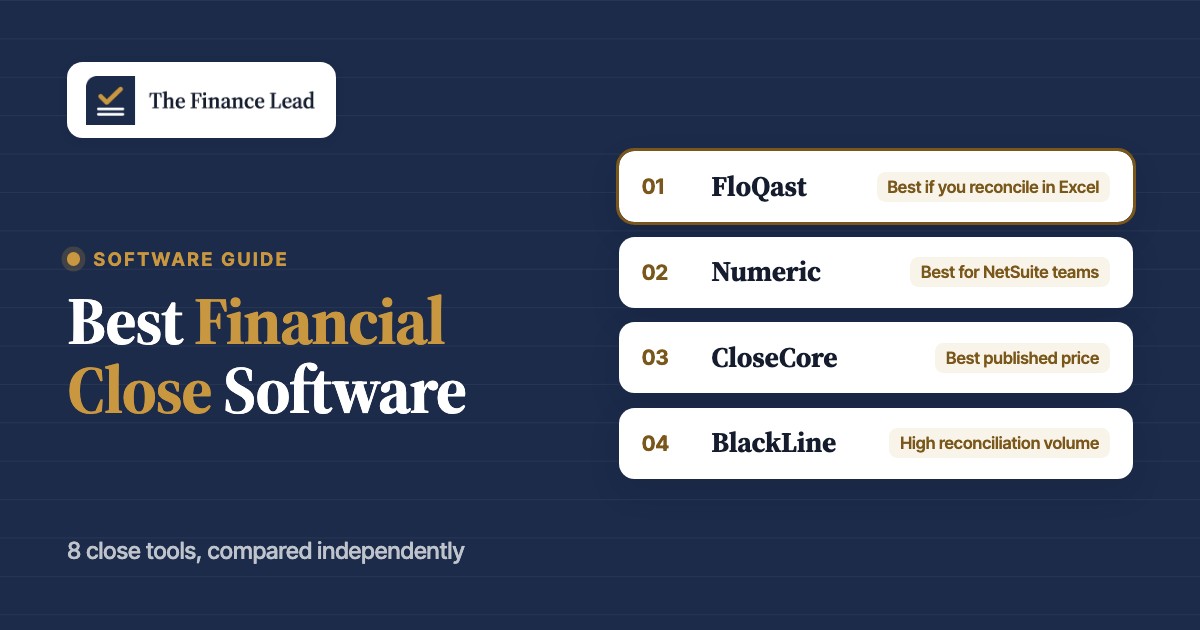
 Best if you reconcile in ExcelFloQastKeeps your workpapers in your own cloud storage and ties tagged ending balances to the ERP trial balance.
 Best for NetSuite teamsNumericTransaction-level NetSuite sync, live alerts when a reconciled account breaks and a documented MCP server.
 Best published price for small teamsCloseCoreChecklist and reconciliation tie-outs from $187.50 a month on annual billing, with a free trial.
 Best for high reconciliation volumeBlackLineAuto-certification of low-risk accounts and rule-based matching that feeds straight into journals.
 Best mid-market rec suite on NetSuite or DynamicsAdra by TrintechCertified connectors, threshold auto-reconciliation and multi-way matching.
 Best when consolidation is the hard partOneStreamClose, consolidation and reporting on one data model for multi-entity, multi-currency groups.
 Our product · for the checklist, not the ledgerThe Finance LeadClose checklist with evidence, preparer and reviewer sign-off and reminders, for teams of 2 to 8.
Financial close software compared
| Tool | Type of close tool | Close job it owns best | Pricing | G2 rating |
|---|---|---|---|---|
| FloQast | Close platform with SOX controls | Checklist and Excel-based reconciliation sign-off | Quote only (no per-user fees) | 4.6 (1,417) |
| Numeric | Close management and flux platform | Checklist, GL-tied reconciliations and AI-drafted flux | Price not published (quote only); pricing depends on transaction volume and seats | 4.8 (66) |
| CloseCore | Close checklist and reconciliation tool | Close checklist and reconciliation tie-outs to the ERP | $187.50/month billed annually ($250 monthly) for 5 users and 1 entity; Enterprise Close Automation by quote | 4.8 (11) |
| BlackLine | Enterprise close and reconciliation platform | Balance sheet reconciliations and high-volume transaction matching | Price not published (quote only) | 4.5 (1,068) |
| Adra by Trintech | Mid-market close and reconciliation suite | Threshold auto-reconciliation plus close checklist | Price not published (quote only) | 4.5 (333) |
 HighRadius | Agent-led record-to-report suite | Accruals, journal posting and matching inside the close checklist | Price not published (quote only); outcome-based model, no fees until go-live | 4.0 (2) |
| OneStream | Enterprise CPM platform with close and consolidation | Consolidation and reporting, with recs and matching on the same data | Price not published (quote only) | 4.6 (161) |
 Prophix One | FP&A suite with close and consolidation modules | Consolidation and intercompany, with reconciliation as a module | Price not published (quote only); AWS Marketplace lists $50,000 per 12-month unit for Close Management | 4.4 (215) |
| The Finance Lead Our product | Month-end close checklists | Tracks close tasks, evidence and preparer/reviewer sign-off | Team $39/month (up to 8 team members), Plus $79/month (adds MCP agent integration); 14-day free trial, no credit card required | No reviews yet |
Pricing and G2 data checked on October 19, 2026. G2 ratings cover each vendor's product listing; the HighRadius figure is its dedicated financial close listing, which has only 2 reviews.
What does financial close software do?
Financial close software is the system an accounting team uses to get from "the month ended" to "the books are closed and someone reviewed them." It replaces the close tracker spreadsheet, the folder of reconciliations and the email chains with one place that shows which tasks are done, which balances tie to the general ledger, what was adjusted and who signed off. The software covers six core close jobs.
- The close checklist holds recurring tasks with a preparer, a reviewer, a due date relative to month end and dependencies, and it rolls forward to the next period.
- Account reconciliations compare balance sheet accounts with the trial balance from the ERP, with supporting documents attached and a sign-off when they tie within a materiality threshold.
- Transaction matching clears high-volume accounts such as cash, cards or intercompany line by line against bank or subledger data before the reconciliation.
- Journal entries for adjustments, accruals and reclasses are prepared, approved and posted back to the ERP with an audit trail.
- Flux and variance analysis requires an explanation for month-over-month or budget-to-actual changes above a threshold before the controller signs off.
- Consolidation lets multi-entity groups eliminate intercompany balances, translate currencies and produce group statements.
A small accounting team rarely needs all six close jobs. A one-entity company on QuickBooks Online mostly needs the first two done reliably. A group with ten subsidiaries in four currencies spends most of its close on the last one. That's why the tools below cover such different ground, and why you should first decide which jobs hurt today.
What is close management software?
Close management software is the narrower part of the category: it organizes the month-end close checklist, owners, due dates, sign-off and supporting evidence, and usually ties reconciliations to the ledger, without running consolidation or planning. FloQast, Numeric and CloseCore are close management tools in this sense, and so is our own product at the checklist-only end. Financial close software is the broader term that also covers matching engines, journal automation and consolidation suites such as BlackLine, OneStream and Prophix One. In practice, though, buyers use the two terms for the same search, so it's worth asking each vendor which of the six jobs above it actually performs. If reconciliations are the hard part of your close, our guide to account reconciliation software compares seven tools by the reconciliation job each one owns.
Which close jobs each tool covers
We checked each job against the vendor's own product and help pages, not against competitor lists. "Higher tier" means the feature exists but sits in a separately priced package.
| Tool | Close checklist | Reconciliations | Transaction matching | Journal entries to ERP | Flux analysis | Consolidation |
|---|---|---|---|---|---|---|
| FloQast | Yes | Yes, Excel workpapers | Close AI package | Close AI package | Close AI package | Not documented |
| Numeric | Yes | Yes | Cash matching | NetSuite batch posting | Yes, AI-drafted | Not offered |
| CloseCore | Yes | Yes | Enterprise tier | Enterprise tier | Enterprise tier | Reporting only, no eliminations |
| BlackLine | Yes | Yes | Yes | Yes | Yes | Yes |
| Adra by Trintech | Yes | Yes | Yes | Yes | Yes | No, paired with Planful |
| HighRadius | Yes | Yes | Yes | Yes | Yes | Yes |
| OneStream | Yes, Task Manager | Yes | Yes | Yes | Not documented on close pages | Yes |
| Prophix One | Close command center | Yes | Yes | Not documented | Not documented on close pages | Yes, separate module |
| The Finance Lead (ours) | Yes, with evidence | No | No | No | No | No |
Where does each tool fit in the close calendar?
Each tool fits a different day of the close calendar. The coverage table lists features, and the calendar below shows the same coverage the way a controller lives it: a five-workday close, who usually owns each step on a small or mid-size team, and which tools in this guide do the heavy lifting for that step. The days are an example, not a benchmark, and your own calendar will differ. Our month end close checklist has the full task list behind it.
- ControllerRoll the checklist forward and publish due dates WD -2
- Staff accountantBook accruals and cut off payables WD 1
- Staff accountantMatch bank, card and intercompany transactions WD 1 to 2
- Senior accountantReconcile balance sheet accounts to the trial balance WD 2 to 3
- Senior accountantPrepare and post adjusting journal entries WD 3
- ControllerReview flux and sign off reconciliations WD 4
- Group controllerEliminate intercompany and consolidate entities WD 4 to 5
- ControllerLock the period and hand the close package to the auditor WD 5
In this calendar the checklist step and the final sign-off step are where small teams lose the most time chasing people, and they need the least software. The matching and consolidation steps are where close software saves real hours, but only once volumes are high enough to justify the setup.
What actually shortens the month-end close
Close software shortens the close when it moves work out of the closing days. It doesn't help much when it only adds dashboards. The vendors in this guide document four mechanisms that do this.
- Starting before month end works because recurring tasks roll forward with due dates relative to the period end, so accruals and cutoff tasks start on schedule instead of on day one. FloQast, Numeric and CloseCore all roll checklists forward automatically.
- Letting low-risk accounts certify themselves removes most routine sign-offs: BlackLine auto-certifies low-risk accounts against criteria you set, Adra Balancer auto-reconciles within variance thresholds, and OneStream's AutoRec rules can fully approve a zero-balance or no-activity reconciliation.
- Matching during the month spreads the work: OneStream runs transaction matching several times a day, and Numeric's transaction monitors flag duplicates and unusual balances before the close starts.
- Explaining only what moved keeps flux review short, since thresholds limit commentary to the accounts that changed more than you allow, and Numeric, FloQast's Close AI package and BlackLine's Verity Flux draft the first explanation.
Close management tools for small and mid-size teams
FloQast, Numeric and CloseCore start from the checklist and the reconciliation, connect to the ERPs smaller companies run (QuickBooks Online, Xero, NetSuite, Sage Intacct) and can be live in weeks rather than quarters. They differ, however, in where your workpapers live, how deep the ERP sync goes and what the price looks like.
FloQast
A close management platform that runs the month-end checklist and balance sheet reconciliations on top of the Excel workbooks a team already uses. Its Risk & Compliance suite adds SOX controls on the same platform.
FloQast fits a team that wants structure and sign-off around the Excel reconciliations it already trusts, rather than rebuilding them as web forms.
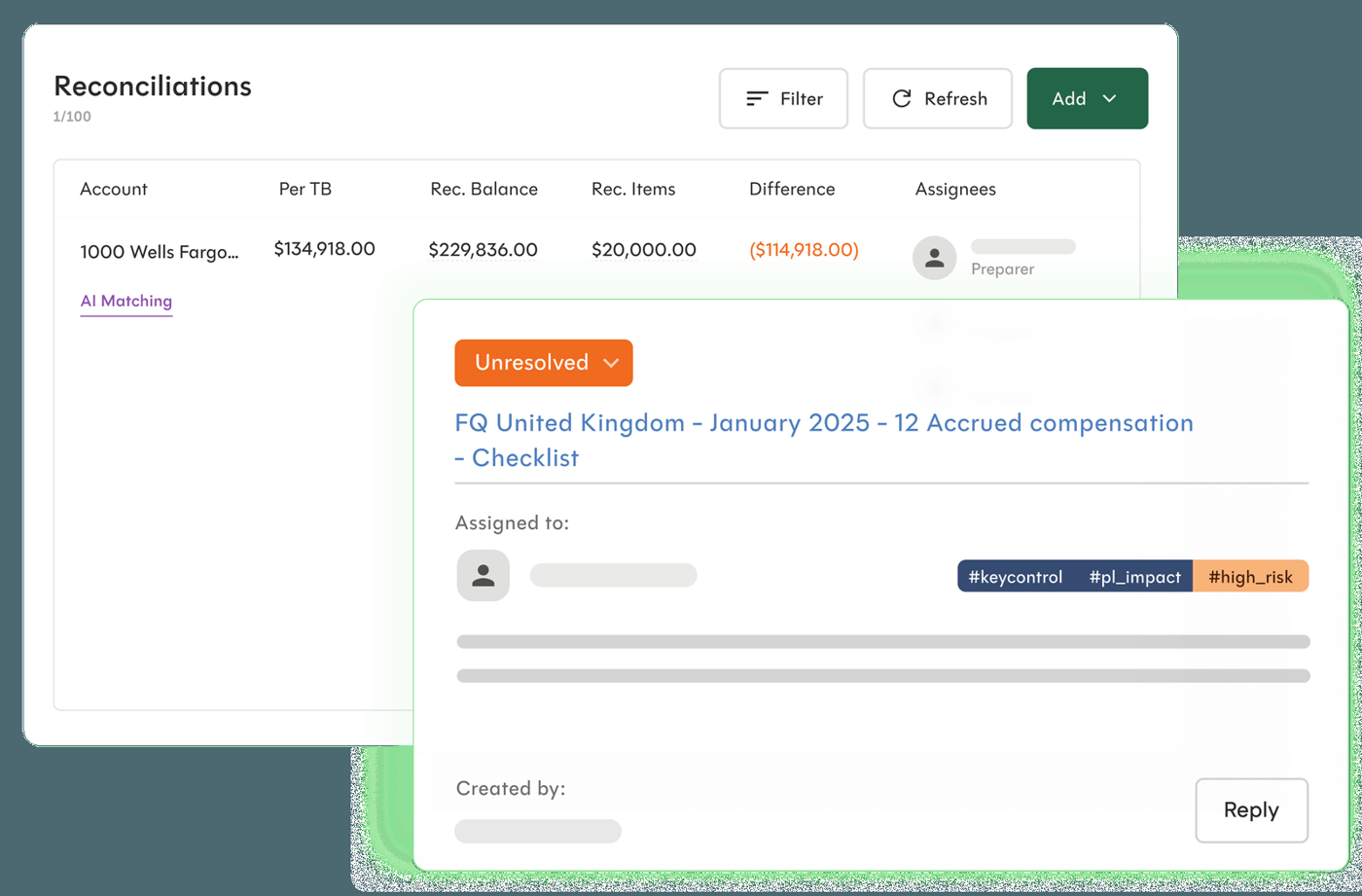
Your existing close checklist is loaded into FloQast and split into folders by process. Each item gets a preparer, a reviewer and a due date, and the checklist rolls forward every month. Reconciliations stay in Excel or Google Sheets in your own Box, OneDrive, SharePoint, Google Drive or Dropbox. A small #FQ tag next to the ending balance lets FloQast read the reconciled figure and show it beside the GL balance it pulls from the ERP. If the two tie within your materiality threshold the preparer signs off; anything else becomes a tracked reconciling item with an owner and an age.
The base package is Close Management. Journal entry management with auto-posting, AI transaction matching for bank and card accounts and AI-drafted flux explanations sit in the higher Close AI package, so check which package your quote covers. FloQast names NetSuite, SAP, Workday, Microsoft Dynamics, Sage Intacct and Xero as ERP integrations. QuickBooks Online isn't on the integrations page, although a help center article refers to QuickBooks Online balances. G2 reviewers put the average implementation at about two months.
- your reconcilers work in Excel or Google Sheets and you want tie-outs, sign-off and a completeness check without new workpapers
- you run NetSuite, Sage Intacct, Workday, SAP, Dynamics or Xero and want Slack or Teams alerts when a GL balance changes after sign-off
- you may add SOX controls later and want them on the same platform as the close
- you want a published price or self-serve start: all three packages are quote only
- you need journal posting and flux in the base product: both sit in the Close AI package
- QuickBooks Online must be a named direct integration
- Users like
- Ease of use and a more organized, visible month-end close (G2 summary themes as indexed by search; the on-page pros/cons widget did not render)
- Users dislike
- Limited report customization and slow performance on bulk edits or at peak times (G2 summary themes and review snippets as indexed by search)
- Source: G2, 1,417 reviews
- Starting price
- Quote only (no per-user fees)
- ERPs
- NetSuite, Sage Intacct, Workday, SAP, Microsoft, Xero
- Packages
- Close Management, Close AI, Risk & Compliance
- Workpapers
- Excel or Google Sheets in your own cloud storage
- Implementation
- About 2 months (G2 user average)
Numeric
Numeric is a close management platform that syncs GL data from the ERP (transaction-line level for NetSuite, trial balance level for QuickBooks Online, Xero, Sage Intacct and, per its blog, Workday) and runs the checklist, reconciliations, flux analysis and transaction monitoring in one workspace. It also ships an MCP server so Claude, ChatGPT and other AI clients can read and update close tasks, reports and flux explanations.
Numeric fits a NetSuite team that wants the close checklist, reconciliations and flux in one workspace with live data, and it also works for QuickBooks Online, Xero and Sage Intacct at trial balance level.
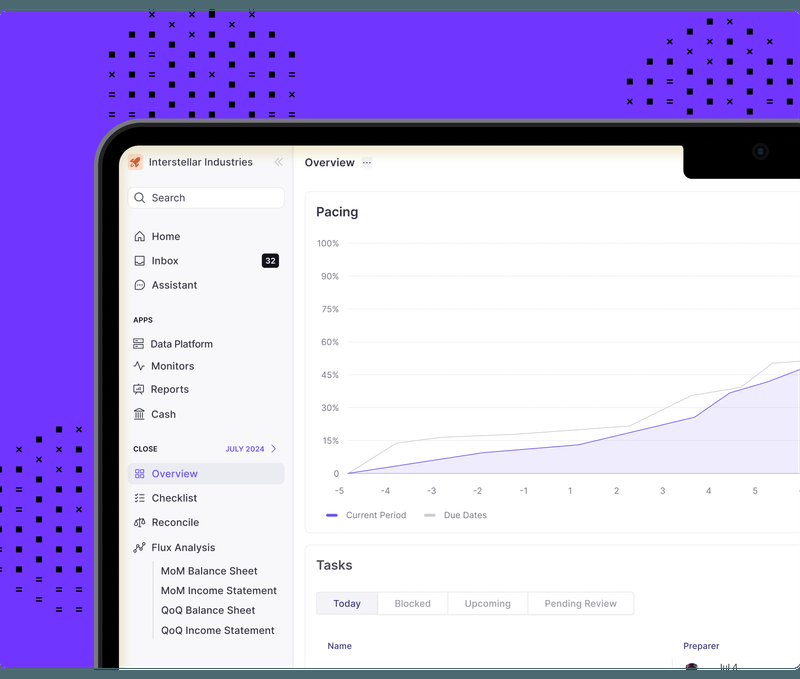
You save your close as a template once. Each new period is generated with owners, business-day due dates, dependencies and last month's notes attached. Numeric pulls GL data from the ERP and reads balances from workpapers in cloud storage, a data warehouse or NetSuite saved searches, and the workpapers can be edited inside Numeric. Accounts that tie and stay under your materiality threshold are submitted automatically. If a later transaction breaks an account that was already reconciled, the owner gets an alert pointing to that transaction.
Flux, however, is where Numeric goes further than most checklist tools. You build reports grouped the way management reads them, AI drafts the variance explanations from transaction detail, and the reviewer edits and approves. Cash matching and batch posting of journal entries are described for NetSuite. Numeric also runs a documented MCP server with more than 20 tools, so Claude or ChatGPT can list open close tasks, query GL transaction lines and draft flux explanations with the same permissions as the user. Numeric doesn't publish a price; its pricing page says the quote depends on transaction volume and seats.
- you close on NetSuite and want transaction-level drill-down and alerts when a reconciled account stops tying
- you want AI-drafted flux commentary that a reviewer approves inside the close tool
- your team already works in Claude or ChatGPT and wants an MCP server for close tasks and GL data
- you run SAP, Oracle or Microsoft Dynamics: none of them is named as a direct sync
- you need a published price: the pricing page lists modules but no amounts
- you need consolidation with eliminations: Numeric doesn't present itself as a consolidation tool
- Users like
- Ease of use (20 mentions) and organization of the close (15 mentions), per G2's pros/cons summary
- Users dislike
- Limited functionality (8 mentions) and limitations (5 mentions), per G2's pros/cons summary
- Source: G2, 66 reviews
- Starting price
- Price not published (quote only); pricing depends on transaction volume and seats
- ERP sync
- NetSuite at transaction-line level; QuickBooks Online, Xero, Sage Intacct at trial balance level
- Auditor access
- Read-only auditor logins with a timestamped audit trail
- MCP server
- 20+ tools for close tasks, reports and flux, for Claude, ChatGPT and other clients
- Implementation
- Under 1 month (G2 user average)
CloseCore
CloseCore is a Seattle-based SaaS close management platform that combines a recurring close checklist, balance sheet reconciliations tied to live ERP trial balances, and cloud file storage, with AI automation (variance explanations, accruals, an AI agent, Excel add-in) in a custom-priced enterprise tier. It is one of the few close tools with published self-serve pricing.
CloseCore is the only tool in this guide with a published self-serve price, which makes it the practical shortlist entry for a 2 to 15 person team that wants FloQast-style structure on a known budget.
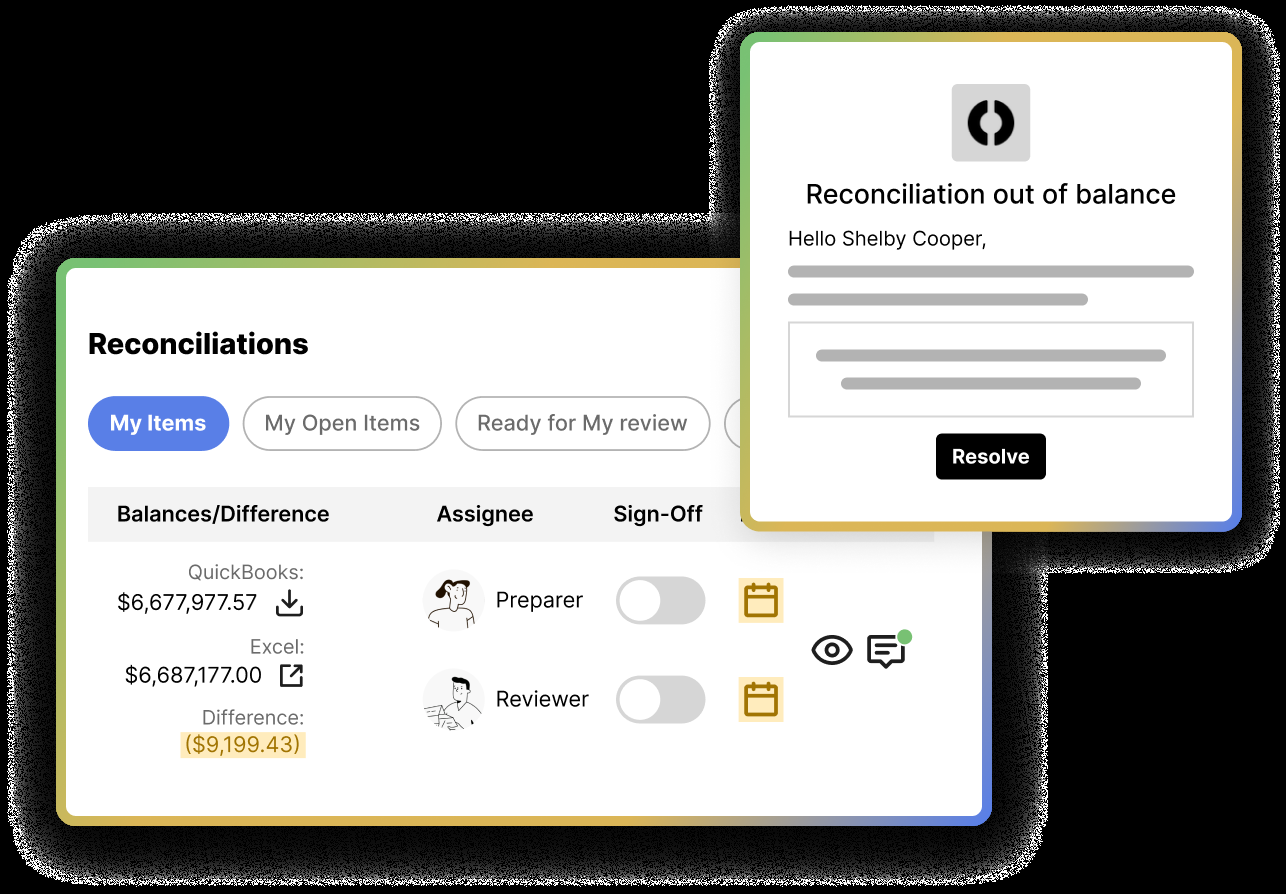
An admin sets up the checklist once from your existing close: tasks, preparer, reviewer and watcher, working-day due dates, subtasks and dependencies. CloseCore connects read-only to the ERP to pull entities, the chart of accounts and monthly trial balances, and to your cloud storage, where it creates and rolls forward the monthly folder structure. Preparers keep their workpapers in Excel. CloseCore ties each workpaper balance to the ERP balance, allows sign-off only within the materiality threshold and alerts the team if a reconciliation falls out of balance later.
Close Management costs $250 a month, or $187.50 a month billed annually, for 5 users, 1 entity and 1 auditor. Variance analysis with AI-drafted explanations, accrual and prepaid schedules, the AI agent and the Excel add-in are in the custom-priced Enterprise Close Automation tier. The ERP list is the broadest here for small companies: QuickBooks Online and Desktop, Xero, NetSuite, Sage Intacct, Business Central, SAP Business One, Acumatica and others, plus a trial balance upload for anything else.
- you're on QuickBooks Online, Xero, NetSuite, Sage Intacct or Business Central and want a checklist plus tie-outs at a published price
- your workpapers live in Excel on SharePoint, OneDrive, Google Drive, Box or Dropbox
- you want to start self-serve within days and add flux or accruals later
- you need flux commentary, accruals or matching on the entry plan: those sit in the Enterprise tier
- you need consolidation with intercompany eliminations and currency translation: none is documented
- you want a large review base before buying: G2 shows 11 reviews
- Users like
- Intuitive interface and responsive support; quick view of ERP balances next to reconciliations and one-click monthly rollforward
- Users dislike
- Occasional syncing issues with task updates; one reviewer reported report dates resetting after logout
- Source: G2, 11 reviews
- Starting price
- $187.50/month billed annually ($250 monthly) for 5 users and 1 entity; Enterprise Close Automation by quote
- Starting price
- $187.50/month billed annually for 5 users, 1 entity and 1 auditor
- Trial
- 14-day free trial, no credit card, no free plan
- Setup
- Self-service typically 1 to 3 days (vendor)
Reconciliation-heavy close platforms
BlackLine, Adra by Trintech and HighRadius are built around the reconciliation and the matching engine. They earn their cost when you have hundreds of balance sheet accounts, several entities or bank and card volumes that nobody should tick off by hand. All three are quote only. None of them documents a QuickBooks Online or Xero connector except HighRadius, which names QuickBooks on its datasheet.
BlackLine
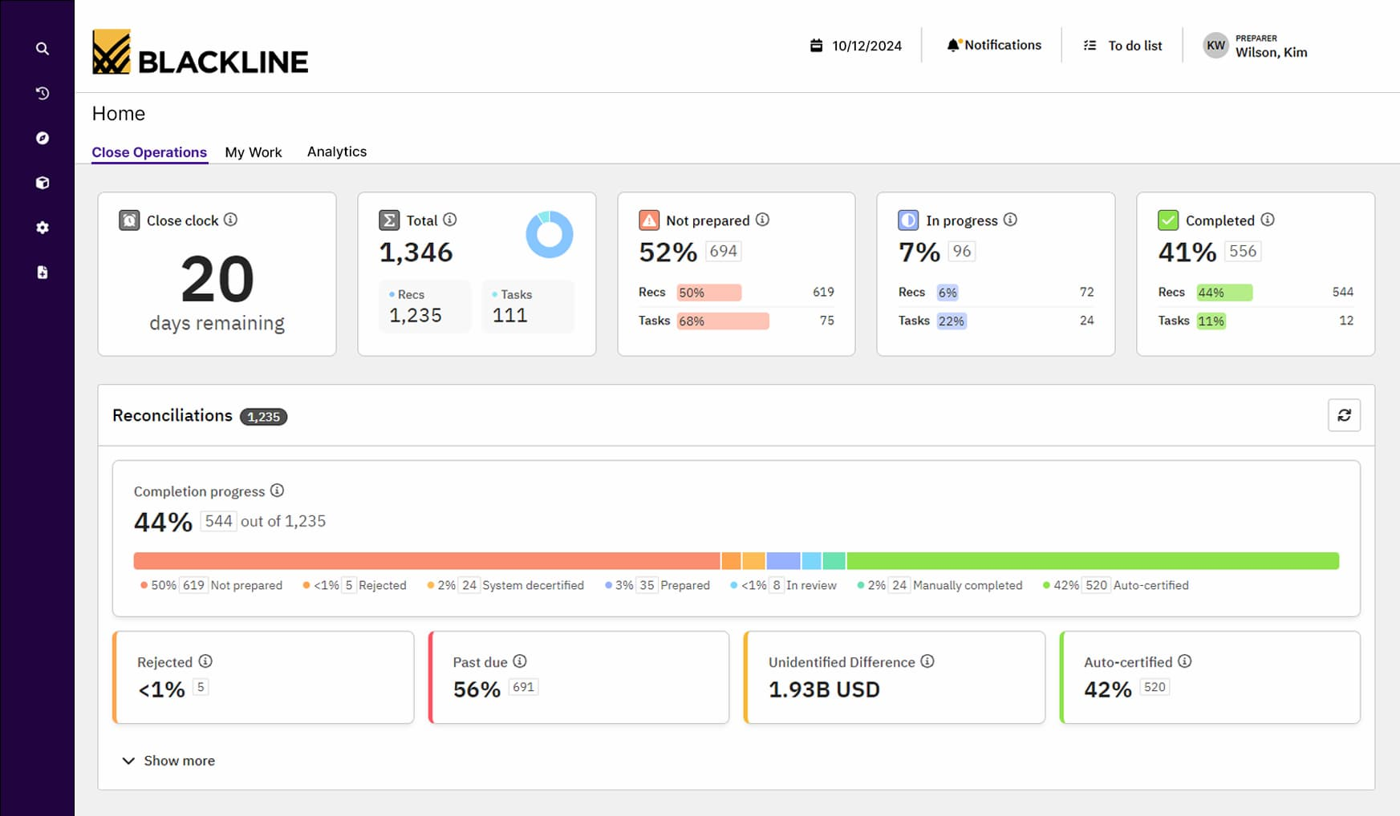
BlackLine is a cloud financial close and consolidation suite with separate modules for task management, account reconciliations, transaction matching, journal entry, reporting and analysis, consolidation and compliance. Its Verity AI layer adds agents such as Verity Prepare for reconciliation prep and Verity Flux for variance analysis.
BlackLine is the reference platform for high-volume reconciliation: it decides which accounts need a person and lets the rest certify themselves.
The controller sets up the close calendar in Task Management with standardized task lists, dependencies and dashboards that flag overdue items. Balances and detail load from the ERP into Account Reconciliations, where each account uses a template. Low-risk accounts are auto-certified against criteria you define, and the Verity Prepare agent drafts reconciling items for the rest so the preparer reviews instead of builds. Cash and other high-volume accounts run through Transaction Matching first: configurable rules match one-to-one, one-to-many and many-to-many, exceptions get suggested matches, and reconciling items and adjusting entries flow into the reconciliation and into Journal Entry.
Journal Entry routes entries through threshold-based approvals and posts them to the ERP. Reporting and Analysis adds flux with Verity Flux, and Consolidation handles ownership and intercompany eliminations. BlackLine sells these as separate modules on quote. As a reference point only, Vendr's buyer data shows a median contract of about $40,125 a year. BlackLine's own pages name SAP, Oracle and NetSuite.
- you reconcile hundreds or thousands of accounts across several entities and want auto-certification of low-risk accounts
- you run SAP, Oracle or NetSuite with bank, card or intercompany volumes that need rule-based matching
- you want consolidation and SOX testing on the same platform later
- you're a 2 to 5 person team on QuickBooks Online or Xero: no connector is documented and contracts are sized for larger teams
- there's nobody to administer it: reviewers repeatedly mention a steep learning curve and complex setup
- Users like
- Centralizes close activities and automates reconciliations, cutting manual work
- Users dislike
- Steep learning curve and complex implementation and configuration
- Source: G2, 1,068 reviews
- Starting price
- Price not published (quote only)
- Close modules
- Task Management, Account Reconciliations, Transaction Matching, Journal Entry, Reporting and Analysis, Consolidation
- ERPs named by BlackLine
- SAP, Oracle, NetSuite
- AI
- Verity Prepare drafts reconciliations, Verity Flux supports variance analysis
- Onboarding
- Often within weeks, per BlackLine
Adra by Trintech
Adra is Trintech's financial close suite for mid-market finance teams, made up of Adra Task Manager, Adra Balancer (balance sheet reconciliations), Adra Matcher (transaction matching), Adra Journal Entry and Adra Analytics. It connects to ERPs such as NetSuite and Microsoft Dynamics and can also work from uploaded spreadsheets.
Adra is Trintech's close suite for mid-market teams, and it's the most reconciliation-focused option that still works when your recs live in spreadsheets today.
The close starts in Adra Task Manager: a task library with instructions and owners, built-in separation of duties between preparer and approver, and linked tasks that notify the next person when they can start. Adra can also turn task descriptions into step-by-step checklists with AI. Balances flow from the ERP into Adra Balancer, which auto-reconciles low-risk accounts within variance thresholds you set and alerts the preparer and approver if a certified balance changes. Teams that aren't ready to leave Excel can still tag and upload their spreadsheets and still get the auto-reconciliation and audit trail.
Cash and other high-volume accounts are matched first in Adra Matcher, which handles 3-way and 4-way matching and suggests matches for exceptions. Adra Journal Entry posts or exports journals to the ERP through two-way integration. Trintech offers certified connectors for NetSuite, including OneWorld, and for Dynamics 365 Finance and Business Central. Adra has no consolidation module of its own; Trintech pairs it with Planful for that, and it positions its other product, Cadency, for large enterprises.
- you're on NetSuite or Dynamics 365 and want certified connectors that post journals back
- you want to keep Excel reconciliations at first and still auto-reconcile low-risk accounts
- you have bank, card or point-of-sale volumes that need multi-way matching
- consolidation is your main pain: Adra relies on Planful for it
- you run QuickBooks Online, Xero or Sage Intacct and want a documented native connector
- Users like
- Streamlines the month-end close by automating account reconciliations and transaction matching
- Users dislike
- Some reviewers feel ease of use and setup could improve
- Source: G2, 333 reviews
- Starting price
- Price not published (quote only)
- Modules
- Task Manager, Balancer, Matcher, Journal Entry, Analytics
- Certified connectors
- NetSuite (incl. OneWorld), Dynamics 365 Finance and Business Central
- Sister product
- Cadency, Trintech's close platform for large enterprises
HighRadius
HighRadius sells a record-to-report suite (close checklist, balance sheet reconciliation, journal entries, intercompany, consolidation, reporting) built around prebuilt AI agents that prepare accruals, post journals and flag anomalies. HighRadius says it was named a Challenger in the 2026 Gartner Magic Quadrant for Financial Close and Consolidation Solutions (it also announced a Challenger placement in the 2025 edition).
HighRadius approaches the close from the preparer's side: prebuilt agents calculate accruals and draft journals, and people approve them.
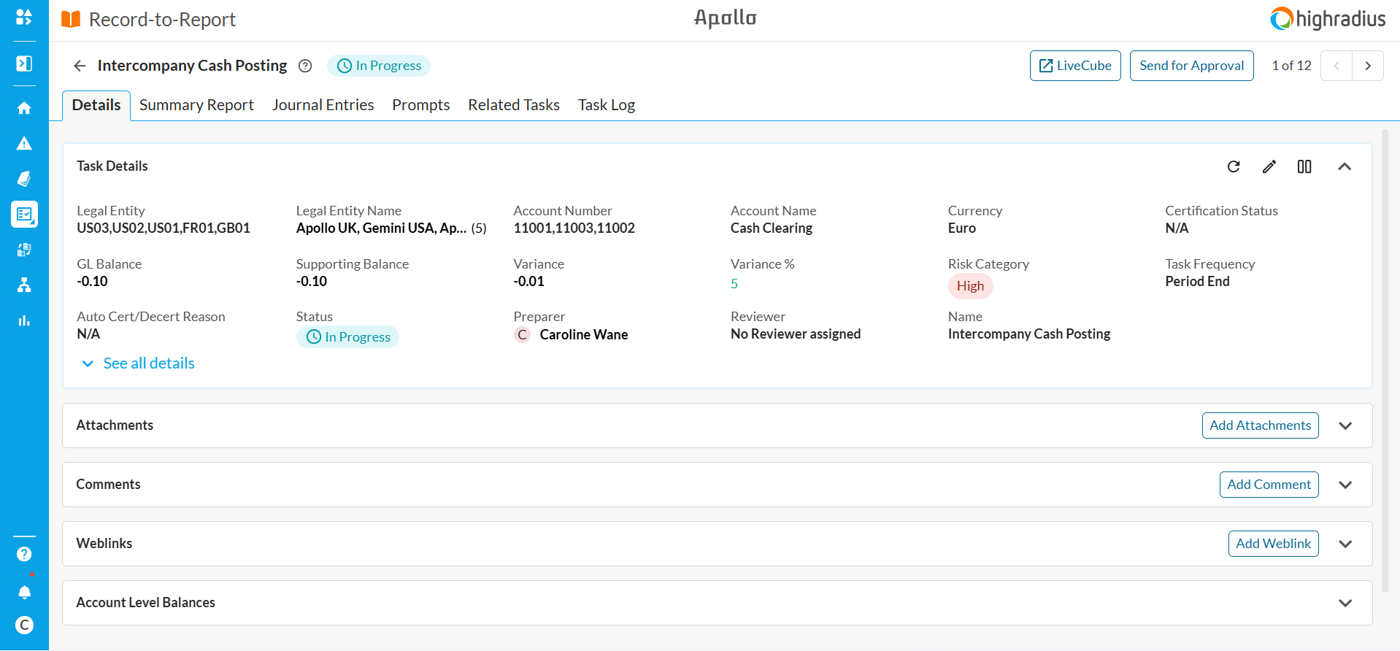
The checklist groups preconfigured tasks by legal entity, each with a preparer, reviewer and approver, and tasks trigger on schedules, periods and dependencies. Data arrives from the ERP, from banks in BAI, BAI2 or MT940 format or by API, and from payroll or expense systems by API, SFTP or Excel upload. Agents then prepare PO, prepaid, unbilled revenue and vendor expense accruals and allocation journals in LiveCube, an Excel-like workspace. Reconciliations match on amount, date and reference, flag missing or duplicate items and generate adjusting journals for exceptions, and approved journals post back to the ERP.
Variance agents flag unusual month-over-month and budget swings with drill-down to the GL. HighRadius says it was named a Challenger in the 2026 Gartner Magic Quadrant for Financial Close and Consolidation Solutions. Pricing is quote only on an outcome-based model, with no setup or subscription fees until go-live according to HighRadius. The weak spot is review evidence. Unlike the four-figure review counts of BlackLine and FloQast, the dedicated G2 listing for its close and reconciliation software has only 2 reviews, and one of them notes that every task must be closed before a new month can open.
- you have high volumes of recurring accruals and journals and want agents to prepare them for approval
- you already use HighRadius for order-to-cash or treasury
- you want fees to start only after go-live
- you're a small team with a simple close: the suite is sold to enterprises and has no self-serve plan
- you want peer reviews before buying: the close listing on G2 has 2 reviews
- Users like
- Journal entry automation and configurable matching rules, easy to use
- Users dislike
- Upload delays and Business Central compatibility; all tasks must be closed before a new month or checklist can open
- Source: G2, 2 reviews
- Starting price
- Price not published (quote only); outcome-based model, no fees until go-live
- Gartner
- Challenger, 2026 Magic Quadrant for Financial Close and Consolidation Solutions (vendor claim)
- ERPs named
- SAP, Oracle, NetSuite, Dynamics 365, Sage Intacct, Workday, QuickBooks
- Bank data
- BAI, BAI2, MT940 files or API
CPM suites with close and consolidation
OneStream and Prophix One are corporate performance management suites. The close is one part of a platform that also does consolidation, reporting and, in Prophix's case, budgeting first. They make sense when the group close (eliminations, currency translation, statutory reporting) is the bottleneck, not when a five-person team needs a better checklist.
OneStream
OneStream is an enterprise CPM platform that runs consolidation, account reconciliations, transaction matching, journal entries, reporting and planning in one application on a single data model. It says it was named a Leader in the 2026 Gartner Magic Quadrant for Financial Close and Consolidation Solutions (report dated 9 March 2026).
OneStream fits multi-entity, multi-currency groups that want close, consolidation and reporting on one data model instead of three tools.
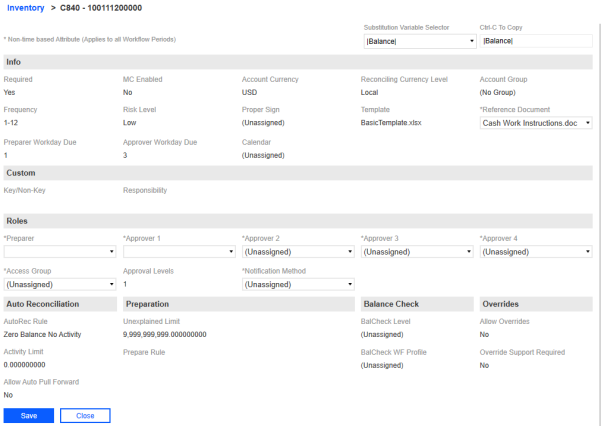
Trial balances load once from the ERP with drill-back to source journals, and the same data feeds reconciliations, the close, consolidation and reporting. Close tasks run in Task Manager, installed from the OneStream Solution Exchange, which enforces that the same user can't complete and approve a task in the same month. In Account Reconciliations an admin builds the inventory from GL accounts and assigns a preparer and up to four approvers per reconciliation. AutoRec rules based on zero balance, activity or an expression either prepare a reconciliation for approval or approve it fully.
Transaction Matching runs one-sided or three-way matches several times a day and feeds matched items into the reconciliations. Journal Entry Manager handles operational and consolidation journals across ERPs, and consolidation covers intercompany eliminations, currency translation and acquisitions under US GAAP and IFRS. OneStream says it was named a Leader in the 2026 Gartner Magic Quadrant for Financial Close and Consolidation Solutions. It names SAP, Oracle, Microsoft Dynamics and Infor as connectors, but we found no vendor page naming QuickBooks or Xero.
- consolidation, intercompany and currency translation are the hardest part of your close
- you want to replace several finance tools with one platform for close, consolidation, reporting and planning
- you have an internal admin or partner to configure workflows and rules
- you're a small team on QuickBooks Online, Xero or Sage Intacct that needs a checklist and recs within weeks
- you want a tool accountants configure themselves: ease of setup is its lowest G2 sub-score
- Users like
- One platform for consolidation, planning and reporting; strong business rules, governance and support
- Users dislike
- Steep learning curve and harder setup (ease of setup is the lowest sub-score)
- Source: G2, 161 reviews
- Starting price
- Price not published (quote only)
- Gartner
- Leader, 2026 Magic Quadrant for Financial Close and Consolidation Solutions (vendor page)
- Close modules
- Consolidation, Account Reconciliations, Transaction Matching, Journal Entry Manager, Task Manager
- ERPs named
- SAP, Oracle, Microsoft Dynamics, Infor
Prophix One
Prophix One is a cloud financial performance platform built around budgeting and planning, with separately priced modules for close management (account reconciliation, close tasks, audit trail), financial consolidation and intercompany. The close work sits in the Close Management module (Account Reconciliation, generally available since September 2024) plus the Financial Consolidation module for multi-entity groups.
Prophix One is a planning platform first; its Close Management and Financial Consolidation modules make sense if you already plan in Prophix or want one vendor for both.
Trial balances flow from the ERP into Prophix One on a schedule aligned to the close calendar, through the same integration the planning side uses. Preparers work reconciliations in templates configured by account type, with required fields and a document checklist, and prior period balances roll forward. Bank and subledger transactions are matched automatically, and Prophix One Intelligence suggests matches for review. Submitting a reconciliation that nets to zero triggers an approval request, and a close command center shows completed, in review, overdue and unreconciled items by period and entity.
For groups, the separate Financial Consolidation module runs intercompany matching and eliminations, currency translation and ownership calculations. At the end, a one-click close package exports reconciliations, support and sign-offs to Excel for the auditor. Prophix doesn't publish prices on its website, but its AWS Marketplace listing shows $50,000 for a 12-month Close Management unit and $60,000 for Financial Consolidation. The account reconciliation part has been generally available since September 2024, so it's younger than the planning product.
- you run a multi-entity group and want consolidation and statutory reporting in the same platform as budgeting
- you already use Prophix for planning and want reconciliations on the same data integration
- your ERP is NetSuite, SAP, Dynamics, Oracle, Workday, Sage Intacct or Epicor
- you're on QuickBooks Online or Xero: neither is named on Prophix's integration pages
- you only need a checklist and balance sheet reconciliations: AWS Marketplace lists the close module alone at $50,000 per 12-month unit
- Users like
- Ease of use, flexible reporting and responsive support
- Users dislike
- Steep learning curve for advanced features and slow performance or report load times
- Source: G2, 215 reviews
- Starting price
- Price not published (quote only); AWS Marketplace lists $50,000 per 12-month unit for Close Management
- Close module
- Close Management (account reconciliation, generally available since September 2024) plus Financial Consolidation
- ERPs named
- NetSuite, SAP, Oracle, Dynamics 365, Workday, Sage Intacct, Epicor, Acumatica
- Auditor package
- One-click close package export to Excel
When does a team need financial close software?
A team needs financial close software once reconciliations, matching or consolidation take more hours than a checklist can control. A team doesn't need it yet when the close is late only because tasks are forgotten, evidence is missing or a reviewer is waiting; a checklist with owners and sign-off fixes that. The most common version of this question comes from small teams on accounting forums: "We only need a checklist, owners and sign-off. Do we really need FloQast?" The answer depends on three things more than on company size.
- Reconciliation volume. If fewer than a few dozen balance sheet accounts need a monthly reconciliation and bank matching happens in the ERP's bank feed, a reconciliation engine saves little.
- Entities and currencies. One entity in one currency doesn't need consolidation software. Several entities with intercompany balances quickly do.
- Where the time goes. If the close runs late because people forget tasks, attach the wrong support or wait on a reviewer, the fix is ownership and evidence, not matching.
| Your situation | What to look at first |
|---|---|
| 2 to 8 people, one entity, QuickBooks Online or Xero, reconciliations already in Excel | A close checklist with evidence and sign-off, or CloseCore if you also want tie-outs to the ERP |
| 5 to 15 people on NetSuite or Sage Intacct, growing account count | FloQast, Numeric or CloseCore |
| Mid-market on NetSuite or Dynamics with bank, card or POS volume | Adra by Trintech or BlackLine |
| Several entities and currencies, consolidation is the bottleneck | OneStream or Prophix One, or BlackLine with its consolidation module |
| Large enterprise on SAP or Oracle with very high volumes | BlackLine, HighRadius or Trintech's Cadency |
If you're in the first row of the decision table, the gap isn't software for reconciliations. It's knowing what is complete, what evidence is missing and who still has to sign off. That's the narrow job our product, The Finance Lead, does for teams of 2 to 8: recurring close checklists, evidence attachments, preparer and reviewer sign-off and reminders, from $39 a month. It doesn't reconcile, post entries or connect to your ledger, so it isn't a substitute for the platforms above once you need those jobs.
How do you choose financial close software?
Choose financial close software by matching the ERP connection, the place your reconciliations live and the package that holds the jobs you need, then test it on your own trial balance. Every vendor demo looks good on a clean dataset, but yours won't be clean, so these six criteria separate the tools in practice.
- ERP connection depth comes first, so ask whether the tool syncs at trial balance level or at transaction level, how often it refreshes, and whether journals post back to the ERP. Numeric, for example, documents transaction-level sync only for NetSuite and trial balance sync for QuickBooks Online, Xero and Sage Intacct.
- Where reconciliations live shapes the rollout, because FloQast and CloseCore keep Excel workpapers in your own storage, while BlackLine, Adra and OneStream move them into templates. Neither approach is wrong, but a switch of method doubles the change management.
- The base package often leaves out jobs you need. FloQast's journal entries and flux are in Close AI, and CloseCore's flux, accruals and agent are in its Enterprise tier. Price the package that contains the jobs you listed, not the entry package.
- Auditor access is worth checking, including whether auditors get their own read-only login and whether that seat costs extra. Numeric offers read-only auditor logins, and CloseCore includes one auditor in its entry plan.
- Administration decides long-term success, because reconciliation engines and CPM suites need someone who maintains rules, templates and mappings. If that person doesn't exist, you'll want a tool your accountants can configure themselves.
- Implementation evidence should come from a reference customer with your ERP and your entity count, and you should compare the vendor's timeline with what G2 reviewers report.
- Last month's trial balance and three of your hardest reconciliations
- Your current close checklist with owners and due dates
- One reconciliation that changed after sign-off last quarter, to test the alert
- The list of entities, currencies and intercompany pairs
- The request list your auditor sent last year
- A question on which package includes journal posting and flux
Which ERPs does each financial close tool connect to?
ERP support is the first filter, because a close tool without a connector for your general ledger falls back to trial balance uploads. Teams on QuickBooks Online, whose own plans we break down in our QuickBooks Online pricing guide, have the shortest list. The table lists only ERPs that each vendor names on its own pages; "not named" means we found no vendor page that lists it, not that an upload or partner connector is impossible.
| Tool | QuickBooks Online | Xero | NetSuite | Sage Intacct | SAP, Oracle or Dynamics |
|---|---|---|---|---|---|
| FloQast | Only in a help center article | Yes | Yes | Yes | SAP and Microsoft Dynamics |
| Numeric | Yes, trial balance level | Yes, trial balance level | Yes, transaction level | Yes, trial balance level | Not named |
| CloseCore | Yes | Yes | Yes | Yes | SAP, Oracle Cloud, Dynamics 365 |
| BlackLine | Not named | Not named | Yes | Not named on BlackLine pages | SAP and Oracle |
| Adra by Trintech | Not named | Not named | Yes, certified | Not named | Dynamics 365, certified |
| HighRadius | Yes, on its datasheet | Not named | Yes | Yes | SAP, Oracle, Dynamics 365 |
| OneStream | Not named | Not named | Not named on current pages | Not named | SAP, Oracle, Dynamics |
| Prophix One | Not named | Not named | Yes | Yes | SAP, Oracle, Dynamics 365 |
Do auditors get their own access?
Auditors get their own access in most of these close tools, but the terms differ. Numeric gives auditors a read-only login with a timestamped audit trail. CloseCore includes one auditor in its entry plan, and its fact sheet says external auditors get free read-only access. OneStream has an Auditor role that only sees fully approved reconciliations. Prophix One exports a one-click close package to Excel and offers dedicated auditor licenses in its consolidation module. Still, ask every vendor whether an auditor seat is free, priced per seat or part of a module, because it's rarely on the pricing page.
How much does financial close software cost?
Financial close software costs from about $187.50 a month for a small team on CloseCore's published annual plan to tens of thousands of dollars a year for enterprise platforms, but only one of the eight tools publishes a price on its website. Everything else is a quote, so the useful comparison is what each vendor does publish and what an independent source says.
| Tool | What the vendor publishes (USD) | Other price reference (USD) | Implementation evidence |
|---|---|---|---|
| CloseCore | $187.50 a month billed annually, $250 monthly, for 5 users and 1 entity | n/a | Self-service typically 1 to 3 days (vendor) |
| FloQast | Three packages, quote only, no per-user fees | n/a | About 2 months (G2 user average) |
| Numeric | Modules only, quote based on transaction volume and seats | n/a | Under 1 month (G2 user average) |
| BlackLine | Quote only, sold by module | Vendr median about $40,125 a year | Often within weeks (vendor) |
| Adra by Trintech | Quote only | n/a | Not documented |
| HighRadius | Quote only, no fees until go-live | n/a | Not documented |
| OneStream | Quote only | n/a | Not documented |
| Prophix One | Quote only on its website | AWS Marketplace: $50,000 per 12-month Close Management unit | 60 days for one customer's consolidation (vendor case) |
How long does implementation take?
Implementation takes from a few days for a self-serve checklist tool to several months for a platform, and only some vendors document it. CloseCore says self-service setup typically takes 1 to 3 days and its enterprise tier 2 to 4 weeks. G2 reviewers report under one month for Numeric and about two months for FloQast. BlackLine says onboarding is often completed within weeks, Prophix cites one customer whose consolidation went live in 60 days, and Adra, HighRadius and OneStream publish no timeline. The limitation of every figure here is scope: one entity with clean reconciliations goes faster than ten entities with intercompany.
What is the difference between financial close, consolidation and FP&A software?
Consolidation software combines the books of several entities, eliminates intercompany balances and translates currencies; it starts where the entity-level close ends. FP&A software plans, budgets and forecasts on top of closed actuals. OneStream and Prophix One do all three, which is why they show up in every financial close list. Planning-first tools such as Cube, Planful or Vena often appear in those lists too, but their close features are thinner, so we left them out. If your problem is the entity close, start with a close tool; if it's the group close, look at consolidation depth first.
FAQ
What is the difference between financial close software and consolidation software?
Financial close software runs the entity-level close: checklist, reconciliations, matching, journal entries and flux. Consolidation software combines several entities, eliminates intercompany balances and translates currencies. OneStream, Prophix One, BlackLine and HighRadius offer both, while FloQast, Numeric and CloseCore focus on the close.
Is there free financial close software?
None of the eight tools in this guide has a free plan. CloseCore offers a 14-day free trial and publishes its price, and auditors get free read-only access there. For a one-entity company a structured close checklist in a spreadsheet is a workable free start.
Is FloQast or BlackLine better for a mid-size team?
FloQast suits a mid-size team that reconciles in Excel and wants checklist structure and sign-off around those workpapers. BlackLine suits a team with hundreds of accounts, several entities and bank or card volumes that need rule-based matching and auto-certification. Both are quote only, and G2 reviewers mention a steeper learning curve for BlackLine.
Which financial close software works with QuickBooks Online?
Numeric syncs QuickBooks Online at trial balance level and CloseCore connects to QuickBooks Online and Desktop. HighRadius names QuickBooks on its datasheet. FloQast refers to QuickBooks Online in its help center but doesn't list it on its integrations page.
Do we need close software if we already close in Excel?
A team that closes in Excel doesn't always need close software. If the close is late because tasks are forgotten or evidence is missing, a checklist with owners and sign-off fixes most of it. Close software pays off once reconciliation volume, entities or matching work grow beyond what spreadsheets can control.
Which financial close tools offer AI features?
Most financial close tools now offer AI features. BlackLine has Verity Prepare and Verity Flux, FloQast puts AI matching and flux in Close AI, Numeric drafts flux explanations and runs an MCP server, HighRadius uses prebuilt accrual and journal agents, and CloseCore keeps its AI agent in the Enterprise tier.