SOX compliance software is a platform that runs the internal control work the Sarbanes-Oxley Act of 2002 requires: the risk and control matrix, control testing, evidence requests, deficiency tracking and the certifications behind each 10-Q and 10-K. The right SOX tool depends less on features than on two facts about your company: whether an external auditor has to attest to your controls under Section 404(b), and whether your gaps sit in business-process controls (the close, revenue, payroll) or in IT general controls (access, change management).
We compared nine SOX compliance tools, from Optro (formerly AuditBoard), Workiva and Diligent to FloQast, Hyperproof and Drata, for controllers and small finance teams at pre-IPO and newly public companies. None of the nine publishes a price, so this guide focuses on what each tool does at each step of a SOX year, who should skip it, and what reviewers report. It's written for the person who'll own the program, not for a GRC department.
Our picks by situation
 Best SOX-first platformOptro (formerly AuditBoard)Built around SOX from the start, with 302/404 certification workflows and AI-assisted testing.
 Best if you file with WorkivaWorkivaControls, testing and the 10-K on one platform, with unlimited seats.
 Best for controller-led SOXFloQastControl evidence comes out of the close tasks your team already runs.
 Best for SOX plus SOC 2HyperproofOne control set mapped across frameworks, with a clean auditor request workflow.
 Best for ITGC evidence onlyDrataAccess reviews and monitoring for the IT slice of SOX, not the financial controls.
SOX compliance software compared
| Tool | Tool class | SOX work it covers best | Pricing | G2 rating |
|---|---|---|---|---|
| Optro (formerly AuditBoard) | SOX-first audit and risk platform | Full SOX program: RCM, testing, issues, 302/404 certifications, auditor access | Quote only (demo request) | 4.6 (1,638) |
| Workiva | SOX plus SEC reporting platform | SOX testing and remediation next to the 10-K and SEC filings | Quote only (unlimited seats on all plans) | 4.5 (2,266) |
 Diligent One | Audit, risk and board platform | SOX 404 projects and multi-level 302 sub-certifications | Quote only (tiered by company size) | 4.3 (161) |
 MetricStream | Enterprise GRC suite | 302/404 certification plans for complex, multi-entity scoping | Quote only | 3.8 (14) |
 Resolver | Integrated risk and GRC suite | Classic ICFR cycle from account scoping and walkthroughs to certifications | Quote only (modules, customization, active users) | 4.3 (178) |
 LogicGate Risk Cloud | No-code GRC platform | Section 404 testing workflows, evidence collection and remediation | Quote only (per application plus Power User licences) | 4.6 (184) |
| FloQast | Close platform with SOX controls | SOX controls and testing tied to the month-end close | Quote only (no per-user fees) | 4.6 (1,417) |
| Hyperproof | Multi-framework compliance platform | Evidence collection and auditor requests across SOX, SOC 2 and ISO | Quote only | 4.5 (218) |
| Drata | Security compliance automation | IT general controls evidence: access reviews, change management, monitoring | Quote only (Foundation, Advanced, Enterprise) | 4.7 (1,329) |
 The Finance Lead Our product | Month-end close checklists | Tracks close tasks, evidence and preparer/reviewer sign-off | Access code | No reviews yet |
Pricing and G2 data checked on October 17, 2026. None of the nine vendors publishes a list price. G2 ratings cover each vendor's whole product, not only its SOX module.
What SOX compliance software does: core features
SOX compliance software replaces the spreadsheet risk and control matrix, the shared drive full of evidence and the email threads with control owners. To be SOX compliant, a public company needs documented key controls over financial reporting, evidence that those controls operated, testing that shows they work, and management sign-off on the result. A real SOX tool can prove three things for every key control: who owns it, how often it ran and was tested, and that a reviewer signed off. A folder of screenshots can't, and that's the gap auditors probe first.
Most SOX platforms cover the same core jobs:
- Scoping. The tool helps you pick significant accounts and the processes behind them, usually by materiality and financial statement assertion.
- Risk and control matrix (RCM). Risks, controls, owners, frequency and key reports sit in one versioned library, linked to process narratives and flowcharts.
- Walkthroughs and testing. Testers document the test of design and operating effectiveness, select samples, attach evidence and record a conclusion that a reviewer signs.
- Evidence requests. The tool sends requests (the PBC list) to control owners with due dates and reminders, and it keeps the audit trail.
- Deficiencies. Exceptions become issues with a severity rating, a remediation owner and a retest.
- Certifications. Process owners answer sub-certification questionnaires before the CEO and CFO sign the Section 302 certifications.
- Reporting and auditor access. The audit committee and the external auditor see status in the tool instead of in emailed spreadsheets.
Most companies assess their controls against the COSO 2013 framework, which has five components and 17 principles. Several tools map controls to COSO so you can show coverage by principle.
Business-process controls vs IT general controls
SOX tools split into two classes, but vendor-written listicles rarely say so. Program platforms (Optro, Workiva, Diligent, MetricStream, Resolver, LogicGate, FloQast) run the whole internal control over financial reporting (ICFR) program: business-process controls such as account reconciliations, journal entry review and revenue cutoff, plus the testing and certifications around them. The reconciliation and close side of that work is compared in our guide to financial close software. Catching fraud inside those processes, such as a changed vendor bank account or an unusual manual journal entry, is a separate category; see our comparison of fraud detection software.
IT general controls (ITGC) are the access, change management and operations controls over the systems that produce your numbers. Tools like Drata pull that evidence from your identity provider, cloud and ticketing systems, but they don't run the financial side of the program. Hyperproof sits in between: it has ICFR and ITGC templates, but its documented strengths are IT evidence and audit requests.
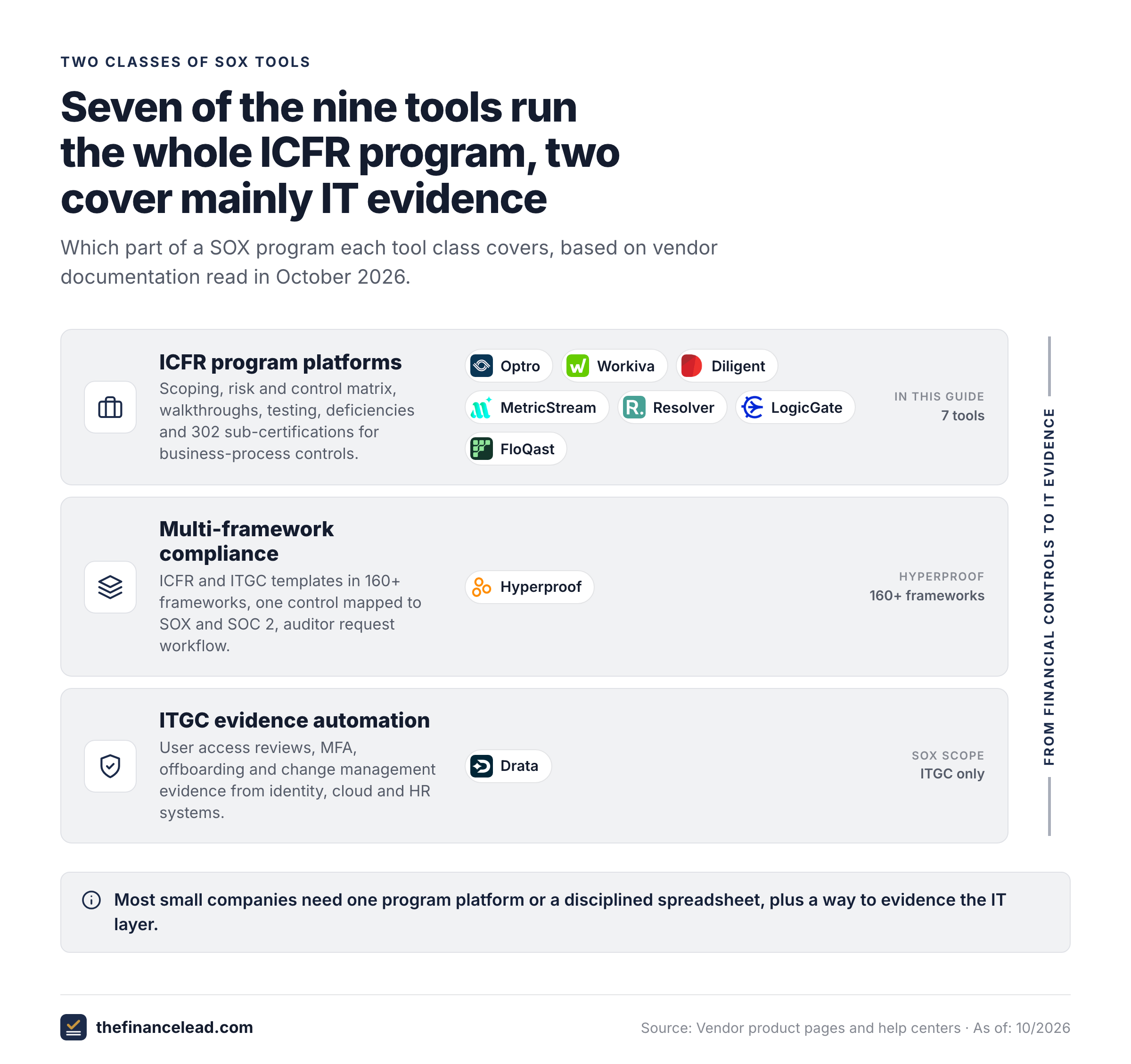
A small company often needs one program platform, or a disciplined spreadsheet, plus a way to evidence the IT layer. If your ERP or payroll runs at a service provider, you'll also collect its SOC 1 report and test the user controls it lists.
SOX compliance requirements by company type
Every SEC-reporting company deals with Section 302 and Section 404(a). Only some need Section 404(b), and that's what decides how much auditor collaboration your software has to support.
- Section 302: the CEO and CFO certify each 10-Q and 10-K, including that they evaluated internal controls and disclosed significant deficiencies and material weaknesses to the auditor and audit committee (17 CFR 240.13a-14).
- Section 404(a): management assesses ICFR in every annual report. A newly public company skips this in its first 10-K and files a transition statement instead (Item 308 of Regulation S-K).
- Section 404(b): the external auditor attests to management's assessment under PCAOB standards. Non-accelerated filers and emerging growth companies are exempt (15 U.S.C. 7262).
| Filer status | Threshold (USD) | 404(a) management assessment | 404(b) auditor attestation | What your software must handle |
|---|---|---|---|---|
| Emerging growth company | Revenue under $1.235 billion, for up to five fiscal years after the IPO | Yes, from the second 10-K | No | Management testing, evidence and 302 sub-certifications |
| Non-accelerated filer | Public float under $75 million, or a smaller reporting company with revenue under $100 million | Yes, from the second 10-K | No | The same jobs at a smaller scale |
| Accelerated filer | Public float of $75 million to under $700 million | Yes | Yes | Auditor access, PBC requests, reliance on management testing |
| Large accelerated filer | Public float of $700 million or more | Yes | Yes | All of the above across more entities and controls |
Section 302 certifications apply in every row: the CEO and CFO sign them with each 10-Q and 10-K. In practice, most companies back those signatures with sub-certifications from process owners, which is why several tools below have a dedicated sub-certification workflow.
Thresholds come from the SEC's filer definitions in Rule 12b-2 and Rule 405. Since April 27, 2020, smaller reporting companies with annual revenue under $100 million no longer count as accelerated filers, so they skip 404(b) but still do 404(a) (SEC Release 34-88365).
The stakes are personal for the signers. Under Section 906, knowingly certifying a report that doesn't comply carries fines up to $1 million and up to 10 years in prison, and willful certification up to $5 million and 20 years (18 U.S.C. 1350).
Private companies, of course, don't file Section 302 certifications or Section 404 reports. A few SOX provisions still reach everyone, though: Section 802 makes destroying or falsifying records to obstruct a federal investigation a crime punishable by up to 20 years (18 U.S.C. 1519). A company planning an IPO usually builds its controls a year or more ahead, because the first 404(a) assessment arrives with the second annual report and the auditor looks at controls from the first audit on. Confirm your own filer status with your securities counsel and auditor.
SOX audit timeline: who owns each step
In a finance team of two to eight people, the controller often owns controls, reviews other people's work and coordinates with an outsourced internal audit provider. Here's how a typical calendar-year SOX cycle splits up, and which tool class serves each step. If your SOX work runs through an internal audit team, our comparison of the best audit management software for finance teams shows what an audit looks like inside each product. Analytics tools such as Caseware IDEA and MindBridge, which test whole populations instead of samples, are covered in our guide to internal audit software.
- ControllerScope significant accounts, update the RCM and key reports Q1
- Process ownersConfirm narratives and flowcharts, walk through key controls Q2
- Internal auditInterim testing of design and operating effectiveness Q2 to Q3
- ITUser access reviews, change management and backup evidence Quarterly
- ControllerCollect sub-certifications before each 10-Q and 10-K Each quarter
- Internal auditYear-end rollforward testing, rate deficiencies, track remediation Q4
- External auditorTest controls and attest (404(b) filers only) Q3 to Q1
- CFO and CEOSign the 404(a) assessment and 302 certifications in the 10-K After year end
SOX-first platforms for public companies
These three run a complete SOX program, and they're the names most audit firms already know. They fit companies with 404(b) on the horizon or already in place, although smaller filers use them too.
Optro (formerly AuditBoard)
AuditBoard's platform under its new name since March 9, 2026. Its Controls Management product (the former SOXHUB) runs SOX programs, and a separate Autonomous Testing product uses AI agents to run attribute tests on evidence.
Optro fits a newly public SaaS or tech company that's building a small internal audit team (or using an outsourced one), wants the platform most SOX practitioners have already used, and expects to add internal audit and IT compliance later.
In practice, testers work from a queue of assigned control tests, document narratives, complete testing and log an issue straight from a failed test. Certification workflows tie each 302/404 sign-off to the evidence underneath it. Optro AI can draft narratives and flowcharts from notes and policies, and helps with sample selection, population checks, evidence validation and tickmarking. Its outputs are marked and need a practitioner's review. Optro is AuditBoard's new name since March 9, 2026, and its SOX product is the former SOXHUB.
- you are newly public or a late-stage pre-IPO company and want a platform built around SOX first, with internal audit and IT compliance available later
- you want AI-assisted fieldwork (sample selection, evidence validation, tickmarking) with workpapers you can trace back to the evidence
- you are a small team on a tight budget: pricing is quote-only and G2 reviewers report about four months to implement on average
- you only need a light RCM and testing tracker: most of the platform would go unused
- Users like
- ease of use and audit management (top positive themes on G2)
- Users dislike
- limited functionality and customization in some areas (top negative themes)
- Source: G2, 1,638 reviews

How it works in practice
Capabilities that matter for SOX: a multi-framework control library (SOX plus J-SOX and other regimes), role-based access for control owners and external auditors, and a separate Autonomous Testing product (from the Midship acquisition) whose AI agents run attribute tests on uploaded evidence such as access reviews and bank reconciliations and build Excel workpapers linked to the source. Optro says the link between Autonomous Testing and Controls Management is still being built, so ask what's live in your plan.
Integrations: NetSuite, Oracle, Workday, Okta and Paylocity as evidence sources, plus Jira, ServiceNow, Slack, Teams, Google Drive, an Excel add-in, REST and SCIM APIs and an MCP server.
G2 reviewers report about four months to implement on average.
- Starting price
- Quote only (demo request)
- SOX module
- Controls Management (formerly SOXHUB)
- Certifications
- 302/404 workflows tied to evidence
- G2 implementation time
- About 4 months on average
Workiva
A cloud platform for financial reporting, SEC filing and GRC. Its SOX solution manages controls, testing, issues and remediation on the same platform many filers use to build the 10-K.
Workiva fits a filer that already builds its 10-K and SEC filings in Workiva, or plans to, and wants controls, testing and disclosures in one place with every control owner and auditor logged in.
In practice, risk-based scoping starts the year: you map controls and risks to COSO 2013 and Workiva's AI flags coverage gaps. Requests go to control owners for samples, reviewers approve the sample evidence on the control's test form, and testers mark up evidence in the viewer. Workiva's testing agents can refine test attributes, generate rules and run tests, with each conclusion checked against annotated evidence and open to reviewer override. A remediation agent drafts issues and action plans from failed tests.
- you already prepare SEC filings in Workiva, or plan to, and want controls and disclosures in one place
- you want every control owner and your auditors in the tool without paying per seat
- you are a small pre-IPO team that only needs SOX tracking: third-party purchase data on Vendr averages close to $60,000 a year
- you need ready-made Okta or Jira connectors for ITGC evidence: none are listed in Workiva's connector catalog
- Users like
- user-friendly interface and real-time collaboration
- Users dislike
- missing features and a learning curve
- Source: G2, 2,266 reviews

How it works in practice
Capabilities that matter for SOX: a control library with linked process flowcharts that update when a control changes, COSO coverage dashboards, and results you can package with evidence for the auditor. The October 2026 release lets users create action plans directly from the issue form.
Integrations: 70+ prebuilt connectors, including NetSuite, SAP, Oracle EPM and ERP, Workday, BlackLine, Salesforce and ServiceNow, plus open APIs. We found no Okta or Jira connector, and you'll notice that if you want ITGC evidence pulled automatically.
Licensing: Workiva's pricing page says every plan includes unlimited seats. Third-party purchase data on Vendr puts the average contract near $60,000 a year; it's an estimate, not a quote.
- Starting price
- Quote only (unlimited seats on all plans)
- Seats
- Unlimited users on all plans
- Connectors
- 70+ prebuilt, incl. NetSuite, SAP, Oracle, Workday
- AI
- Testing and remediation agents with reviewer override
Diligent One
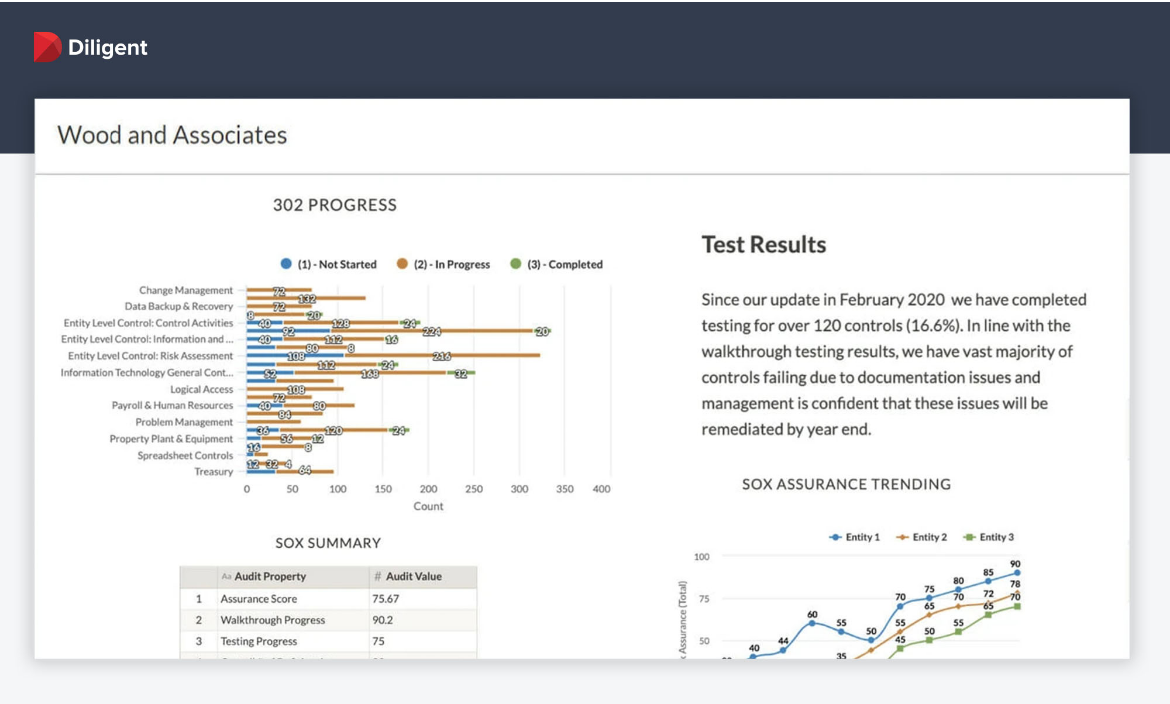
The platform formerly known as Galvanize HighBond. SOX 404 programs run in its Projects and Frameworks apps, 302 sub-certifications in Projects and Results, with ACL-style analytics robots for automated control tests.
Diligent One fits a company whose internal audit team already uses ACL analytics or HighBond, or a filer with many reporting units where 302 sub-certifications have to cascade through several management levels.
In practice, a SOX 404 program starts in Frameworks, the central record of controls, seeded from SOX templates and tagged by entity. Projects pull in those controls with two-way sync and hold the planning memo, narratives with sign-off, the RCM with risk scoring, requests to control owners and test plans split into rounds such as Q1 to Q4. Results roll up to the framework in real time. Exceptions become issues with severity and owners, and remediation runs through actions and retests.
- your internal audit team already uses ACL or HighBond and wants SOX on the same platform
- you need 302 sub-certifications that cascade through several management levels and reach people without a paid licence
- you run SAP and want cloud-only testing: the SAP connector needs an on-premise Robots Agent and an extra subscription
- you want a fast, simple setup: ease of setup and customization are the weakest themes in G2 reviews
- Users like
- ease of use and breadth of features
- Users dislike
- limited customization and configuration effort
- Source: G2, 161 reviews
How it works in practice
Capabilities that matter for SOX: 302 sub-certification programs with sequenced or parallel responders, questionnaire templates, escalation triggers (for example a weekly reminder on requests idle for 10 days) and quarterly rollforward. Requests can go to people without a paid licence. Automated control tests run on Diligent's analytics robots.
Integrations: robots connectors for NetSuite, Oracle Financials Cloud, Workday, Microsoft Dynamics 365, Salesforce and ServiceNow. SAP needs an on-premise Robots Agent and an extra subscription.
AI: AuditAI launched in March 2026 for audit planning and evidence requests. Its announcement doesn't describe SOX testing, so treat it as an internal audit feature for now. Diligent says a SOX program can be set up in 10 days; that's a vendor claim.
- Starting price
- Quote only (tiered by company size)
- SOX apps
- Projects, Frameworks, Reports, Results
- 302 sub-certifications
- Sequenced or parallel, non-licensed users allowed
- ERP data
- NetSuite, Oracle, Workday connectors; SAP via on-prem agent
GRC suites with a SOX module
These platforms handle SOX as one application inside a broader governance, risk and compliance suite. They make sense when risk management, internal audit or policy work will live in the same system. If SOX is the only job, they're usually more platform than you need.
MetricStream
An enterprise GRC suite whose SOX compliance product handles 302 and 404 certification plans and questionnaires, issue routing to a disclosure committee and multi-entity organization structures.
MetricStream fits a large accelerated filer with many legal entities and a dedicated GRC team that wants SOX inside the same suite as enterprise risk, audit and policy management. It isn't built for a three-person finance team.
In practice, SOX runs as certification plans: the team defines 302 and 404 plans and questionnaires, sends them through a multi-entity organization structure and reviews a 302 sub-certification report before the officers sign. Issues found in testing can route to a disclosure committee. The May 2026 release added AI refinement for testing workpapers, and the AI also suggests and classifies issues.
- you are a large filer with many legal entities and want SOX inside an enterprise GRC suite that also covers risk, audit and policy
- your disclosure committee needs 302 sub-certification reports and issue escalation built in
- you are a lean finance team: reviewers describe complex implementations and rigid configuration
- you want automated evidence from named ERP or identity connectors: none are documented publicly
- Users like
- broad GRC coverage and dashboards
- Users dislike
- complex implementation and usability
- Source: G2, 14 reviews

How it works in practice
Testing: MetricStream's control testing module runs design and operating effectiveness tests through questionnaires, supports bulk sample upload and includes segregation of duties tests.
What the public docs don't show: walkthrough documentation, PBC request lists, automated evidence collection, an auditor portal and named ERP or identity connectors. The help center is behind a customer login, so ask for these in the demo.
Reviews: G2 lists only 14 reviews across all MetricStream products. Reviewers praise broad coverage and dashboards and complain about complex implementation and rigid configuration. With so few reviews, it's worth asking for references from companies your size.
- Starting price
- Quote only
- Certifications
- 302 and 404 plans with a sub-certification report
- Structure
- Multi-entity organization hierarchy
- AI
- Issue classification, testing workpaper refinement (May 2026)
Resolver
An integrated risk platform whose Internal Controls Management app covers SOX and Canadian 52-109 programs: financial statement scoping, RCMs, walkthroughs, testing, deficiencies and quarterly or annual certifications.
Resolver fits a mid-size or large filer that wants the textbook ICFR sequence in one application, from materiality and account scoping through walkthroughs, testing and business-unit certifications.
In practice, setup starts in the library: processes, risks, controls, business units and financial statement accounts. Financial statement scoping sets materiality, maps accounts to assertions and processes, and rates account risk to decide what gets tested. Owners confirm narrative changes in a portal, testers document walkthroughs with a design-effectiveness conclusion, and testing captures procedures, results, work papers and prior-period results. Deficiencies go to owners with due dates and remediation plans.
- you want the classic ICFR sequence in one app: materiality and account scoping, walkthroughs with a design conclusion, testing, issues and business-unit certifications
- you also run, or plan to run, internal audit or enterprise risk in the same suite
- you are a small pre-IPO team that wants a quick start: G2 lists enterprise as its largest segment and setup effort as the main complaint
- you need named ERP or identity connectors for automated evidence: none are documented
- Users like
- responsive customer support
- Users dislike
- setup and customization can be complex and slow
- Source: G2, 178 reviews

How it works in practice
Capabilities that matter for SOX: quarterly or annual certification letters to business-unit leads, who see control effectiveness and open issues for their area before signing. That's the closest documented match to 302 sub-certifications in this group. Built-in reports include an audit committee report, control effectiveness summary and RCM export. A 2025 release added an external auditor overview and request form.
Integrations: listed in general terms (data import, process automation, analytics). We found no named ERP or identity provider connector.
Resolver also covers Canadian 52-109 programs, which helps cross-listed companies.
- Starting price
- Quote only (modules, customization, active users)
- Scope
- SOX and Canadian 52-109
- Scoping
- Materiality, accounts mapped to assertions
- Reports
- Audit committee, control effectiveness, certification summary
LogicGate Risk Cloud
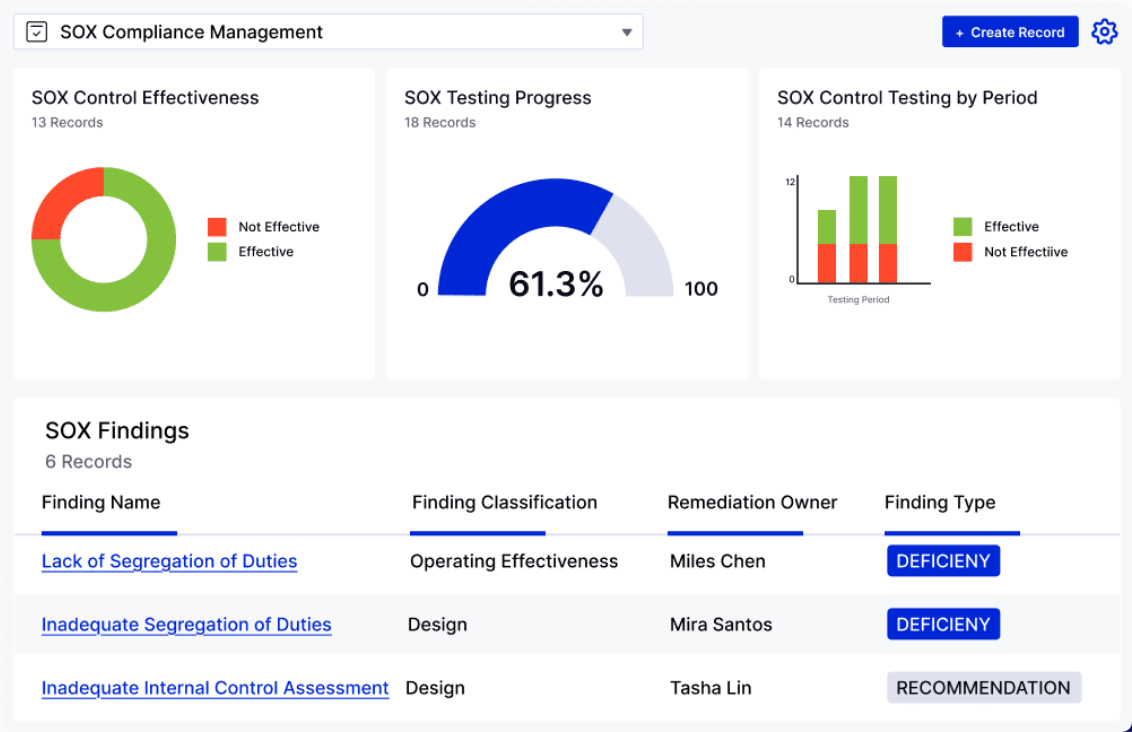
A no-code GRC platform sold as prebuilt applications. Its SOX Compliance Application covers Section 404 control testing, evidence collection, remediation tracking and reporting.
LogicGate fits a company that wants SOX next to enterprise risk or IT controls in a configurable platform, has someone who'll own the no-code setup, and has many control owners who need access without a seat cost.
In practice, you build repositories of processes, sub-processes, entities, key reports and IT systems, then document versioned SOX controls linked to scored risks. Configurable workflows send testing tasks and documentation requests to control owners with reminders and deadlines. Failed tests flow into remediation tracking, and reports show control effectiveness, process risk scores and remediation progress over time.
- you want SOX next to enterprise risk, internal audit or IT controls in one configurable platform
- many control owners and your auditors need access: only Power Users (admins and builders) need a paid licence
- you want AI evidence testing on SOX controls: LogicGate documents it for its Controls Compliance and Internal Audit apps, not the SOX app
- you want something that works with little configuration: G2 reviewers name configuration as the main friction
- Users like
- no-code customization and support quality
- Users dislike
- configuration can be challenging
- Source: G2, 184 reviews
How it works in practice
Capabilities that matter for SOX: automated evidence collection from HR and IT sources on a schedule, and free access for Standard and External users, so auditors and control owners don't need paid licences. Only Power Users who build and administer the program do.
The catch for SOX buyers: LogicGate's AI evidence testing is documented for its Controls Compliance and Internal Audit apps, not the SOX app. The public pages also don't describe walkthrough narratives, sample selection or 302 sub-certifications.
Integrations: Jira, Slack and Microsoft 365 natively, HR and security evidence sources, REST API, SFTP and an MCP server. ERP data comes in through the API or SFTP; no ERP connector is named.
- Starting price
- Quote only (per application plus Power User licences)
- Licensing
- Standard and External users at no extra licence cost
- SOX objects
- Processes, entities, key reports, IT systems, versioned controls
- ERP data
- REST API or SFTP, no named ERP connector
Finance-led SOX on the close platform
FloQast
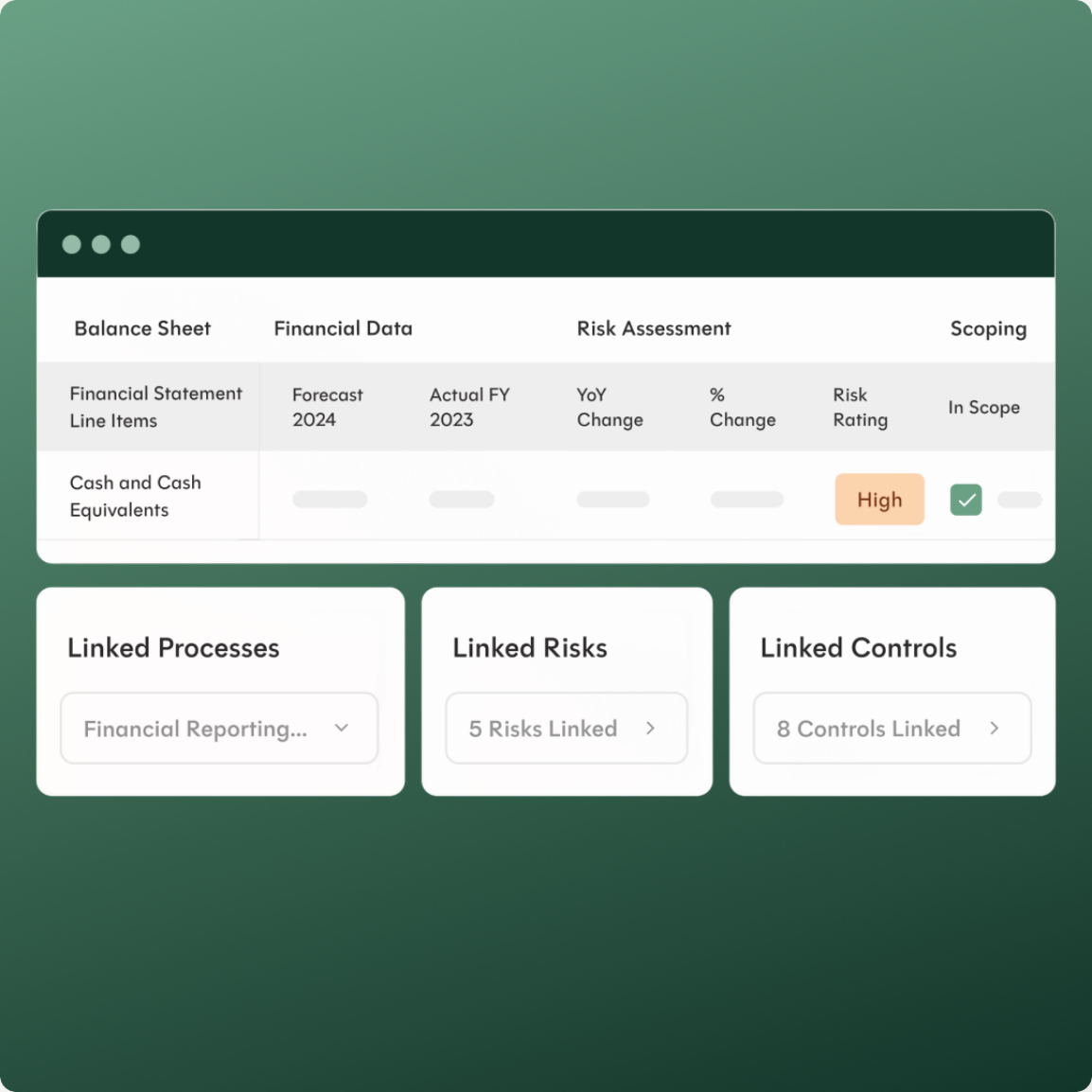
An accounting platform that started in month-end close. Its Risk & Compliance suite includes Financial Controls, which covers SOX scoping, the RCM, narratives and flowcharts and phased control testing.
FloQast fits a controller-led pre-IPO or newly public company on NetSuite, Sage Intacct or Workday where the accounting team, not a GRC function, owns SOX, and where the close already runs (or will run) in FloQast.
In practice, the RCM lives in FloQast's Financial Controls product and stays linked to process narratives and flowcharts. Control owners keep them current through automated certifications instead of editing separate Word and Visio files. Controls flow into a Tests tab, where admins set up testing phases per program (for example interim and year-end, for controls and key reports separately). Each phase holds status, testers, review notes, issues and evidence request files. Because controls are built into close workflows, execution evidence syncs from the close tasks themselves.
- your accounting team runs, or will run, the close in FloQast and you want control evidence captured from close tasks
- SOX is owned by the controller rather than a separate GRC or internal audit team
- you need broad IT and security GRC (SOC 2, ISO 27001) with identity and ticketing connectors: the integrations list is mostly ERPs, storage and chat
- you don't use FloQast for the close: much of the SOX value comes from evidence flowing out of close workflows
- Users like
- ease of use and a better-organized close
- Users dislike
- limited advanced reporting and slow performance at peak times
- Source: G2, 1,417 reviews
How it works in practice
Capabilities that matter for SOX: phased testing per compliance program, imported test sheets, and a first pass on attribute testing by AI (FloQast doesn't say which plan includes it). Control owners sign off and upload evidence with automatic reminders.
What it doesn't document: a 302 sub-certification workflow, segregation of duties analysis or a dedicated auditor portal.
Integrations: NetSuite, SAP, Workday, Microsoft, Sage Intacct and Xero, plus Box, Google Drive, OneDrive, SharePoint, Dropbox, Slack and Teams. Identity providers and ticketing tools aren't on the list, so ITGC evidence comes from elsewhere.
Pricing model: quote-only packages (Close Management, Close AI, Risk & Compliance) with no per-user fees. G2's rating mostly reflects close users, and some reviewers say a small team with a simple close may not get enough value for the cost.
- Starting price
- Quote only (no per-user fees)
- SOX product
- Financial Controls (Risk & Compliance suite)
- Testing
- Custom phases per program, for controls and key reports
- ERPs
- NetSuite, Sage Intacct, Workday, SAP, Microsoft, Xero
ITGC and multi-framework evidence
Hyperproof
A compliance operations platform with 160+ frameworks, including a SOX template with ICFR and ITGC controls, automated evidence through Hypersync connectors and an audit workspace for external auditors.
Hyperproof fits a SaaS company that's already running SOC 2 or ISO 27001 and now has SOX, where much of the SOX scope is IT general controls and the same evidence should count for several audits.
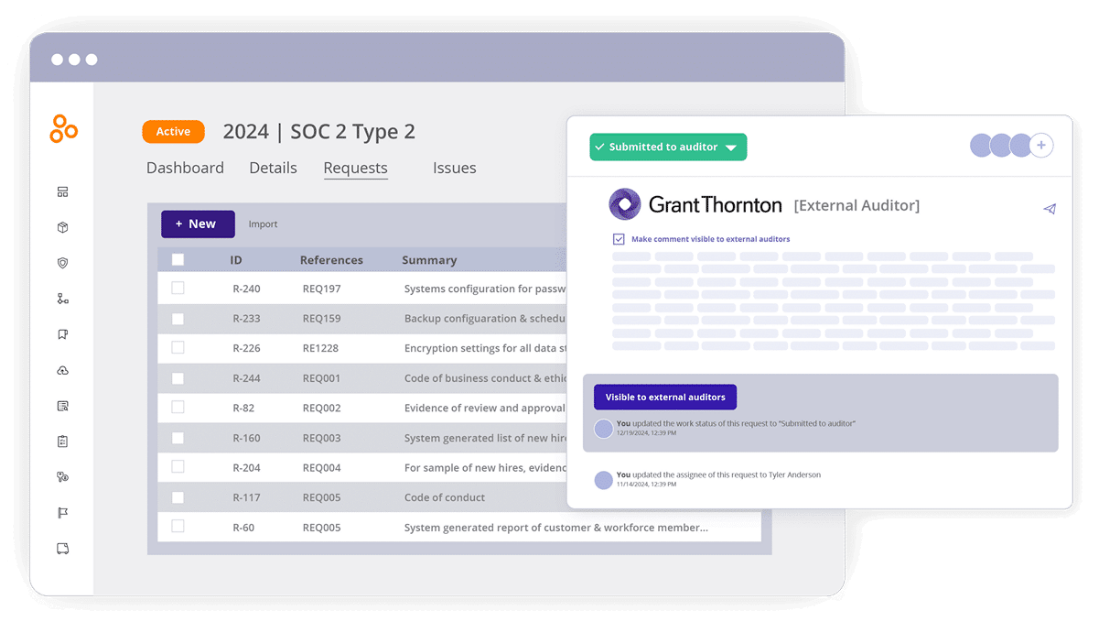
In practice, you start from a SOX template with COSO and COBIT controls for ICFR and ITGC, then edit it. Controls map across frameworks, so one tested control covers SOX and SOC 2. Hypersync connectors pull evidence from Okta, Entra ID, Jira, ServiceNow, AWS and, since March 2026, NetSuite, on demand or on a schedule. For the audit, you open an audit space: the auditor raises requests, your team links controls and evidence and submits, and the auditor approves or sends it back.
- you run SOX next to SOC 2 or ISO 27001 and want one control tested once and reused across audits
- your SOX scope leans on IT general controls and you want evidence pulled from Okta, Entra ID, Jira or AWS
- you need financial-statement scoping, materiality and walkthrough documentation: Hyperproof doesn't document these
- you need deep ERP evidence: NetSuite was added in March 2026, SAP, Oracle and Workday financials aren't in the catalog
- Users like
- ease of use and automated evidence collection
- Users dislike
- learning curve, setup effort and limited reporting
- Source: G2, 218 reviews
How it works in practice
Capabilities that matter for SOX: external auditors see only the audits they're added to, and only evidence that has been submitted. Auditors record their own tests on the audit's Controls tab with a procedure, exception and conclusion per test. High-frequency controls can be tested automatically, and a failure creates a task for the owner.
What it doesn't document: financial statement scoping, materiality, walkthroughs or 302 sub-certifications. A controller who needs those will build them by hand, or pair Hyperproof with a finance-side tool.
AI: offered through an early access program (Discover, Validate, Advise and Act agents), not yet generally available.
- Starting price
- Quote only
- Frameworks
- 160+, incl. SOX with ICFR and ITGC templates
- Auditor access
- Auditors see only the audits they're added to
- Evidence
- Hypersync connectors on demand or on a schedule
Drata
A continuous compliance platform built around SOC 2 and ISO 27001 that also lists SOX ITGC. It covers IT general controls only, and its help center lists SOX ITGC as requirements-only, so you map each requirement to controls yourself.
Drata fits a company that's already using Drata for SOC 2 and whose SOX gap is the IT layer: user access reviews, offboarding, MFA and change management evidence over financially relevant systems.
In practice, Drata doesn't run a SOX program. You ask your account manager to add the SOX ITGC framework, then map each requirement to existing or custom controls, because Drata's help center lists SOX ITGC as requirements-only (not pre-mapped). Connected identity, cloud and HR systems feed continuous monitoring tests. Access reviews run per application: reviewers approve or revoke accounts and see warnings for former employees, missing MFA and excess admin rights, and Drata packages the evidence per app for the auditor.
- you already run SOC 2 in Drata and want to reuse access, change and monitoring evidence for SOX ITGCs
- finance runs business-process controls elsewhere and your gap is user access reviews, offboarding and MFA evidence
- you need a full SOX program: business-process controls, walkthroughs, sampling, deficiency evaluation and 302 certifications aren't covered
- you expect a ready-made SOX control set: the framework isn't pre-mapped and has to be added by your account manager
- Users like
- responsive support, easy setup and integrations
- Source: G2, 1,329 reviews

How it works in practice
Capabilities that matter for SOX: user access reviews (an add-on on Foundation and Advanced, included in Enterprise), continuous control monitoring and an AI agent that suggests mappings for custom controls.
The limits: no business-process controls, walkthroughs, sampling, deficiency evaluation or 302 certifications. We found no NetSuite or QuickBooks integration guide; you can add those apps manually for access reviews. Finance still needs a program tool or a spreadsheet for everything else, while Drata handles the IT evidence.
G2 reviewers praise support, setup and integrations; we couldn't retrieve G2's complaint summary.
- Starting price
- Quote only (Foundation, Advanced, Enterprise)
- SOX scope
- ITGC only, requirements-only framework
- Access reviews
- Add-on on Foundation and Advanced, included in Enterprise
- AI
- Custom control mapping agent
We've left out ServiceNow IRM and Archer, which other lists include. ServiceNow fits companies that already run ServiceNow for IT, and Archer is a heavily customized enterprise suite; neither is a natural first SOX tool for a small finance team.
How AI is used in SOX testing
AI in SOX compliance software mostly does three jobs: it drafts documentation (narratives, flowcharts, control descriptions), it runs attribute tests against evidence, and it drafts issues and remediation plans from failed tests. A human reviewer still signs every conclusion, and each vendor here says so in its own documentation.
The state of play differs a lot between tools, and "AI-powered" on a sales slide tells you very little. Each vendor documents something different.
- Workiva documents testing agents that refine test attributes, generate rules and run tests, with each conclusion checked against annotated evidence and open to reviewer override, plus a remediation agent.
- Optro documents AI help with sample selection, population checks, evidence validation and tickmarking. Its separate Autonomous Testing product builds Excel workpapers from evidence, but Optro describes the link to Controls Management as still in progress.
- FloQast says AI takes a first pass at attribute testing, without saying which plan includes it.
- MetricStream added AI refinement for testing workpapers in its May 2026 release.
- LogicGate documents AI evidence testing only for its Controls Compliance and Internal Audit apps, not the SOX app.
- Hyperproof offers its agents through an early access program, not general availability.
Two checks belong in every evaluation before AI testing sways the decision. Confirm that the feature is generally available on the plan you're quoting, not in early access. Then ask your external auditor whether they'll rely on work an AI agent performed and what documentation they'll want, which matters especially once 404(b) applies.
How to choose SOX compliance software
Choosing SOX compliance software starts with your stage and your control mix, not with a feature list. A first-year filer with 60 key controls and no 404(b) needs something different from an accelerated filer with three ERPs, even though both will see the same demo.
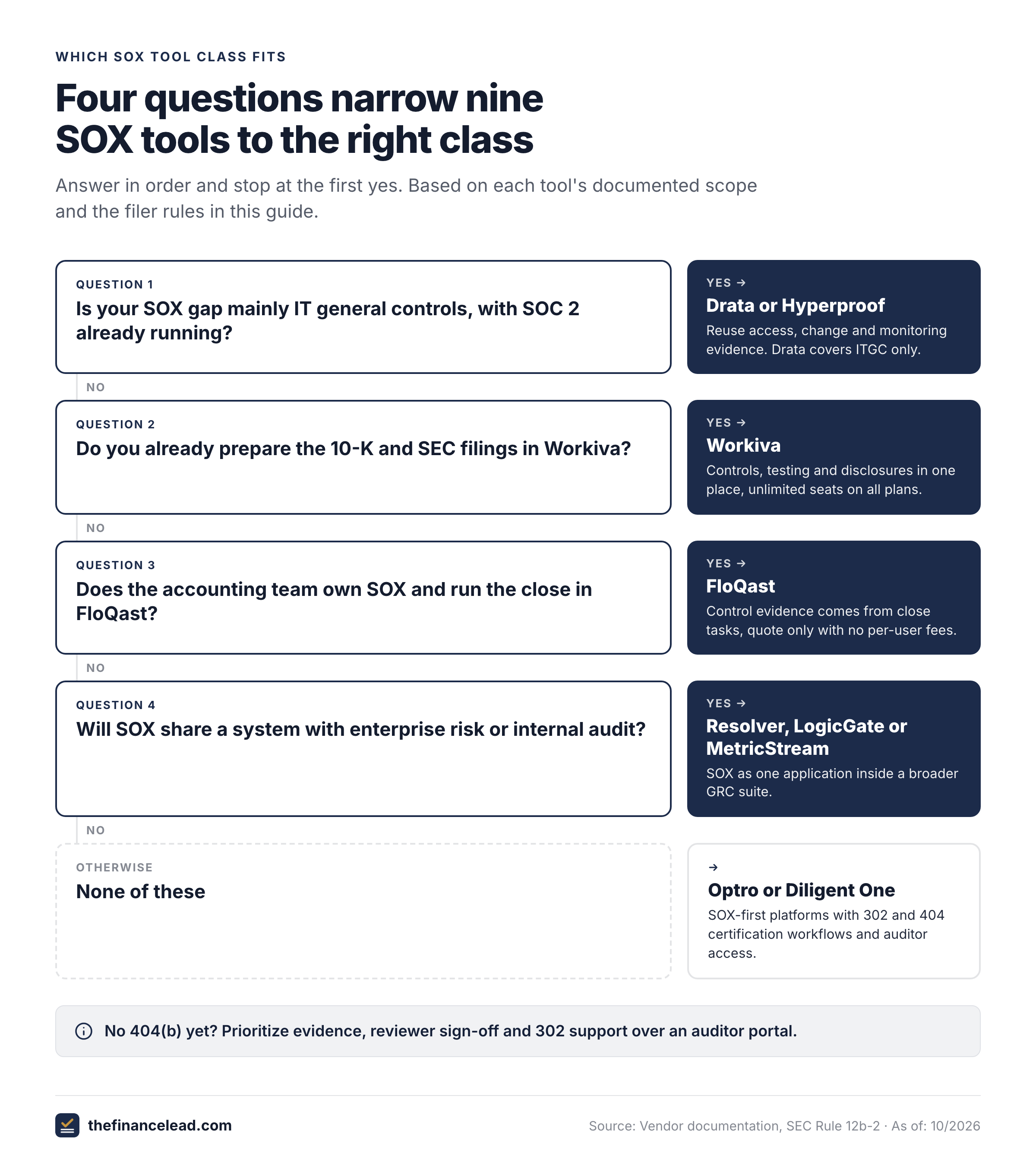
- Filer status and timeline. If 404(b) is two or more years away, prioritize clean evidence, reviewer sign-off and 302 support. If it applies now, weigh auditor access and request workflows heavily.
- Where your controls live. Mostly close and reporting controls point to a finance-led or SOX-first platform. Mostly IT controls point to an ITGC tool, possibly next to a spreadsheet RCM.
- Who runs SOX. A controller who tests part-time needs a tool that works out of the box. A GRC or internal audit team can handle a configurable suite.
- Licensing. Ask who needs a paid seat. Workiva includes unlimited seats, LogicGate charges only for Power Users and FloQast says it has no per-user fees. Control owners and auditors add up fast on per-seat pricing.
- ERP and identity integrations. Ask for the named connector for your ERP and identity provider, not "open APIs".
- Auditor fit. Ask your external auditor whether they already work in the tool and will rely on testing documented there.
- Implementation effort. Implementation time ranges widely. G2 reviewers report about four months on average for Optro, while Diligent says a SOX program can be set up in 10 days (a vendor claim). Ask for the typical time to the first tested quarter at a company your size, and who does the setup.
- Show me a failed control test turning into an issue, a remediation plan and a retest
- Show me a 302 sub-certification going out and coming back with an exception
- Which of our users need a paid licence, and what do auditors pay?
- Which connector pulls evidence from our ERP and our identity provider today?
- Which AI features are generally available on the plan you're quoting?
- How long did a company with our control count take to finish its first tested quarter?
- Can we export the RCM, tests and evidence if we leave?
SOX compliance checklist for small finance teams
Before you buy anything, make sure the basics exist. A tool speeds up a program that has these pieces, but it doesn't create them. Admittedly, that's less exciting than a demo. Use this as a working list in the year before your first 404(a) report.
- Significant accounts and processes scoped, with materiality documented
- Risk and control matrix with owner, frequency, key reports and evidence for each key control
- Process narratives or flowcharts for revenue, close and reporting, payroll, purchasing and cash
- Segregation of duties reviewed in the ERP, with compensating controls where roles overlap
- Month-end close checklist with evidence attached and reviewer sign-off per task
- Journal entry review and account reconciliation controls with review evidence
- User access reviews and change management evidence for the ERP and other in-scope systems
- SOC 1 reports collected for service providers, with the user controls they list mapped to your RCM
- Deficiency log with severity rating and remediation owner
- Sub-certification questionnaire for process owners before each 10-Q and 10-K
- Test plan and calendar agreed with internal audit and the external auditor
Several of these controls are monthly close controls. If your close checklist, evidence and reviewer sign-off still live in a spreadsheet, it's worth fixing that first. Later SOX testing gets far easier, whichever platform you pick.
FAQ
What is the best software for SOX compliance?
The best SOX compliance software depends on your stage and control mix. Optro (formerly AuditBoard) and Workiva are the most common SOX-first platforms for public companies, FloQast suits controller-led teams that run the close in FloQast, Hyperproof fits companies running SOX next to SOC 2, and Drata covers only IT general controls.
Is SOX compliance still a thing?
SOX compliance is still mandatory for every SEC-reporting company. The Sarbanes-Oxley Act of 2002 requires CEO and CFO certifications with each 10-Q and 10-K under Section 302, an annual management assessment of internal control over financial reporting under Section 404(a), and an auditor attestation under Section 404(b) for accelerated and large accelerated filers.
What is the difference between SOX and SOC 2?
The difference between SOX and SOC 2 is scope and purpose. SOX is a US law for public companies that covers internal control over financial reporting. SOC 2 is a voluntary attestation report on a service organization's security and related controls, usually requested by customers. A SaaS company can need both, and tools like Hyperproof map one control set to both frameworks.
How much does SOX compliance software cost?
SOX compliance software is sold on quote: none of the nine vendors in this guide publishes a list price. Licensing models differ, though. Workiva includes unlimited seats, LogicGate charges only for Power User licences and FloQast says it has no per-user fees. Third-party purchase data on Vendr puts Workiva's average contract near $60,000 a year.
Do private companies need SOX compliance software?
Private companies don't file SOX 302 certifications or 404 reports, so they don't need SOX compliance software for that purpose. Companies preparing for an IPO usually start building controls a year or more before listing, and many begin with a spreadsheet RCM and a close checklist before buying a platform.
Can you run SOX compliance in spreadsheets?
Running SOX in spreadsheets works for many first-year filers, especially without a 404(b) requirement. It gets hard once you have many control owners, quarterly sub-certifications and an auditor who needs evidence requests tracked. That's usually when teams move to a dedicated tool.