FloQast doesn't publish a price list. Its pricing page shows three packages, Close Management, Close AI and Risk & Compliance, and every one of them ends in a "Contact Sales" button. What the page does say is that there are no per-user fees: the company states that pricing is built around value, not headcount. For a number to plan around, the best public benchmark is Vendr's buyer data, which puts the median FloQast buyer at $24,663 per year and the range at $10,199 to $68,404. That's a third-party estimate, not a FloQast rate, and your own quote will depend on what you buy.
This guide separates three kinds of information so you can budget without guessing: what FloQast itself states, what a buyer-data source reports, and what you still have to get in writing before you sign. If you're still choosing between tools, start with our overview of financial close software and come back here once FloQast is on the shortlist.
- Three packages, all quote-only: Close Management, Close AI and Risk & Compliance.
- No per-user fees, according to FloQast's own pricing page.
- Vendr's buyer data reports a $24,663 median per year, with a $10,199 to $68,404 range.
- Vendr also reports annual escalators of often 3 to 7 percent, which you can ask to cap.
- Get entities, modules, implementation, term and renewal terms in one written quote.
How much does FloQast cost?
There's no dollar amount on FloQast's pricing page. Each package leads to a sales conversation, so any figure you read elsewhere is either a buyer-data estimate or a guess.
The most useful public estimate comes from Vendr, a software buying platform that publishes pricing pages built from its customers' purchases. As of its February 2026 update, Vendr reports a median of $24,663 per year for FloQast, with a low of $10,199 and a high of $68,404, based on 316 purchases. It also says buyers saved 23 percent on average. Vendr's page shows a different deal count, 192, in its header, so treat the sample size as approximate rather than exact.
- median annual price, Vendr
- $24,663
- lowest annual price, Vendr
- $10,199
- highest annual price, Vendr
- $68,404
- packages, all quote-only
- 3
Two cautions apply. First, these are contract values from deals Vendr saw, so they exclude buyers who negotiated elsewhere and may not reflect today's packaging. Vendr's text still uses product names such as AutoRec that don't appear on FloQast's current pricing page, and it describes pricing drivers like entity and user counts that FloQast doesn't list. Second, a median says nothing about your scope. A single-entity team buying only Close Management and a multi-entity group buying Close AI plus Risk & Compliance won't land near the same number.
Use the range to size a first budget line, then replace it with a written quote.
Does FloQast charge per user?
No. The pricing page headline reads "No Per-User Fees," followed by "Pricing Built Around Value, Not Headcount." FloQast says its packages scale with business outcomes rather than seat count, so adding accountants isn't what moves the price.
That's a meaningful difference from tools that bill per seat, because a growing close team doesn't automatically raise the bill. It isn't a promise of a flat price, though. "Built around value" means something else sets the number, and the page doesn't say what. Vendr's buyer data points to entity count, modules and contract length. FloQast hasn't confirmed those drivers publicly, so ask the sales team to name the variables in your quote.
If you're comparing against a seat-priced tool, convert both offers to total cost over the same term, with the same number of entities and the same modules. A seat-priced tool can be cheaper for a team of four and more expensive for a team of forty.
What FloQast packages exist?
FloQast organizes its offering into three packages. Close AI includes everything in Close Management, and Risk & Compliance is available on its own or with any Close package.
- Close ManagementQuote contact sales
- Close checklist
- Account reconciliations
- Accounting operations and projects
- AI assistant
- ERP integration
- Close AIQuote contact salesMarked most popular
- Everything in Close Management
- AI agents and AI matching
- Automated reconciliations
- Journal entry posting
- COSO-aligned AI governance
- Risk & ComplianceQuote contact sales
- Controls and audit readiness
- Enterprise risk management
- Operational audits and testing
- Sold on its own or with any Close package
Package contents are taken from FloQast's pricing page as of November 5, 2026. FloQast lists no dollar amounts.
| Package | What FloQast says it's for | Ask sales |
|---|---|---|
| Close Management | Running every close from one checklist, with reconciliations and projects | Which entities and ERPs are in scope? |
| Close AI | Automating matching, reconciliations and journal entries with AI agents | Which accounts and transaction types are automated? |
| Risk & Compliance | Designing, testing and remediating controls in one place | Which frameworks and audit teams are covered? |
FloQast marks Close AI as its most popular package. That label describes popularity, not suitability. A team that hasn't standardized its checklist yet may get little from automation layered on top.
What does Close Management include?
Close Management is the foundation. FloQast lists a close checklist, account reconciliations, accounting operations, projects, an AI assistant and ERP integration. The pitch is to run every close from one checklist and have every reconciliation tied out and signed off.
On the product pages, the reconciliation side lets you assign preparers, reviewers and due dates, add review notes, and see status across consolidated entities down to a single reconciliation. FloQast also describes audit reports that document process changes. The accounting operations side extends the same checklist logic to work outside the close, with dashboards for areas such as accounts payable, compliance, FP&A and reporting.
For a controller, the practical question is whether your current pain is coordination or calculation. If tasks slip because nobody sees who owns what, this layer addresses it. If the real problem is matching thousands of bank lines, you'll want to see Close AI. Our guide to month-end close process walks through where teams usually lose time.
What does Close AI add?
Per the pricing page, Close AI adds AI agents, AI matching, automated reconciliations and journal entry posting on top of Close Management. The feature list includes three-way matching of high-volume transactions, automated amortization, depreciation and subledger reconciliations, anomaly detection that routes unusual transactions for review, real-time explanations of account variances, and generative AI governance aligned to COSO requirements.
FloQast's reconciliation page adds that teams can move manual reconciliation schedules out of spreadsheets and match thousands of transactions at once with AI, from amortization and depreciation schedules to subledger-to-GL reconciliations.
Treat these as vendor descriptions. They tell you what the product is designed to do, not how accurate it is on your data. Ask for a pilot with your own messy accounts: partial matches, late files, a changed chart of accounts. Define the tolerance for an auto-posted journal entry and who reviews exceptions before anything reaches the ledger. For a broader view of the category, see our comparison of account reconciliation software.
What does Risk & Compliance cover?
Risk & Compliance is the controls layer. FloQast lists controls, audit readiness, enterprise risk management and operational audits and testing, and says you can update a control once and have it change everywhere it's used, test controls with evidence already attached, and track issues to remediation.
It can be bought alone, which matters if another system runs your close. FloQast also argues that combining it with the Close packages gives auditors evidence from every close and AI action. If SOX is on your plate, compare it with dedicated tools in our roundup of SOX compliance software before treating the bundle as the only path.
What drives your FloQast quote?
FloQast doesn't list its pricing variables, so treat this section as a checklist of what to ask, not a formula. Based on how the packages are structured and what Vendr's buyer data reports, expect the quote to depend on a handful of things. The first is the package mix: Close Management alone, Close Management with Close AI, and whether Risk & Compliance is added. The second is entity count, meaning how many legal entities or reporting units close in the platform and how the vendor defines one. The third is the scope of automation, such as which accounts and transaction types Close AI covers. The last two are the contract term, one year versus several, and the services around the subscription, including implementation, data migration and training.
What does implementation cost?
FloQast's pricing page doesn't list implementation fees, and the product pages don't either. Vendr's page does mention separate professional services fees for setup, migration and training, but its dollar ranges there are not a FloQast statement, so don't budget from them alone.
Ask for a written statement of work that names the entities, ERP connections, data migration, training and acceptance criteria. FloQast's reconciliation page says it integrates directly with ERPs and connects data from banks, subledgers and other source systems. It also integrates with cloud storage such as Box, Dropbox, Google Drive and SharePoint, and with Slack and Microsoft Teams. For each integration your team depends on, ask whether it's standard, configured or custom, and who owns it after go-live.
A quote can look attractive while leaving the hard work outside its scope. Request assumptions and exclusions in writing, and budget internal time for finance and IT, which no vendor invoice will show.
What about contract length and renewal?
Contract length and renewal terms matter because Vendr reports that FloQast contracts often include annual price escalators of 3 to 7 percent, and recommends negotiating a cap or removing them on multi-year deals. It also reports that buyers commonly get lower pricing on multi-year terms or when a competing platform is in the evaluation. These are buyer-side observations, not FloQast policy, but they tell you which terms to put on the table.
Before you sign, ask for four things in writing. Get the renewal term and the notice period to cancel or change scope. Get a cap on annual increases, stated as a percentage. Get the price treatment of any entity or module you add mid-term. And get your data export rights in case you leave.
If you're renewing rather than buying, bring last year's order form and ask what changed in packaging. FloQast's current Close Management, Close AI and Risk & Compliance structure may not match the module names on an older contract.
How do you build a three-year cost model?
Your three-year cost model starts from the benchmark, and each input gets replaced as the quote arrives. The calculator shows what Vendr's reported low, median and high annual prices add up to over a contract of one to five years, with no escalators and no implementation fees. At three years that's a flat $30,597 at the low end, $73,989 at the median and $205,212 at the high end.
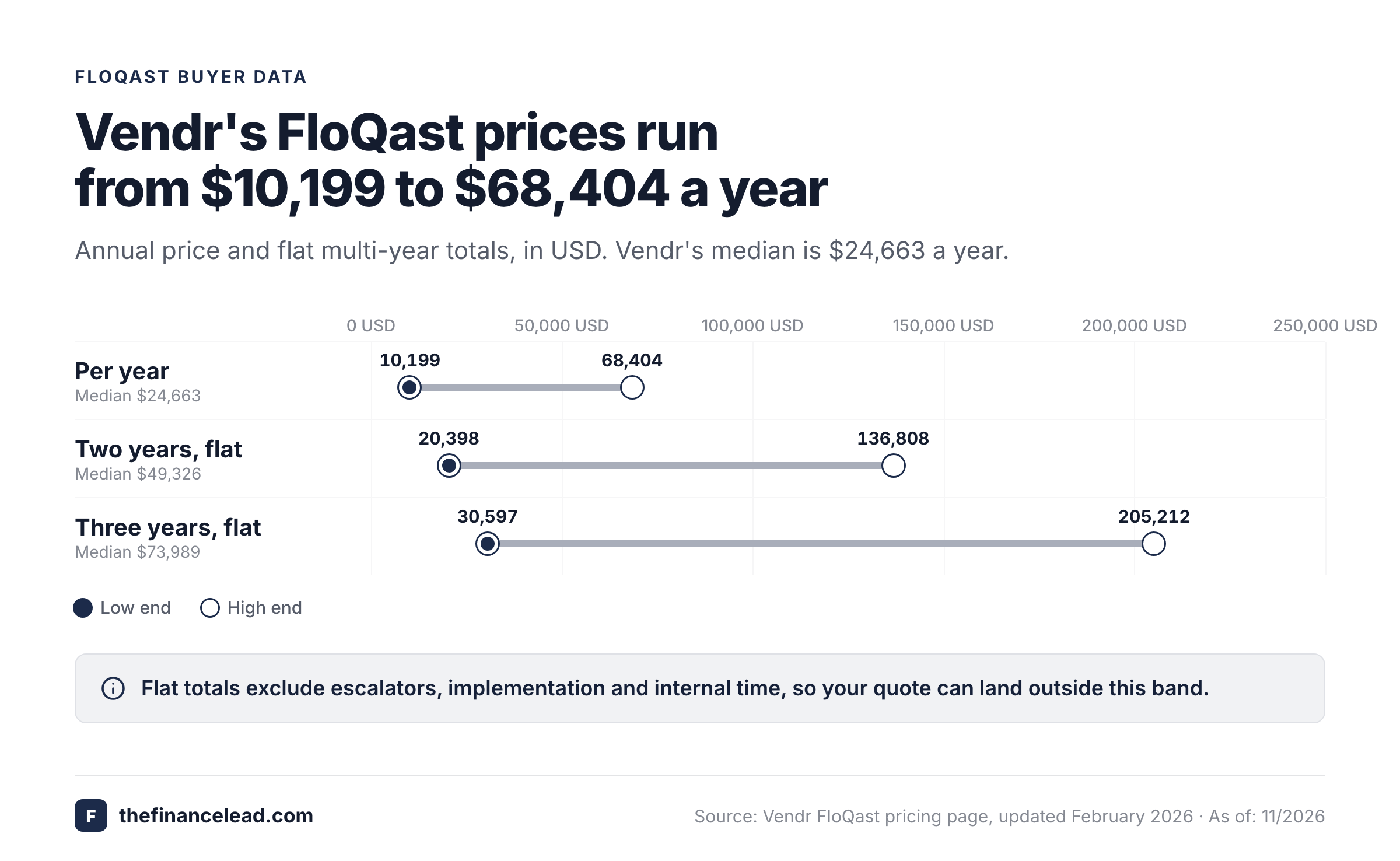
Built from Vendr's February 2026 FloQast figures. Excludes escalators, implementation, taxes and internal staff time. Your written quote controls the real price.
Then add the cost lines a median can't see, and note the document where each one should appear in the table below.
| Cost line | What to collect | Where it should appear |
|---|---|---|
| Subscription | Annual amount per package and billing period | Order form |
| Escalators | Percentage increase per year and any cap | Order form |
| Implementation | Fixed fee or capped hours | Statement of work |
| Integrations | Connector setup and any recurring fee | Implementation plan |
| Internal labor | Finance, IT and security hours | Your own estimate |
| Expansion | Price of added entities or modules | Commercial terms |
As an illustration, a 3 percent escalator on a $24,663 starting price adds about $1,500 to the third year, and a 7 percent escalator adds about $3,600. Those amounts look small next to the subscription, but they repeat every renewal year and compound.
FloQast or a spreadsheet close?
A spreadsheet close can work for a small, stable team with few entities, simple reconciliations and a controller who reviews everything personally. It isn't free, though. Chasing owners by email, rebuilding the checklist each month and collecting evidence from scattered files all take hours.
Compare FloQast with your actual baseline, not an idealized one. Track how long reconciliations take, how many tasks are late each close, and how long it takes to answer an auditor's evidence request. If those numbers are small, a lighter approach may do. Our month-end close template is a practical starting point for teams not ready for a platform.
Which package should you ask about first?
- Your close lives in spreadsheets and emailAsk for a Close Management quote first.
- High-volume bank or subledger matching is the bottleneckAsk for Close AI and request a pilot on your own data.
- SOX controls and audit evidence are the painAsk for Risk & Compliance, alone or with a Close package.
- You want predictable renewalsRequire the escalator cap and notice period in the order form.
- You're a very small team with a simple closePrice a spreadsheet template plus a lighter tool before taking a demo.
What should you ask for in the FloQast demo?
The FloQast demo should run on your own scenario instead of a generic tour: a month-end close across several departments with clear preparer and reviewer roles, a late data feed and an exception that needs approval.
- Quote names each package and what it includes
- Entity count and the definition of an entity are written down
- Escalator percentage and cap are stated
- Implementation scope, hours or fee and acceptance criteria are stated
- Every integration you need is marked standard, configured or custom
- A pilot on your own reconciliations is offered, with its cost
- Renewal term, notice period and data export rights are in the order form
- Verbal promises appear in the signed documents
Is there a free plan or trial?
FloQast's pricing page doesn't show a self-serve plan, free tier or trial price. Its calls to action are "Contact Sales" and "Get a Demo." That's a statement about the page today, not proof that a trial or proof of concept can't be arranged. Ask whether a scoped pilot is available, what it costs, how long it lasts and what happens to your data afterward.
Does FloQast publish its prices?
No. The pricing page lists Close Management, Close AI and Risk & Compliance, and each leads to Contact Sales. There are no dollar amounts.
Is FloQast priced per user?
FloQast says it isn't. Its pricing page states there are no per-user fees and that pricing is built around value, not headcount.
How much does FloQast cost per year?
Vendr reports a median of $24,663 per year, with a range of $10,199 to $68,404, based on its buyer data as of February 2026. Your quote can differ.
Can FloQast raise its price every year?
Vendr reports that contracts often include annual escalators of 3 to 7 percent. Ask for the percentage and a cap in the order form.
Does FloQast offer a free trial?
The pricing page doesn't list one. Ask sales whether a paid or free pilot is available for your scope.
Which FloQast package is most popular?
FloQast marks Close AI as most popular on its pricing page. Popularity doesn't mean it fits a team that hasn't standardized its close.