Treasury management software gives a finance team one place to see cash across bank accounts, forecast what comes next and, in the larger products, send payments and manage risk. Some tools are full treasury management systems with payments, bank connectivity and in-house banking. Others are lighter layers that pull in bank and ledger data and forecast cash, often with little or no payments and risk work.
We compared seven tools in those two groups: Kyriba, GTreasury, Nomentia and SAP Treasury and Risk Management as systems, and Trovata, Agicap and Tesorio as visibility and forecasting layers. We read vendor pricing, feature and help pages and checked review ratings in November 2026. We read vendor material and did not run these products, and none of the vendors paid for a placement. Our own product tracks the month-end close and isn't a treasury tool, so it appears only as a marked row.
- treasury and cash tools compared
- 7
- that publish a full price on the vendor site
- 0
- G2 rating range across the six that have one
- 4.2 to 4.7
- groups: treasury systems and forecasting layers
- 2
What is treasury management software?
Treasury management software is a tool that shows a company's cash across its bank accounts, forecasts future cash and, in the larger systems, runs payments, bank connectivity and financial risk in the same place. A treasury management system, or TMS, is the full version of that. A cash forecasting tool is the lighter version.
Banks use the same words for something different. In US business banking, treasury management is the name for the cash management services a bank sells to companies, such as payments, collections and account reporting. The software in this article is what your own team runs on top of one or many bank relationships.
Four jobs separate it from a spreadsheet.
- Seeing cash. Balances and transactions from every bank account arrive automatically, so the daily cash position doesn't depend on someone downloading statements.
- Forecasting cash. Forecasts are built from bank history and ERP data, such as open invoices and bills, and compared with what actually happened.
- Moving cash. Payments are created, approved and sent with controls, and balances can move between entities or banks.
- Managing exposure. Debt, investments, FX and interest-rate risk are tracked in the larger systems.
The tools below cover those jobs to different depths, and the lighter ones skip payments and risk on purpose rather than by accident, and most teams need only the first two, not all four. If your question is about the forecast itself, our guide to financial forecasting software covers planning tools. For the reconciliation that sits next to treasury, see bank reconciliation software.
Our picks by situation
Start from how many banks and entities you run and whether you need to send payments from the tool.
 Best for a multi-bank, multi-entity treasury that wants one platformKyribaCash position, AI forecasting and payments, with a packaged Essentials offer for midsize companies.
 Best when forecasting depth and payments belong in one systemGTreasury (Ripple Treasury)Real-time cash positions with transaction-level tagging, forecasting and risk, sold by quote.
 Best for many banks, mainly in Europe, with modular licensingNomentiaBank connectivity and payments first, with cash forecasting and in-house banking as later modules.
 Best for a company that already runs S/4HANASAP Treasury and Risk ManagementTreasury on the same data as the general ledger, with in-house banking inside the ERP.
 Best for API-based bank data and cash reporting firstTrovataNormalized bank data across banks and entities, with forecasts, payments and a TMS module on top.
 Best for a small or midsize team that wants forecasts and payments without a full TMSAgicapConsolidated cash, 13-week forecasts and payment instructions, with QuickBooks, Xero and NetSuite connections.
 Best for a NetSuite team that forecasts from receivables and payablesTesorioA 13-week forecast built from NetSuite AR and AP data, with collections tooling in the same platform.
Treasury management software compared
| Tool | Type | Core strength | Price (USD) | G2 rating |
|---|---|---|---|---|
| Kyriba | Treasury management system | Daily cash position, AI cash forecasts and payments across bank accounts in one platform | No public price; the Essentials package for midsize companies is priced on banking footprint, other modules by quote | 4.5 (95) |
| GTreasury (Ripple Treasury) | Treasury management system | Real-time cash positions, forecasting, payments and risk for multi-bank, multi-entity treasuries | No public price; custom quote, modular | 4.2 (32) |
| Nomentia | Treasury and cash management suite | Bank connectivity, payments, cash positioning and forecasting in a modular suite | No public price; sales-led, modular licensing | 4.6 (13) |
| SAP Treasury and Risk Management | ERP-native treasury | Cash management, liquidity forecasting, in-house banking and risk inside SAP S/4HANA | No public price; SAP licensing and implementation partner quote | 4.2 (52) |
| Trovata | Cash visibility and forecasting platform | Normalized bank data through APIs, cash reporting and forecasts, with payments and TMS modules | Vendor publishes no price; according to a third-party comparison site, a base package costs about $24,000 a year for one bank, 100 accounts and 10 users | No reviews yet |
| Agicap | Cash flow management | Bank and accounting sync with 13-week forecasts, plus payments and transfers, for SMBs and mid-market finance teams | No plan prices on the vendor pricing page; annual subscription with a minimum 12-month term; 24-hour free trial and free demo | 4.4 (367) |
| Tesorio | Cash forecasting from AR and AP | 13-week cash forecast from ERP receivables and payables, plus collections tooling | Quote only: annual platform fee plus an add-on cost per AI agent; no public price and no free trial | 4.7 (248) |
 The Finance Lead Our product | Month-end close checklists | Tracks close tasks, evidence and preparer/reviewer sign-off | Team $39/month (up to 8 team members), Plus $79/month (no member limit, read-only MCP server); card required at checkout | No reviews yet |
Prices read from vendor pages in November 2026. Quote means the vendor publishes no price. Trovata's G2 rating isn't shown.
A feature grid hides the real difference, which is how far each tool goes beyond showing and forecasting cash. This table lists what each vendor states for the main treasury jobs.
| Tool | Forecasting | Payments | Risk modules |
|---|---|---|---|
| Kyriba | Automated daily cash position and AI forecasting | Single point of entry for payments, with controls | Risk management and treasury capabilities; the midsize page lists no specific risk modules |
| GTreasury | Real-time positions with transaction-level tagging; automated forecasting | Payments and netting on the platform | Risk management on the platform |
| Nomentia | Cash positioning and forecasting under View | Payments hub, bank account management, fraud prevention | Debt, derivatives, exposure, hedge accounting; in-house bank, netting, pooling |
| SAP Treasury and Risk Management | Cash position analysis with drill-down and liquidity forecasting | Bank communication and payments inside S/4HANA | In-house banking and risk, inside the ERP |
| Trovata | Cash visibility and forecasts from bank data and ERP inputs | Initiate, approve, transmit and reconcile | TMS module, FX and capital markets management |
| Agicap | Consolidated bank and accounting data with forecasts up to 13 weeks | Sends payment instructions to banks, including ACH for US businesses | Not stated by the vendor |
| Tesorio | 13-week forecast from NetSuite AR and AP data plus bank transactions | Not stated by the vendor; collections and cash application instead | Not stated by the vendor |
Bank and ERP connections decide whether any of this works for you, so check them before you compare features.
| Tool | Bank connectivity | ERP named |
|---|---|---|
| Kyriba | Connects to 10,000 banks globally | SAP, Dynamics 365, NetSuite, Workday, QuickBooks |
| GTreasury | 13k connected banks (vendor); a G2 reviewer says it connects to banks, investment platforms and ERPs | ERP inputs for forecasting; the vendor names none |
| Nomentia | 10,000+ bank connections worldwide (vendor); host-to-host, SWIFT and local options | ERP connectivity as a module; systems not named by the vendor |
| SAP Treasury and Risk Management | House bank accounts as master data in S/4HANA | Is part of S/4HANA |
| Trovata | API-driven MultiBank Connector; 56K bank accounts on the platform | ERP inputs; systems not named by the vendor |
| Agicap | US banks through SWIFT, host-to-host and partner connectors; more than 300 international banks listed | QuickBooks, Xero and Oracle NetSuite named; OpenAPI for other tools |
| Tesorio | Bank transactions blended with ERP data | NetSuite, Sage Intacct, Workday, Zuora, Salesforce, Stripe |
How do you choose treasury management software?
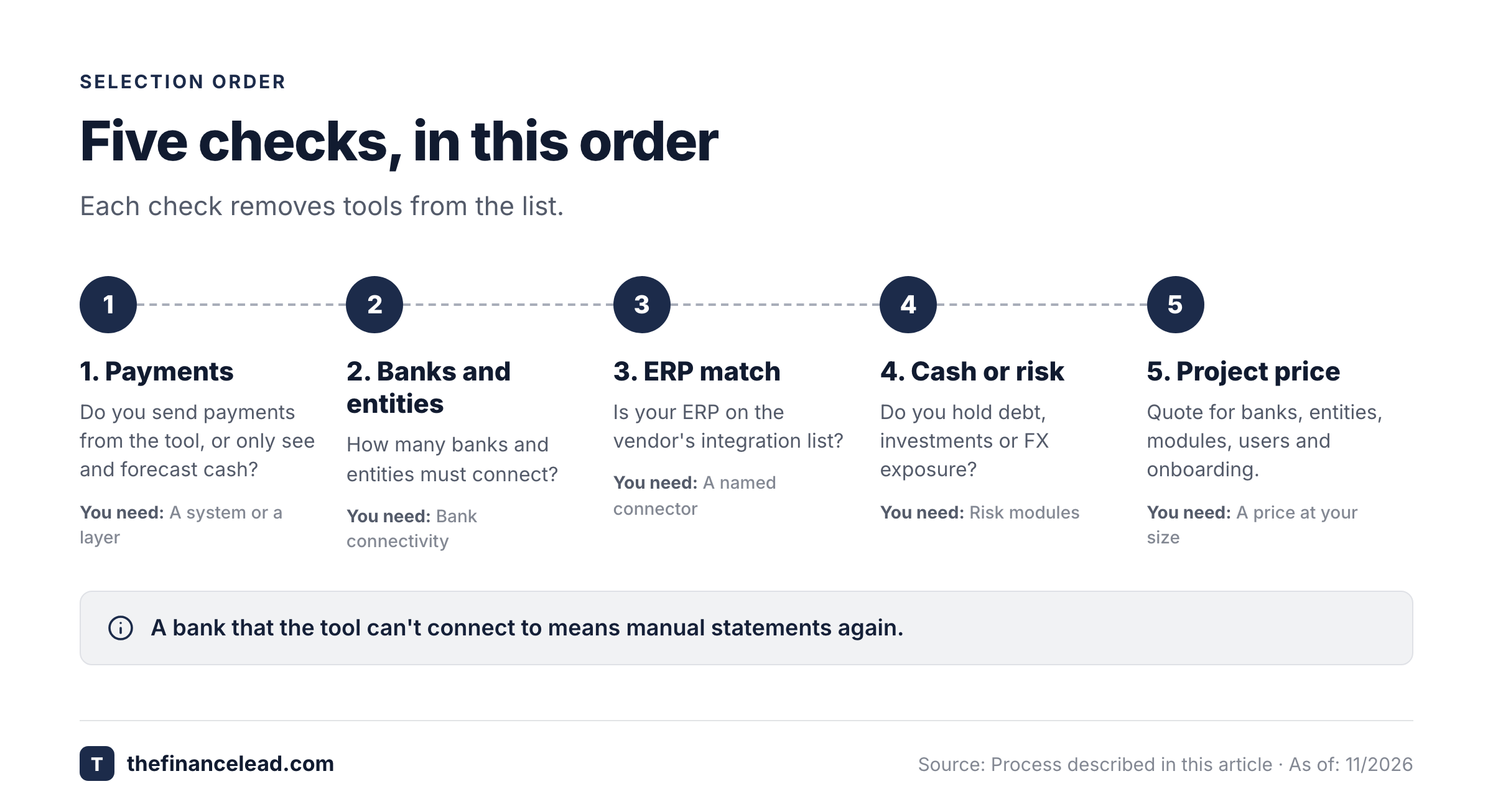
Choose in this order, because each step removes tools from the list.
- Decide whether you need to send payments. If the tool only has to show cash and forecast it, a lighter layer such as Agicap, Trovata or Tesorio is enough. If treasury approves and sends payments, or moves cash between entities, you're shopping for a system such as Kyriba, GTreasury or Nomentia.
- Count banks and entities. One bank and one entity rarely needs a treasury system, especially when the bank portal already shows the balance. Many banks across countries and entities is especially where bank connectivity becomes the main project.
- Match your ERP. Check that your ERP is named on the vendor's integration list. The cash forecast is only as good as the receivables and payables data feeding it.
- Separate cash from risk. Debt, investments and FX or interest-rate hedging are separate modules in the larger systems. Buy them only when you have those exposures, not because the demo included them.
- Price the whole project. None of the seven publishes a full price, so the quote moves with bank connections, entities, modules and users, and bank onboarding is part of the work.
Then ask each vendor the questions that decide the project.
- Which of our banks do you connect to, how (API, host-to-host, SWIFT) and who owns the onboarding?
- Which of our ERP or accounting systems do you integrate with, and what data does the forecast read from it?
- How often do balances and transactions update, and is that intraday or daily for our banks?
- Can we send and approve payments here, and what controls and audit trail do we get?
- Which modules are in the quote, and what does each add when we grow to more banks or entities?
- What do we pay in USD at our bank, entity and user count, and what is the contract term?
Treasury management systems
These four are systems: they connect to banks, run payments and carry some form of risk or in-house banking. They are priced by quote and implemented as projects.
Kyriba
Kyriba
Kyriba is a cloud treasury platform that covers cash visibility, cash forecasting, payments, bank connectivity and risk management. Its midsize page describes automated daily cash positions, AI-powered forecasting, a single point of entry for payments and bank-agnostic connectivity, with a packaged Essentials offer and fixed-scope implementation services.
Kyriba suits a company with several banks and entities that wants cash position, forecasting and payments on one platform and may add risk modules later.
Treasury job it does best: the daily cash position and the forecast built on it. Kyriba's midsize page describes automated daily cash positions, AI-powered forecasting and a single point of entry for payments.
What's under the hood: the vendor says it connects to 10,000 banks globally and integrates with SAP, Microsoft Dynamics 365, NetSuite, Workday and QuickBooks. It lists SOC 1, SOC 2 and SOC 3 Type II reporting. For midsize buyers it offers an Essentials package priced on banking footprint and implementation services with a fixed scope.
What it doesn't do: it doesn't publish a price, and the midsize page names no risk modules, so confirm what's in the package. Reviewers on third-party sites report that complex implementations are hard and that support responsiveness is inconsistent.
- You have many banks and entities and want one platform for cash and payments
- Your ERP is on the vendor's integration list
- You have one or two banks and a spreadsheet still works
- You want a price before talking to sales: Kyriba prices its Essentials package on your banking footprint and quotes other modules
- Users like
- Cash positioning and forecasting capabilities, per reviewer summaries on aggregator sites
- Users dislike
- Reviewers on third-party sites report that complex implementations are hard and that support responsiveness is inconsistent
- Source: G2, 95 reviews
How it works in practice
G2 lists Kyriba at 4.5 from 95 reviews. Cash forecasting quality depends on clean ERP data and timely bank statements, which is true of every tool in this article.
- Starting price
- No public price; the Essentials package for midsize companies is priced on banking footprint, other modules by quote
- Bank connectivity
- 10,000 banks (vendor)
- ERP integrations
- SAP, Microsoft Dynamics 365, NetSuite, Workday, QuickBooks and more (vendor)
- Forecasting
- AI-powered cash forecasting with import, manual entry and accuracy measurement
- Payments
- Single point of entry for payments, with controls
- Security
- SOC 1, SOC 2, SOC 3 Type II
- Packaging
- Essentials for midsize companies
GTreasury
GTreasury (Ripple Treasury)
GTreasury is a cloud treasury management system, now sold as Ripple Treasury, powered by GTreasury. The vendor describes real-time cash positions with transaction-level tagging, automated cash forecasting, payments, netting and risk management on one platform.
GTreasury suits a treasury team that wants forecasting depth and payments in the same system, across several banks and entities.
Treasury job it does best: cash visibility and forecasting. The vendor describes real-time views of cash positions with transaction-level tagging and says automated forecasting improves accuracy by over 30 percent. That is a vendor claim.
What's under the hood: a cloud platform for cash, payments, netting and risk management. Vendor pages now sit under the name Ripple Treasury, powered by GTreasury. A G2 reviewer says it connects well with banks, investment platforms, ERPs and HR systems.
What it doesn't do: it doesn't publish a price. G2 reviewers mention support response time and navigation as weak points, and implementation experiences vary: one reviewer reports still being in implementation more than a year after subscribing.
- Forecasting depth is the main reason you're buying
- You want payments and risk in the same system
- You are a small team and need a short implementation: one G2 reviewer reports still implementing GTreasury over a year after subscribing
- You want a price before a demo: GTreasury quotes by module across cash, payments, netting and risk
- Users like
- Cash visibility and breadth of capability for light and heavy users
- Users dislike
- Support response time and navigation come up as weak points; implementation experiences vary
- Source: G2, 32 reviews
How it works in practice
G2 lists GTreasury at 4.2 from 32 reviews.
- Starting price
- No public price; custom quote, modular
- Brand
- Ripple Treasury, powered by GTreasury
- Forecasting
- Automated cash forecasting; vendor claims accuracy gains of over 30%
- Cash position
- Real-time, transaction-level tagging (vendor)
- Scope
- Cash, payments, netting and risk on one platform (vendor)
- Banks
- 13k connected banks (vendor homepage, November 2026)
Nomentia
Nomentia
Nomentia's Smart Treasury Suite is organised in modules: Connect (bank, ERP and market data connectivity), Pay (payments hub, bank account management, fraud prevention), View (cash positioning and forecasting), Manage (debt, derivatives, exposure and hedge accounting) and Optimise (in-house bank, netting, pooling, reconciliation, cash application). The company is a Nordic vendor formed in 2020 from OpusCapita's cash management business and Analyste.
Nomentia suits a company with many banks, mainly in Europe, that needs bank connectivity and payment control first and wants to license modules as it grows.
Treasury job it does best: connecting banks and controlling payments. The Smart Treasury Suite is organised as Connect, Pay, View, Manage, Optimise and Advise. Connect covers bank, ERP and market data connectivity. Pay covers a payments hub, bank account management, direct debits, sanctions screening and payment fraud prevention.
What's under the hood: View holds cash positioning and cash flow forecasting, which the vendor says is built from ERP, bank and treasury data with AI scenario planning. Manage covers debt and investments, derivatives, guarantees, exposure and hedge accounting. Optimise covers an in-house bank, intercompany netting, cash pooling, bank account reconciliation and cash application. Bank accounts connect through host-to-host, SWIFT or local options.
What it doesn't do: it doesn't publish a price. Bank integration work at go-live is a theme in reviews on other sites.
- You work with many banks and want to start with connectivity and payments
- You want to add netting or an in-house bank later
- You need a self-serve start: Nomentia licenses its modules (Connect, Pay, View, Manage, Optimise, Advise) through sales quotes
- Users dislike
- Reviewers elsewhere note that bank integration work at go-live can overshadow the software
- Source: G2, 13 reviews
How it works in practice
G2 lists Nomentia at 4.6 from 13 reviews, a small base.
- Starting price
- No public price; sales-led, modular licensing
- Connectivity
- Host-to-host, SWIFT, local
- Modules
- Connect, Pay, View, Manage, Optimise, Advise
- Forecasting
- Forecasts built from ERP, bank and treasury data, with AI scenario planning (vendor)
- In-house bank
- In-House Bank, intercompany netting and cash pooling under Optimise
- Banks
- 10,000+ bank connections worldwide (vendor page, November 2026)
SAP Treasury and Risk Management
SAP Treasury and Risk Management
SAP's Treasury and Risk Management sits inside S/4HANA and shares data with the general ledger. SAP describes cash position analysis with drill-down, liquidity forecasting, bank account management, and in-house banking, which moved into Advanced Payment Management for S/4HANA Cloud customers.
SAP Treasury and Risk Management suits a company that already runs S/4HANA and wants treasury on the same data as accounting.
Treasury job it does best: cash management inside the ERP. SAP's material describes cash position analysis with drill-down, liquidity forecasting and bank account management, where house bank accounts are master data in S/4HANA.
What's under the hood: In-House Cash is the older in-house banking solution. The newer In-House Banking is available from SAP S/4HANA Cloud release 2208 and now sits with Advanced Payment Management. Product names and scope changed across releases, so check the documentation for your release.
What it doesn't do: it doesn't publish a price. G2 reviewers describe a complex interface and configuration that often needs consultants, and say licensing and support are too costly for mid-sized companies.
- You run S/4HANA and want one data model
- You need in-house banking for subsidiaries inside the ERP
- You don't run SAP
- You are a mid-sized team without SAP consultants
- Users like
- S/4HANA integration and ready-to-use cash management
- Users dislike
- Complexity, unintuitive interface and the cost of consultants
- Source: G2, 52 reviews
How it works in practice
G2 lists SAP Treasury and Risk Management at 4.2 from 52 reviews. For the ERP itself, see our guide to enterprise accounting software.
- Starting price
- No public price; SAP licensing and implementation partner quote
- Cash position
- Cash position analysis with drill-down and a cash flow analyzer (SAP material)
- In-house banking
- In-House Cash (older); In-House Banking from S/4HANA Cloud 2208
- Bank accounts
- Bank account management treats house bank accounts as master data in S/4HANA
Cash visibility and forecasting tools
These three start from cash visibility and forecasting. Trovata and Agicap also describe payments, Tesorio's pages center on receivables, and none of them lists the risk and in-house banking depth of the systems above.
Trovata
Trovata
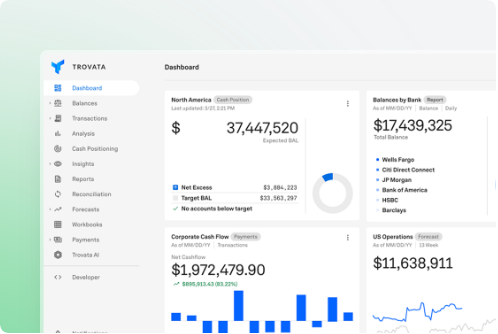
Trovata pulls bank data through an API-driven MultiBank Connector, normalizes it and shows cash positions across banks and entities. Forecasts are built from historical data, ERP inputs and projected activity, and the platform adds payments (initiate, approve, transmit, reconcile) and a TMS module.
Trovata suits a finance team that wants API-based bank data and cash reporting first and may grow into payments and a TMS.
Treasury job it does best: a normalized view of bank data. The vendor describes an API-driven MultiBank Connector that it calls self-healing and cloud-native, with real-time cash visibility, cash reporting across banks and entities, and forecasts built from historical data, ERP inputs and projected activity.
What's under the hood: payments to initiate, approve, transmit and reconcile with policy controls and audit trails, plus a TMS module and bank relationship, FX and capital markets management. The vendor lists 56K bank accounts on the platform.
What it doesn't do: the vendor doesn't name ERP systems on its product page and doesn't publish a price. A comparison site reports a base package of about $24,000 a year for one bank, 100 accounts and 10 users, a figure the vendor doesn't publish.
- You want cash visibility through APIs before a full TMS
- You want one normalized bank data layer for reports and forecasts
- You need a low entry price
- You need named ERP connectors confirmed before a demo
How it works in practice
No G2 rating is shown for Trovata.
- Starting price
- Vendor publishes no price; according to a third-party comparison site, a base package costs about $24,000 a year for one bank, 100 accounts and 10 users
- Bank data
- API-driven MultiBank Connector
- Scale
- 56K bank accounts
- Payments
- Initiate, approve, transmit and reconcile payments with policy controls and audit trails (vendor)
- Modules
- Trovata AI, Trovata TMS, bank relationship, FX and capital markets management
Agicap
Agicap
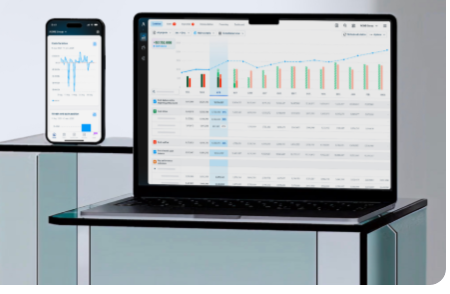
Agicap is a cash flow management platform that consolidates bank and accounting data, projects forecasts up to 13 weeks ahead and sends payment instructions to banks, including ACH for US businesses. The vendor also lists collections, accounts payable and bank reconciliation modules, and describes the product as built for SMBs and mid-market companies.
Agicap suits a small or midsize finance team that wants consolidated cash, 13-week forecasts and payment instructions without a full treasury management system.
Treasury job it does best: forecasting from synced data. Agicap consolidates cash data from several banks, finance tools and entities and projects short-term forecasts up to 13 weeks ahead. G2 lists historical data, reforecasting, multiple forecast types and rolling forecasts.
What's under the hood: the vendor says it sends payment instructions to banks, including ACH for US businesses, and suggests balancing transfers for cash pooling. It also lists collections, accounts payable and bank reconciliation modules. US banks connect through SWIFT, host-to-host and partner connectors, and QuickBooks, Xero and Oracle NetSuite are named as supported. It's an annual subscription with a minimum 12-month term and a 24-hour free trial.
What it doesn't do: the vendor lists no FX or interest-rate risk, debt or in-house banking. Integration issues are the most common complaint on G2, at 13 reviews in one summary, followed by limited customization.
- You have a small or midsize finance team and want forecasts and payments without a treasury system
- You use QuickBooks, Xero or NetSuite
- You need FX or interest-rate risk, debt or in-house banking
- Integration reliability is critical to your bank and ERP setup
- Users like
- Ease of use, customer support and forecasting
- Users dislike
- Integration issues, limited customization and missing features
- Source: G2, 367 reviews
How it works in practice
G2 lists Agicap at 4.4 from about 367 reviews, and the count differs between page snapshots. The vendor's pricing page lists no plan prices, so request a quote for your country.
- Starting price
- No plan prices on the vendor pricing page; annual subscription with a minimum 12-month term; 24-hour free trial and free demo
- Forecast
- Up to 13 weeks (vendor)
- Payments
- Sends payment instructions to banks, including ACH for US businesses; suggests balancing transfers for cash pooling (vendor US page)
- US banks
- Supported through SWIFT, host-to-host and partner connectors (vendor US page)
- Integrations
- QuickBooks, Xero, Oracle NetSuite named; OpenAPI for other tools (vendor US page)
- Trial
- 24-hour free trial; free demo (vendor US page)
- Contract
- Annual, minimum 12 months
Tesorio
Tesorio
Tesorio automates collections with multi-step dunning campaigns triggered by invoice age, plus an AI agent that drafts follow-ups and logs payment promises. Its cash application agent matches incoming payments to open invoices and posts them to the ERP, flagging exceptions for review.
Tesorio suits a NetSuite team that forecasts cash from receivables and payables and wants collections tooling in the same platform.
Treasury job it does best: the receivables-driven forecast. The vendor describes a 13-week cash forecast built from AR and AP data in NetSuite plus bank transactions, and its site lists AP forecasting next to AR.
What's under the hood: Tesorio says it's a NetSuite Preferred Partner and allows up to six automated syncs a day. It lists Sage Intacct, Workday, Zuora, Salesforce and Stripe as integrations, and says any ERP can connect through Tesorio Connect. Its collections side adds dunning campaigns and cash application.
What it doesn't do: the vendor doesn't describe payments initiation, bank connectivity at treasury depth or risk management. Pricing is quote-only, with an annual platform fee plus add-ons, and no free trial.
- You run NetSuite and the forecast depends on receivables
- You also want collections automation
- You need payments or bank connectivity at treasury depth
- You need a published price or a trial
- Users like
- Ease of use and automation, with collections efficiency and team visibility
- Users dislike
- Some reviewers cite sync issues and features that need improvement
- Source: G2, 248 reviews
How it works in practice
G2 lists Tesorio at 4.7 from 248 reviews, mostly about its collections features. Our accounts receivable automation software guide covers that side.
- Starting price
- Quote only: annual platform fee plus an add-on cost per AI agent; no public price and no free trial
- Reminders
- Multi-step dunning by days past due, amount or customer tier; emails, tags and owner assignment
- Cash application
- AI matching of bank, lockbox and remittance data; partial payments and multi-entity (vendor claims 90%+ to 95%+ auto-match)
- Integrations
- NetSuite, Sage Intacct, QuickBooks Online, Salesforce, Slack, Dynamics 365
- Customer portal
- Pay by ACH or card, set promise-to-pay dates, resolve disputes (vendor claim)
- Forecasting
- Invoice-level predicted pay dates and AR forecast
- ERP
- NetSuite first; Sage Intacct, Workday and others
- Syncs
- Up to six a day (NetSuite)
Does SAP have a treasury management system?
Yes. SAP sells Treasury and Risk Management inside S/4HANA, with cash management, liquidity forecasting, bank account management and in-house banking. It's covered above. The practical question is whether you already run SAP, because the value comes from sharing data with the ledger, and reviewers describe the configuration as heavy.
What does treasury management software cost?
None of the seven vendors publishes a full price. Kyriba says its Essentials package is priced on your banking footprint, Agicap sells an annual subscription with a minimum 12-month term and a 24-hour free trial, and Tesorio charges an annual platform fee plus add-ons. A comparison site reports about $24,000 a year for Trovata's base package, which the vendor doesn't publish. Treat any number you read that isn't from a vendor quote as a rough guide.
The bill moves with the same things in every product: the number of banks and accounts connected, the entities, the modules, and the users. Bank onboarding and the ERP integration are part of the project, so ask for the implementation fee and the timeline as well as the license.
- Cash visibility and a forecast with light payments workAgicap, Trovata or Tesorio
- Payments, many banks, several entitiesKyriba, GTreasury or Nomentia
- You run S/4HANASAP Treasury and Risk Management
- NetSuite and a receivables-driven forecastTesorio
- European banks and modular licensingNomentia
What does a treasury cycle look like?
Treasury runs on a daily and a monthly rhythm, and each step has an owner. The tool only changes how long the steps take, not who is responsible.
- Treasury analystConfirm balances loaded from every bank and investigate any account that didn't update Every morning
- Treasury analystSet the daily cash position and flag accounts below the minimum balance Every morning
- Treasury managerApprove payments and move cash between accounts or entities Daily
- Treasury analystUpdate the rolling forecast with new receivables, payables and known one-off items Weekly
- ControllerReconcile bank balances to the ledger and hand cash balances to the close Month-end
- Treasury managerCompare forecast with actual cash and note why the gap opened Month-end
The cycle fails at the first row when a bank connection silently stops updating, and a stale balance looks exactly like a good one. Ask every vendor how a broken connection is shown to the user.
Where does the month-end close fit?
Bank balances and cash reconciliations are close tasks, and the treasury tool only supplies the numbers. Someone still has to reconcile the bank accounts, sign off the cash balance and attach the evidence. Our product tracks that part of the close, so each cash task has an owner, a reviewer and its evidence. It isn't a treasury tool, and it doesn't touch ledgers or bank data. For reconciliation tools, see our guide to bank reconciliation software.
FAQ
What is treasury management software?
Treasury management software shows a company's cash across its bank accounts, forecasts future cash and, in larger systems, runs payments, bank connectivity and financial risk. The full version is called a treasury management system, or TMS.
What does treasury management mean in banking?
In US business banking, treasury management is the name for the cash management services a bank sells to companies, such as payments, collections and account reporting. Treasury management software is what a company's own team uses to see and forecast cash across its banks.
Does SAP have a treasury management system?
Yes. SAP Treasury and Risk Management runs inside S/4HANA with cash management, liquidity forecasting, bank account management and in-house banking. It fits companies that already run SAP, and reviewers describe the configuration as complex.
What are the best tools for treasury management?
For a full system with payments and many banks, Kyriba, GTreasury and Nomentia are the main options here. For cash visibility and forecasts with lighter payments and no deep risk modules, Agicap, Trovata and Tesorio are the lighter options. SAP Treasury and Risk Management fits S/4HANA companies.
What are the main cash management tools?
The common cash management jobs are a daily cash position, a cash forecast, bank connectivity, payments with approval controls and bank reconciliation. A forecasting layer covers the first two or three, and a treasury management system adds payments and risk.
How much does treasury management software cost?
None of the seven vendors publishes a full price. Quotes depend on banks connected, entities, modules and users, and one comparison site reports about $24,000 a year for a Trovata base package, which the vendor doesn't publish. Ask for the implementation fee as well as the license.