Month-end close best practices are repeatable controls for preparing accurate, complete and reviewed financial results on a predictable schedule. A strong process combines clear ownership, documented cutoffs, risk-based reconciliation, retained evidence, independent review and a habit of fixing what went wrong last month. The objective isn't simply to close faster. It's to produce numbers that finance leaders can explain and trust.
This guide is written for US accounting managers, controllers and finance leads. Adjust the sample calendar and thresholds to your business model, transaction volume, entity structure and reporting obligations. For the full sequence of stages, see our month end close process guide, and for task-level lists use the month end close checklist.
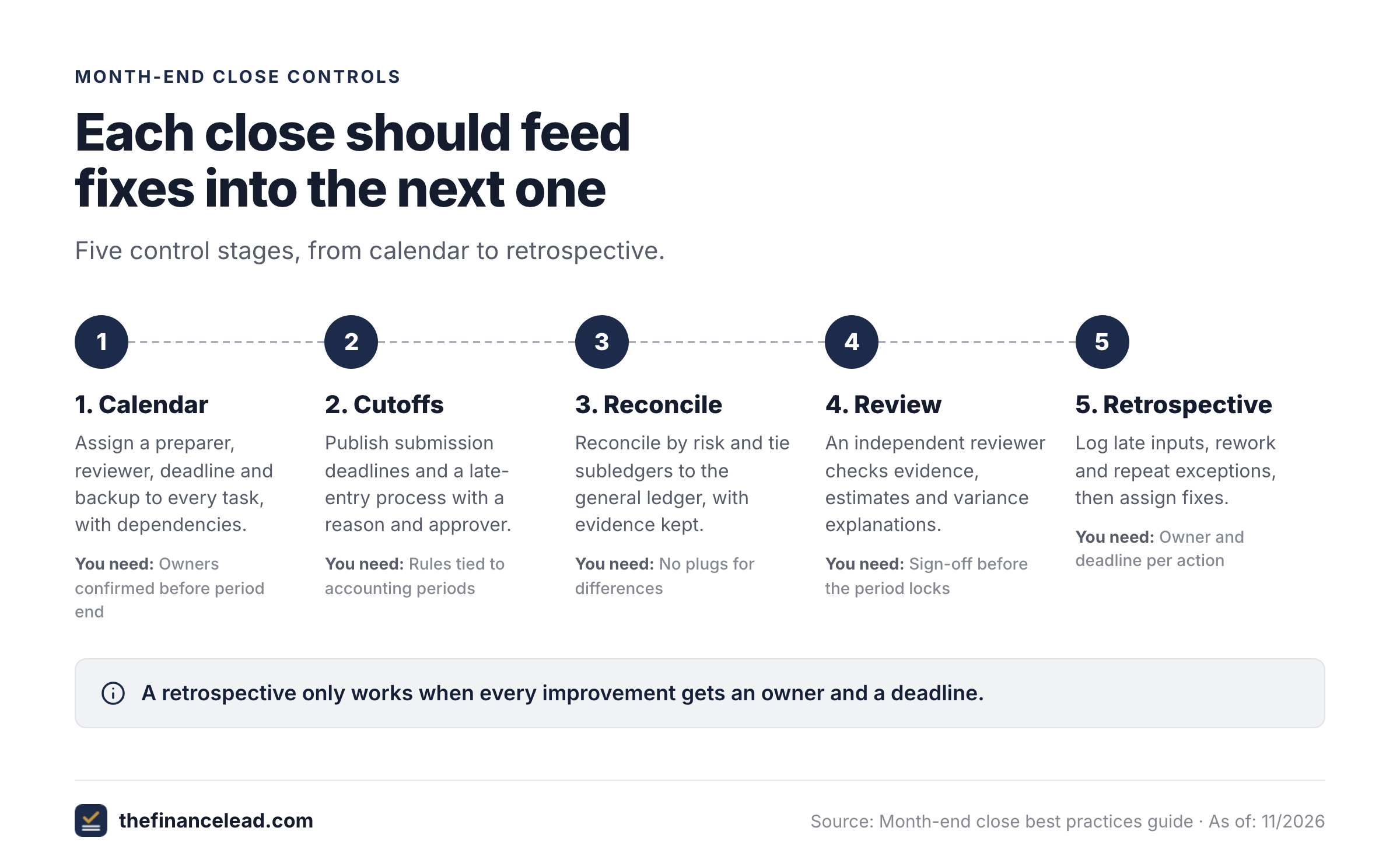
- Build a close calendar with dependencies, named owners and backups.
- Finish recurring work during the month and publish transaction cutoffs.
- Reconcile by risk, tie subledgers to the general ledger and keep evidence.
- Require independent review, explain variances and track exceptions.
- Measure speed and quality together, then run a retrospective after every close.
What are month-end close best practices?
Month-end close best practices are the habits that make a close predictable: everyone knows what's due, the inputs arrive on time, balances are supported, and someone other than the preparer has looked at the result. They sit between a plain task list and a full control framework. A checklist tells people what to do, while best practices explain how the work is owned, evidenced and reviewed so the answer still holds up when someone asks about it three months later.
Most late or messy closes trace back to a small number of causes. Inputs arrive after the cutoff, reconciliations get started too late, reviewers see a number but not its support, or the same exception returns every month because nobody owns the fix. The practices below address those causes in the order a controller usually meets them, and they're deliberately plain: you won't need new software to start.
Create a close calendar with dependencies
Work backward from the date leadership needs approved reporting. Assign every task a preparer, a reviewer, a deadline, the required inputs and a link to the evidence. An accounts receivable reconciliation can't be finalized before billing is complete. Consolidated reporting can't be finalized before subsidiary balances and intercompany eliminations are ready. A list of deadlines without these dependencies can hide the real bottleneck, and you won't see it until the close is already late.
Use a shared tracker, and keep it simple enough that people actually update it, with task, entity, owner, backup, due date, status, blocker and review sign-off. Confirm responsibilities before period end. When an upstream input is delayed, update the dependent tasks and escalate early instead of silently moving deadlines. That's far cheaper than explaining a missed date afterward.
The sample below shows how dependencies shape a calendar. It's illustrative, not a benchmark, so stretch or compress it for your own volume and entity count. Our month end close calendar guide goes deeper on scheduling.
| Close window | Main work | Depends on | Typical owner |
|---|---|---|---|
| Before period end | Publish calendar, confirm backups, clear open exceptions | Prior close retrospective | Controller |
| First business days | Complete subledger activity, obtain source reports, reconcile cash | Cutoff submissions from business partners | Accounting manager |
| Middle of the close | Post supported accruals, reconcile balance sheet accounts, resolve intercompany differences | Final subledger balances | Senior accountant |
| Late close | Review variances, clear reviewer comments, approve journals | Completed reconciliations | Controller |
| Final step | Obtain sign-off, lock the period under policy, distribute reporting | All approvals and cleared exceptions | Controller and CFO |
Assign roles so every task has an owner
A close fails quietly when two people each assume the other owns a task. Name one preparer and one reviewer per task and a backup for each person, then write the arrangement down where the whole team can see it. The table shows one common split. Smaller teams combine roles, which is fine as long as the review step doesn't disappear. You'll still want a second pair of eyes on every reconciliation.
| Role | Owns | Evidence to expect |
|---|---|---|
| Controller | Calendar, policy decisions, final approval and period lock | Sign-off record, approved close package |
| Accounting manager | Reconciliation quality, accrual schedules, exception log | Reviewed workpapers, aged exception list |
| Staff accountant | Preparation of reconciliations and journal support | Statements, ledger extracts, reconciling item detail |
| AP, AR and payroll leads | Complete, timely cutoff submissions | Submission confirmations, subledger reports |
| Business partners | Accurate coding, approvals and late-entry reasons | Approved requests and supporting documents |
Complete recurring work before month-end
Review transaction coding, aged receivables, vendor invoices, credit card activity, suspense accounts and unresolved exceptions during the month. Stable accounts can sometimes be reconciled on a rolling basis, which is why they're the best place to start. Keep preliminary work clearly labeled, because final source data may change after the last day.
Create a pre-close exceptions log listing the problem, the financial impact, the owner and the expected resolution. Distinguish activities that can be finished early from those requiring complete period-end information. This prevents the team from waiting until the first business day to discover missing data, which is when it's most expensive to fix. A weekly review of recurring blockers often creates more value than a new dashboard.
Define transaction cutoffs
Publish clear submission deadlines for invoices, employee expenses, payroll, revenue transactions and manual journals. Explain the accounting period rules, not merely the administrative deadlines. A vendor invoice that's received late may still require an accrual if the service belongs to the closing period. Similarly, future-period revenue mustn't be pulled forward to improve reported results.
Maintain an approved late-entry process with a reason, preparer, approver, amount and period. Restrict access to reopen closed periods, so nobody can quietly change what's already been reported. Track exceptions and identify business partners who repeatedly submit incomplete information. Cutoff discipline supports accuracy while keeping the process predictable, and that's what lets the team plan.
Reconcile accounts based on risk
Prioritize cash, receivables, payables, inventory, payroll liabilities, deferred revenue and significant estimates based on financial statement risk. A reconciliation should identify the ledger balance, the supporting balance, the reconciling items, the evidence, the preparer, the reviewer and the sign-off date.
Differences need a disposition, not a convenient plug. Categorize each one as timing, valid adjustment, error or unresolved exception. Age open items and escalate those without a clear owner. A small cash discrepancy may deserve attention even when it's immaterial, because it can reveal a broken process. That's exactly why a reconciliation shouldn't be judged by size alone. Document the review frequency and depth for lower-risk accounts according to your policies and applicable requirements.
Tie subledgers to the general ledger
Confirm that accounts payable, accounts receivable, payroll, inventory and fixed-asset reports reconcile to their general ledger control accounts. Record the report parameters and the extraction time. Two correct reports can appear inconsistent if they use different cutoffs, so they're only comparable when run with the same parameters.
Investigate failed interfaces, duplicated transactions, changed account mappings and incorrect posting periods. Don't force a match through an unexplained journal entry. Correct the root cause when possible, because a plug just moves the problem to next month, where it's harder to trace. Preserve the source extracts and reconciliation evidence so another accountant can reproduce the conclusion. Review repeated differences for patterns that suggest a system or process defect. Differences that repeat month after month deserve a root-cause look, since they're rarely random.
Standardize accruals and estimates
Maintain schedules for accrued expenses, prepaid costs, depreciation, amortization, deferred revenue and other relevant estimates. Each schedule should state the method, inputs, assumptions, calculation and approval. For unbilled services, retain evidence of the period to which the expense relates.
Decide whether reversing entries are appropriate and confirm that reversals occur in the intended period. Compare prior estimates with actual results to identify bias or recurring errors. If you're always a little low, that's a pattern worth fixing. Templates reduce arithmetic work but can't replace judgment about recognition, measurement and materiality. Require reviewers to challenge unusual changes instead of approving the same estimate automatically. If you want a ready-made structure, our month end close template covers schedules and sign-off fields.
Separate preparation from review
A meaningful reviewer checks source evidence, reasonableness, exception handling and completeness. Approval isn't merely a button click. Where possible, the reviewer should be independent of the preparer, and they shouldn't be the person who posted the entry. Smaller teams may need compensating controls, such as owner review, restricted posting access, exception reports or periodic external oversight. Document those limitations rather than claiming segregation that doesn't exist.
Define escalation rules, so nobody has to guess what's serious, for material differences, unsupported estimates, unusual manual entries and repeated late adjustments. Keep the history when a reviewer returns work for correction, so it's clear what changed and why. A clear review trail helps both management and auditors understand what happened.
Perform variance analysis that explains performance
Compare actual results with prior periods, budgets and forecasts where they're relevant. Examine revenue, gross margin, operating costs, cash and working capital. Use both absolute and percentage thresholds appropriate to each account. A large percentage movement on a tiny balance may not matter, while a modest payroll movement may be significant.
Require explanations that identify business drivers rather than restating the arithmetic. Link unusual movements to invoices, headcount changes, contracts or other supporting evidence; it's the support that makes the explanation credible. Distinguish timing effects from structural changes, because they're handled differently. Variance analysis can reveal missing entries that mechanical reconciliations alone don't catch. It's often where a forgotten accrual first shows up.
A useful explanation names the cause, the amount and what happens next. "Software expense is higher because of an annual renewal that was prepaid and should be amortized" tells the reviewer what to check. "Expense increased" doesn't.
Manage intercompany and consolidation carefully
Multi-entity groups need consistent cutoffs, counterparties, currencies and account mappings. Match intercompany receivables and payables, investigate differences, and record elimination entries with support. Maintain a mismatch log, which is simply a shared list, showing the underlying transaction, the entities involved, the cause, the owner and the resolution.
Exchange-rate changes and timing differences can complicate comparisons, so they're worth separating early. Avoid unilateral adjustments that fix one entity while creating another imbalance. Require approved entity results before final consolidation. When a subsidiary is late, document the reporting impact and escalate rather than silently substituting provisional balances.
Automate the right tasks
Automation can collect reports, route approvals, monitor dependencies, match transactions and retain evidence. Start by documenting the workflow and identifying a specific failure mode; you can't automate what isn't written down. For example, repeated missing approvals may justify a workflow tool, while high-volume transaction matching may justify rules-based reconciliation.
Test automated rules against known exceptions and investigate unmatched items. A successful import doesn't prove completeness. Monitor failed connections, overrides and manual adjustments, since they're where automated controls quietly break. Evaluate software on reliability, audit trail, access controls, integration effort and ongoing maintenance. Purchasing a platform doesn't fix unclear responsibilities or inconsistent accounting policies. If you're weighing options, our financial close software comparison covers the main categories.
Preserve audit-ready evidence
Store statements, journal support, reconciliation workpapers, approvals and explanations in a controlled location. Use consistent naming for entity, period, account and document type. A reviewer should be able to trace a reported balance back to the ledger and source without asking the preparer to reconstruct the work. If they can't, the evidence isn't finished.
Apply appropriate permissions, particularly to payroll and customer data. Preserve version history for material changes. Make supporting documentation a requirement for task completion; a task isn't done until it's attached. Periodically test whether someone other than the preparer can retrieve and understand the evidence. If they can't, fix the folder before the auditors ask. An organized close package reduces follow-up work later.
Handle post-close adjustments deliberately
Some corrections will surface after the period is locked. What matters is that the response is controlled rather than improvised. Decide in advance who can approve a reopen, what threshold requires it, and where the correction should be recorded: in the closed period, or in the current period with a clear explanation, according to your accounting policy and materiality assessment.
Log every post-close adjustment with the amount, the account, the cause and the approver. Review the log during the retrospective. A cluster of adjustments in the same account usually points to a cutoff gap or a missing accrual, and fixing that cause is worth more than approving the adjustments faster. The next close has less to correct. Refresh any reconciliation or variance explanation that the late entry makes stale, and note the refresh in the evidence folder.
Measure both speed and quality
Define close duration consistently, from a stated starting event to final approval. Track late tasks, overdue reconciliations, open exceptions, review rejections and post-close adjustments alongside elapsed time. Review metrics by phase and dependency, since a single total number doesn't show where time goes.
| Metric | What it shows | Watch for |
|---|---|---|
| Close duration | Elapsed time from the agreed start to final approval | A faster close with more post-close adjustments |
| Late tasks by owner or input | Where the schedule breaks | The same upstream input slipping every month |
| Review rejections | Evidence and preparation quality | Rising rejections after a staffing change |
| Aged open exceptions | Control debt carried forward | Items without a named owner |
| Post-close adjustments | Stability of the released numbers | Repeated entries in one account |
If reconciliation work finishes quickly but approval repeatedly stalls, evidence quality may be the actual problem. If invoices arrive late each month, improve the upstream process rather than expecting overtime to compensate. Don't reward locking the ledger while material exceptions remain unresolved, because that's how errors get buried. Establish improvement goals from your own baseline instead of unsupported universal benchmarks.
Run a close retrospective
After reporting, ask which inputs arrived late, which tasks caused rework and which exceptions recurred. Separate one-off incidents from structural issues. Assign every improvement an owner and a deadline before the next period. Update checklists when accounting policies, systems or organizational responsibilities change. Remove obsolete tasks and train backup owners, so a vacation doesn't stall the close.
Replace vague observations with concrete actions; "communicate better" isn't one. For example, require procurement to provide an open-receipts report before cutoff rather than simply asking for better communication. Review whether each change worked during the following close. If it didn't, that's useful information too.
A practical month-end close checklist
- Before period end: publish the calendar, confirm owners and backups, communicate cutoff rules, review open exceptions and complete preliminary reconciliations where possible.
- Early close: finalize subledger activity, obtain complete source reports, reconcile cash and significant accounts and prepare supported accruals.
- Middle close: complete balance sheet reconciliations, review estimates, resolve intercompany differences and perform variance analysis.
- Final close: clear reviewer comments, approve journals, finalize management explanations, obtain sign-off, lock the period under policy and distribute reporting.
- Carry forward permitted unresolved items only with documented ownership and deadlines.
Common month-end close mistakes
A checklist without owners isn't a control. A bank feed isn't proof that a complete statement has arrived. A reconciliation with unexplained differences isn't finished. An approved journal without source support remains a risk. A locked ledger doesn't necessarily mean the financial statements are accurate.
Two more mistakes are easy to miss. The first is treating the close as one person's job, so the process stops when that person is out. The second is fixing symptoms: approving the same late journal each month instead of changing the cutoff that causes it. Both are addressed by naming backups and turning retrospective findings into assigned actions.
Month-end close best practices FAQ
What should a small team prioritize?
A small team should start with a close calendar, written cutoff rules, standard reconciliations and documented review. Those four habits cover the basics without needing new software or extra headcount.
Should every account receive identical treatment?
No. Match reconciliation frequency and depth to risk, materiality, company policy and applicable requirements. Cash and receivables usually need closer attention than a low-activity prepaid account.
When is the close complete?
The close is complete when required results, reconciliations, explanations and approvals are finished and any later adjustments are controlled. Locking the ledger is a step in that process, not proof that it's done.
How can a team shorten the close without losing accuracy?
Move recurring work into the month, tighten cutoffs, fix the upstream inputs that arrive late and automate only the repeated bottleneck. Cutting review steps to save time usually increases post-close adjustments.
Who should approve the final close package?
The controller typically approves the package, and a CFO may approve final management reporting depending on company policy. The approver should be able to trace key balances to evidence.
How often should the close process be reviewed?
Hold a short retrospective after every close and revisit the full calendar and checklist when policies, systems or team responsibilities change.
Conclusion
An effective month-end close is a controlled workflow, not a monthly scramble. Make responsibilities visible, finish suitable work early, reconcile by risk, require meaningful review and learn from recurring exceptions. Use automation to support the process rather than replace professional judgment. The strongest improvement makes the next close both easier to deliver and easier to trust.